
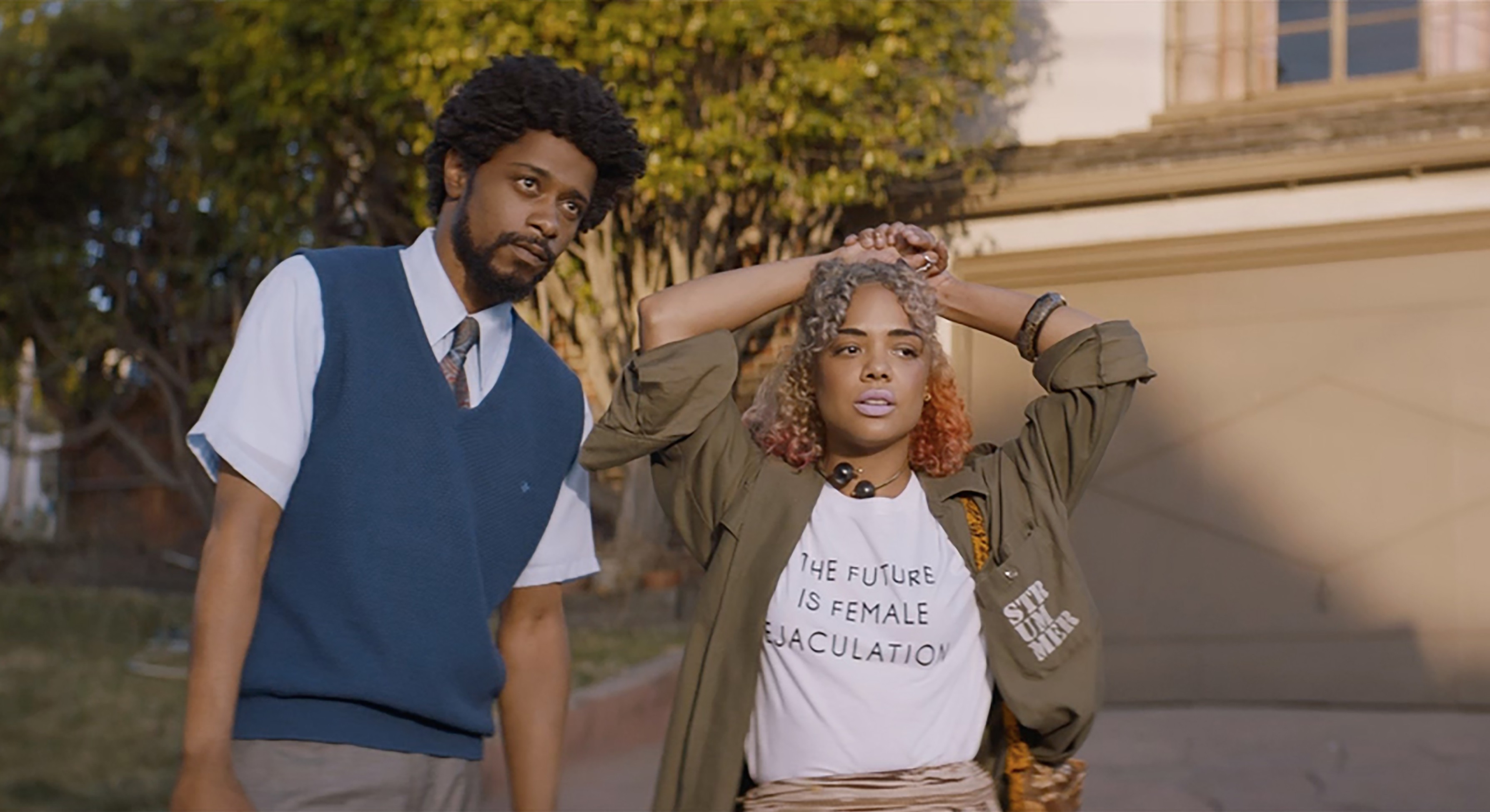
Sorry to Bother You is the next in a new wave of young, imaginative filmmakers who are creating a new Harlem Renaissance of cinematic storytelling, collaborating with great actors and writers from all walks of life to tell new stories from hitherto unexplored lives. It is worth the hype if you can brave a little weird. Dark humor and magical realism abound, ending the two-week drought in the dog days of milquetoast sequels and unworthy blockbusters. Spoilers after the break.
It’s hard not to bring up the easy comparison to last year’s Get Out with this movie: Lakeith Stanfield starred in that film as well, both movies feature casts of color with new(ish) directors of color, both are satires that feature elements of magical realism. Both films are interested in the concept of race relations and have broad appeal to diverse audiences. They feature a lot of code-switching and tokenism, have their feet planted in the traditions and themes of both black and white cinema.
Get Out seems to me more interested in translating to white audiences the sense of fear and alienation felt by Black Americans who make the crossover between cultures. The protagonist of Get Out exemplifies the racial anxieties of one, especially sensitized to the cross-cultural conversation as a result of accidents of circumstance and romantic entanglement. This is in line with Jordan Peele’s personal biography and it is one of the charming and mesmerizing qualities of his comedy variety show on Comedy Central. The film took aim at the clueless bigotry of well-meaning white progressives at a time when the far more comfortable joke wore a bad, orange toupee with a Brooklyn accent. But Peele is also a student of the horror genre and his film reflected a self-described desire to play with the genre.
In contrast, Sorry to Bother You seems more interested in the relationships between people of color, the guilt and sense of obligation to “give back to your community” (as Jerrod Carmichael jokes about) after having found success, the siren song of selling out in corporate America, and the memeification of Blackness. There’s much less feeling of the white/black code-switching and much more introspection about the ways that Blackness interacts with (and sometimes prevents) financial success.
Cash’s discovery of his “white voice” sets him on a perilous path towards financial independence and all the pitfalls therein. Alienation from his former friends and his idealistic romantic partner, especially, plays out in a number of ways: Cash finds himself unable to control when his Voice comes out, to the shock and cringey dismay of Troy and the gang. Troy begs him to stop, even though, by his own admission, the Voice is symptomatic of his desire to fit into the mainstream for financial gain. The Voice, passing as white, is the thing he’s good at doing that no one else his age can or wants to do. The scene at Steve Lift’s party where the CEO of Cash’s company asks him whether he’s ever had to “pop a cap in someone” because he’s from Oakland is at least as critical of the party’s tokenist tendencies as it is interested in crafting the humanity of Cash’s nameless manager. Mr. ___ preemptively tries to shield Cash from performing his Blackness by dismissing Lift’s question. Later, when Mr. ____ makes his way through the orgy to give Cash instructions, he doesn’t chastise him for his earlier minstrelsy, quite the contrary, he tells him, dropping his white Voice for a moment, not to “do that thing you do” (“What thing?”), “the thing where you mess up.” That complex interplay of self-aware betrayal is unique to Sorry to Bother You.
Get Out was sharp in the way it played off of the hypocrisy of white liberals who inadvertently fall into racist tropes of their own through various microaggressions, as well as the hypocrisy of the black folks who are willing to play along, bending over backwards to perform their blackness and whitewash their interactions. Sorry to Bother You‘s focus is on the pervasiveness of Uncle Tomism and cultural amnesia. Everyone (or everyone who draws a paycheck, at least) is guilty of some amount of self-betrayal. Cash tells his friends he needs to protest “from the sidelines,” and the argument with Troy in his swanky Oakland corner apartment is toxic with the venom of his own guilty conscience. Tessa Thompson’s humiliating performance at her art show opening is too much for Cash to take, stripped nearly naked, Lily James’s Voice in her mouth. (Can someone help me understand the significance of the movie she quotes?) Seeing her at her show fulfills the promise made earlier when she alludes to the inauthenticity of her art show patrons when talking to Squeeze on the corner. Troy, like Mr. ____, does not call Cash on his deal with the devil (using the Voice), in part because they too have found success doing the same. The Voice is compartmentalized in such a way that it is separate and apart from their social compact to fight for equal rights, even though it appears to be integral to the capitalist system they’re resisting. That unresolved hypocrisy is messy and interesting.
The wokeness featured by characters in Sorry To Bother You feels highly self-aware. Troy’s political statement behind her art is distorted as Cash nods off, staring at the ember of Troy’s joint. The newspaper articles and flyers and press coverage of the protests are always quick shots, in media res, never meant to be read so much as regarded for their symbolic value. This actually does wonders for the pacing, and excuses the film from some of the more masturbatory tendencies of other social films in vogue whose politics lag behind public opinion, like The Greatest Showman and Wonder. I’m not interested in virtue-signalling my progressive politics through schmaltzy cinema, I virtue-signal through schmaltzy musicals and listening to NPR exclusively.
Aside from the politics, Sorry to Bother You is a textbook case for lively visual humor and comedy dialogue, the sort which Edgar Wright fans will be happy with. Terry Crews as Cash’s uncle is a thing of beauty (Brooklyn 99, and recently while I was back at my folk’s place in Hawaii, they’re obsessed with the Aaron Sorkin comedy Newsroom, and TC is in the first season of that as well!). Armie Hammer’s offer scene in the basement is one of the most fun monologues of the year so far. Cash and Salvador’s gentlemanly near the picket line is unexpected and delightful and a little bit subversive.
In the way of visual humor, the copy machine fiasco behind Cash as he’s making his first calls and the visual representation of phone calls themselves are imaginative and lively. The unexplained Protean photograph Cash pins to the wall of his workspaces and bedside tables in each residence. The claymation informercial. Even the follow-through with parody of reality-gameshow culture. Other jokes like the weirdness of Cash’s black Gold Callers boss, whose first and last names are bleeped out, are not visual, but are justified by the absurdist aesthetic of humor which the visual comedy nurtures throughout.
There’s lots more to talk about in terms of the gender politics of Troy’s character and the wacky turn in the second act and how effective it is as a narrative device, not to mention resolution in the final scenes, but I’m two days overdue on writing this review, so I wanted to leave with some open-ended questions to spark further discussion:
- What narrative purpose does the wellness company and the equisapiens play in the metaphor of the Voice?
- Why does Cash say he will start going back to work at the call center at the end? Why is he allowed to work there after what he does? Why would he even want to work there?
- Is Cash’s reaction to Troy’s admission of infidelity the correct one? And does their status at the end of the film come fully justified? Is it retrospectively engineered to increase the shock factor at the end?
Extra reads: the GQ interview with Tessa, Stanfield, and Riley. Newsweek interview with Tessa. UPDATED: Maya Phillips on Slate talking about the trends of Black Surrealism in TV and movies.
Trailers: Widows, Elizabeth Debicki!, Michelle Rodriguez, and Olivia Pope, taking sweet vengeance on the killers of their action-movie husbands. Looks fun.
Sisters Brothers: adaptation of a book by the same name, featuring Joaquin Phoenix and John C Riley (also by Annapurna Pictures, like Sorry to Bother You). Wife, who’s read the book makes this recommendation to me, “You will probably like it more if you don’t read the book. Movies are always more enjoyable if you don’t know what’s going to happen. It was a good beach read, but the movie looks like it’s going to make it more serious” (and fun). Joaquin Phoenix is having a phenomenal year (and getting better at playing the press game, maybe?) with the exquisite (gruesome and impish) You Were Never Really Here, the upcoming biopic about cartoonist and satirist John Callahan, Don’t Worry, He Won’t Get Far On Foot (after the eponymous memoir, and now this–just on the heels of the news that Phoenix is taking a role as the Joker in an upcoming mistake origin story by DC.


9 Comments