
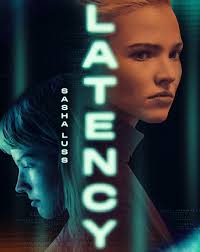
There is a certain sublime pleasure to watching a piece of shit movie that’s been marketed as if it isn’t. Latency was my answer to the question, “Hey, do you want to see a comedy about the Holocaust?” from Wife (Friend helpfully mentions that Stephen Fry wrote a BOOK that sounds like it’s an actually funny time travel comedy about the Holocaust that I recommend to you now!). I went in without anything besides the blurb that said that a “problem gambler” had received a piece of new technology which was making it difficult to figure out if she was in control of what she was doing, all of which sounded intriguing: women gambling in movies are rare (compare the Oceans movies with Molly’s Game or any of your picks for favorite Bond films) and tech-triggered hypnosis presents a personal aesthetic challenge for me. It wasn’t until about thirty seconds into the 8-bit inspired opening sequence (the entire gaming inspired soundtrack to this movie is fabulous) that I realized I had misread the blurb and was going to watch a movie about a gamergrrrrrrl with agoraphobia.
The thing about agoraphobia in 2024 is–it’s always going to be allegory for the audience’s experiences with the pandemic. Kimi, I was reminded by Wife, did this better than really any thriller from that period for so, so many reasons–too many to mention here, except we can get into the weeds a little bit, I guess. Kimi actually acknowledges the existence of the pandemic instead of turning it into a weird blip or acting like it didn’t happen at all, which sort of idealizes the fictional world in a way that makes it difficult for us to sympathize with the struggle of the protagonists. Kimi finds a way to tow the line between sexualizing its young, beautiful, mentally ill protagonist and making her the principle agent of the plot. By comparison, in Latency Hana (Sasha Luss) is an agoraphobic hikikomori because… her mom was? We’re told that through a weirdly detailed photograph she keeps in a Shoebox of Explication that comes up way more often than you might think is warranted. “You never told me your mom was agoraphobic,” Hana’s inexplicably friendly friend Jen (Alexis Ren) says too late in the movie for it to matter. Hana isn’t sexualized at all in her movie, but instead we get these sort of long, lingering shots on her face in the shower multiple times throughout the movie that don’t move the plot along or serve a purpose beyond establishing the shower as a part of her apartment.
I remember asking myself, How does her apartment have a washer and dryer? and then remembering that it doesn’t really matter because she could’ve very easily had a service clean her clothes with her but then it wouldn’t have allowed her to have two or three big spaces for things to hide and lurk in the single location movie I was watching. I suspect that if I read more about this 85 minute movie that I would find out that it took approximately 86 minutes to film and then six months to add all the CGI. The single location set makes the film feel decidedly lowest of the low budget. At no point in the movie do you have a sense of what time it is, likely because it was filmed, as I said before, in about 86 minutes on a Tuesday while everyone else in the building was at work. But questions like, how does this twenty-something white girl who really could’ve solved all of her problems if she had just got a regular fucking job have a washer dryer in unit really pale in comparison to more serious questions like since when do gamers compete for six figure prize pools from their apartment’s wifi connections? What betting markets are paying out 250:1 odds for a Valorant competition? Or, the one Wife asked DAYS after we had seen this movie, “I just don’t get why the company would’ve wanted her to kill people while mind-controlled on their tech in the first place. What purpose did it serve in terms of furthering the company’s aims?” Those questions don’t matter nearly as much as the fact that in every scene that Jen’s in her hair is a different kind of odango and it always looks great.
Jen’s inexplicable attachment to Hana would make a lot more sense if they had included some kind of queer subplot, but instead, Latency prefers to leave things–not even ambiguous just–so bland that you don’t really have follow up questions. It’s basically The Whale if Brendan Fraser were a fit white girl who played video games instead of teaching Melville or whatever.
Latency is a movie about video games that doesn’t care that much about video games. The combined screen time of the bootleg Valorant game they put together is about fifteen seconds. Add that to the Tetris montage and you’re at a cool 1% of the film devoted to actual gameplay for a plot that seems oddly transfixed on the redemptive power of gaming. But the thing is that this movie is quite pessimistic about the prospects of redemption, saving oneself from the clutches of one’s past or the demons of one’s parents. Instead, it offers no solution, just posits a problem and runs with it like an undisciplined Black Mirror episode–sorry, just a Black Mirror episode, I guess.
Latency’s jump scares and creepypastas are almost entirely under the category of “and then she wakes up and it’s a dream,” which gives the movie a sense of being sort of stuck in a loop, which it is literally. The lack of surrogate agency (typified by a movie like Scream VI or Ready or Not) sort of steeps the whole thing in both sense of hopelessness but also boredom, because when nothing is real, nothing really matters, because at any moment the whole thing could be a fiction. That’s not to say you shouldn’t see this movie as a sort of drinking game. I give this zero Babadooks.


