
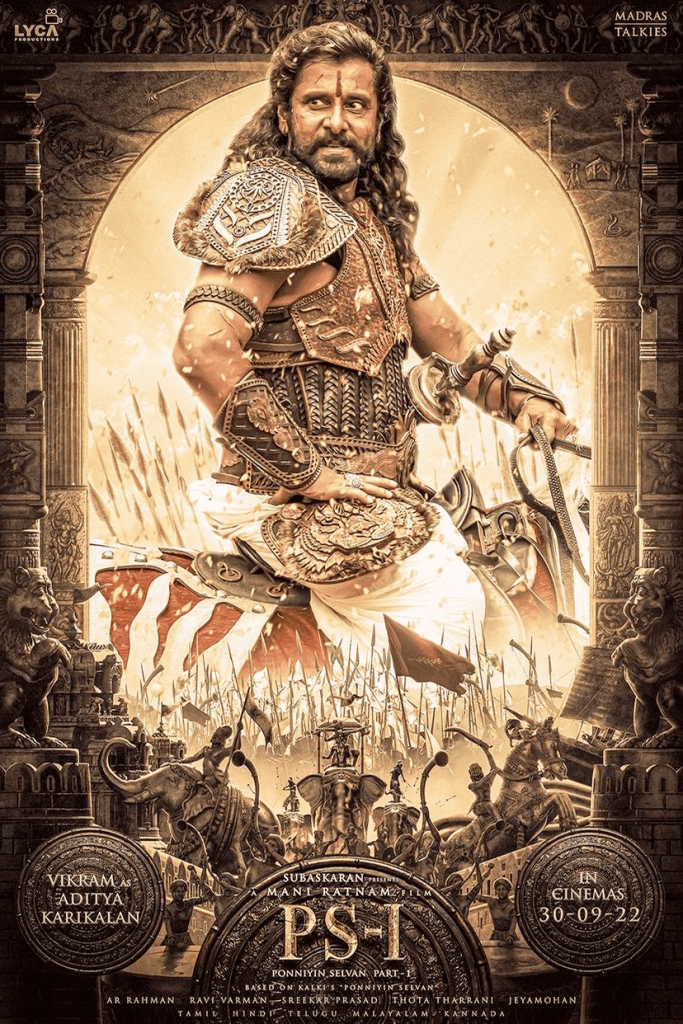
I expect that if you’re reading this review here right now that you are either a huge fan of Ponniyin Selvan and you are absolutely delighted to see someone reviewing this film for you in the same way that you would be happy to buy some lemonade from a kid on your cul-de-sac, completely as an exercise in kindly indulgence and comfortable in the knowledge that you have a variety of other, better options for the same product. On the other hand, one can imagine a scenario in which your interest in 10th c. CE Tamil war epics is not yet kindled, and you may need some comparisons in order to get you situated and contextualized (this was the camp I fell into). I am more than happy to serve you my lemonade. And, as you’ll see, I’m happy to sell lemonade for as many parts Selvan as I am given the opportunity, in part for the novelty of reviewing what is clearly a massive, blockbuster series that exists in a pop culture space that runs parallel to my own. I’m also down to convince you that if you are going to choose any three and a half hour war epic that blatantly blasts through its own intermission without giving you so much as a breath to dab your eyes from the heart-wrenching breakup song of the movie’s first act closer before throwing you into the jaws of its second act battle, it should be Ponniyin Selvan Part 1.
I saw this with Friends who insisted on watching it in Tamil with English subtitles. There are a few different permutations for how to do this, but I think seeing it with a couple people who have varying comfort levels with the dialogue is a perfectly entertaining way to see this movie: for example, walking out of the theater, Friend informs me, “You missed out on SO MUCH WORDPLAY.” (This is me learning that Friend also knows Tamil and also that the script I just read could’ve had puns and being so grateful it mostly didn’t.) Opening weekend featured a few sold out shows and reviews from Friends’ parents that went in wildly different directions from “My mom told me she fell asleep” to “That was amazing,” which made me even more intrigued, as someone whose mom also often likes to fall asleep during movies and whose parents have hot takes on movies (see: Top Gun: Maverick).
But what is it like? What’s the pitch? Ponniyin Selvan was billed to me as Tamil Iliad, a group of warring chieftains duking it out for land, but I think it’s actually more accurately described like Tamil Gladiator, built for the sensitive macho movie goer, complete with the palace intrigue AND spurting jugulars, or maybe it’s better described as like three of the most ornate historical music videos you have ever seen connected loosely by some truly intense sword fighting. However you want to describe it, PS1 evades easy categories: a film with some truly catchy pop music and dance sequences and an equally powerful score, or a historical drama that dabbles in the subtle buffoonery of the hypermasculine fuckboys of ye aulde tymes.
The structure of this movie comes from a classical text written by Kalki Krishnamurthy about a power struggle in the Chozha empire ruled by an ailing Sundara Chozhan, who’s apparently been placed as a sort of regent over the land by a council of chieftains while waiting for a rightful heir to come of age and assume the throne. At least as the band of conspirators have it, Chozhan reneges on his agreement to step aside, paving the way for his three children to inherit the kingdom. His sons Aaditha Karikalan and Arunmozhivarman (who also goes by the titular Ponniyin Selvan because of a childhood accident with a river) are dispatched to fight his battles in various corners of the land, mostly mopping up the last resistance, it seems, but there’s a real Aeneid vibe to the whole thing in that it seems like on Lanka, for instance, there are some truly powerful neutral to hostile powers that the Chozha’s enemies can call upon to help them foil our heroes’ plans. Court intrigue reveals that there are some internal challenges to the emperor’s legitimacy for various reasons, in the form of the delightfully dour Pazhuvettaraiyar duo, Periya and Chinna. Just as an aside here, I think one of the Pazhuvettaraiyar brothers has a weird title like “Prime Minister” or chief economist or something, which is a little jarring considering how much both of them spend time ordering their toadies around and causing havoc in their endless search for spies.
At this point you’re probably not asking yourself, I believe you said the emperor had three children, but you only mentioned two sons who are off fighting forever wars in the frontiers, could you elaborate on the status of the third, aforementioned sibling? Yes, of course. There is a third child–a daughter!–who has some of the most entertaining lines of the movie. Kundavai is sort of a McGuffin for our messenger Vallavaraiyan Vandiyadevan (played by the talented Karthi) whose mission frames the entire story of PS1. There’s some expectation that once Kundavai’s informed of the palace intrigue, she has access to hidden resources or intellect and will marshal the necessary manpower needed to vanquish their foes, but what becomes clear is that she is, much like Ithacan Penelope, working with a considerable lack of resources. In fact, we spend a lot of the first act thinking that Aishwarya Rai Bachchan (“Miss Universe!” Friend’s mom tells me when I ask about my favorite character), playing Lady Nandini, wife to one of the conspirators, is calling the shots and giving aid to the brothers Chozha before that certainty is muddied and muddied further. Kundavai’s knowledge feels a little repetitive seeing as the messenger goes to her father first, before they’re able to meet up and hatch a plan about how to assemble the family to defend themselves from an existential threat.
Kundavai is dispatched to convince her other brother Aaditha to return to the capitol city in order to render aid in the second act, which is when it is revealed that she played a hand in banishing her brother’s old flame, none other than the conniving and morally ambiguous maybe (?) Nandini! Meanwhile, the messenger character is dispatched to do the same for Ponniyin Selvan on Lanka. Trouble happens! We’re left a little worse for wear on a cliff-hanger, with a mysterious mystic savior on a very angry elephant. A movie not entirely without its quirks, but also not so different from the first few episodes of Game of Thrones, another comparison I was given for PS1 in terms of interlocking storylines and characters. On the Venn diagram of plate-spinning plotlines versus shallowness of character development, PS1 doesn’t feel like it has compromised on quality due to quantity (see, Seven Samurai, The Hateful Eight, Ocean’s Eight) and it doesn’t have the alienated, flip-to-the-Personae-Dramatis feel of Tamsyn Muir’s splendid and crowded snuff-book Gideon the Ninth. No, at three and a half hours, PS1 gives its anchor characters, villains and heroes all, their moment in the spotlight and spares no one, not even the bit players, some exquisite moments.
This movie is long. Like, remember when you were worried about The Batman being long and someone told you that it had five, six-hundred endings that really go nowhere, and that made you worried? Imagine that but then tack on an extra hour of backstory of how Alfred became as jaded as he is about the villains of Gotham and you’re almost there.
The fight sequences are probably a little overwrought, but they’re clearly part of the maximalist approach of director Mani Ratnam. One Friend shrewdly observed that the film could have shaved an easy thirty minutes by employing some discipline on the battlefield, and I align myself with that, especially in sequences where it’s fairly difficult to understand the motivation of the Chozha prince in laying siege to that particular keep or city or camp or what have you. The opening to the second act has some elements of this: unspecified villains are slaughtered mercilessly, mostly to give each of the (star-studded!) headliners a chance to show off their moves and splatter the camera lens with blood. Probably the only extended battle scene I have no notes for is the opening to the first act, where the resolution of battle actually has some bearing on the plot later. Otherwise, war is hell and hell is sitting through a fight scene that we have not had contextualized for us enough to really appreciate who we’re supposed to root for and why.
I actually like that we are in medias res when it comes to the events of PS1 and the fact that the Chozha siblings are scattered to the far corners of South India and Lanka is a cool technique for giving each of them some breathing room to tell their own stories. I even like the way that Vallavaraiyan Vandiyadevan serves as a connecting character for the narrative even while it’s entirely clear his fortunes are rising as the empire grows, as does its danger. One more shoutout to Vandiyadevan: he is the only character who gets multiple fight scenes, an extended dance sequence in which he plays a fucking demon doing battle with a sorceress as far as I can tell, and a recurring joke where he befriends horses. The guy has such breadth and depth on screen and makes a lot of tonal shifts in the story just work.
On some performances: Kundavai, played by the luminous Trisha Krishnan, takes the show with her impressions of the self-serious chieftains at court as she stumps them with the offer of marrying off her brothers to their children, thereby increasing their stock in the newly formed empire, as a classic Penelopian delay tactic against would-be conspirators. Likewise, she provides one of the most credible challenges to the charming womanizer and all-around dashing Vallavaraiyan Vandiyadevan when she asks him to jump to his death in pursuit of her affection. Her co-star Sobhita Dhulipala, playing a sort of lady-in-waiting, bestie-type called Vaanathi, is equally talented and seems like she’s being set up for a much larger role in the next film, when presumably we see more than a few fleeting moments of the eponymous hero. Nandini’s subtle manipulations of her husband, the messenger, and the princess make her time on screen some of the most juicy, interesting character studies of the entire film. Everyone came out of the theater with a different take on her motives and where she was going next. I’m a fan of reformed baddie after a reunion with her ex-boyfriend.
PS1 is not a traditional pick for me, but it is in many ways at its core a great movie to see with friends. There were so, so many different people in the theater with us, cheering as superstar actors vogued for the camera for their first time on screen, children shouting at key moments of betrayal, and moms (MOMS!) sitting through gory fight scenes because this is Culture as much as it is Popular Culture. I am ready for the return of Ponniyin next year and you can sign me up for anything these actors have done on back catalogue. Director Mani Ratnam ensures that every scene is over-the-top. There are always two or three overlapping motives for each moment, multiple perspectives to watch a scene play out, and fallout that must be addressed, exploited, or parodied by the cast of characters. The story is sprawling and genre-bending and the movie clips along, unburdened by the preoccupation with modern standards of morality or politics, even as it finds ways to inject new life into the movie and novel it is adapting.


