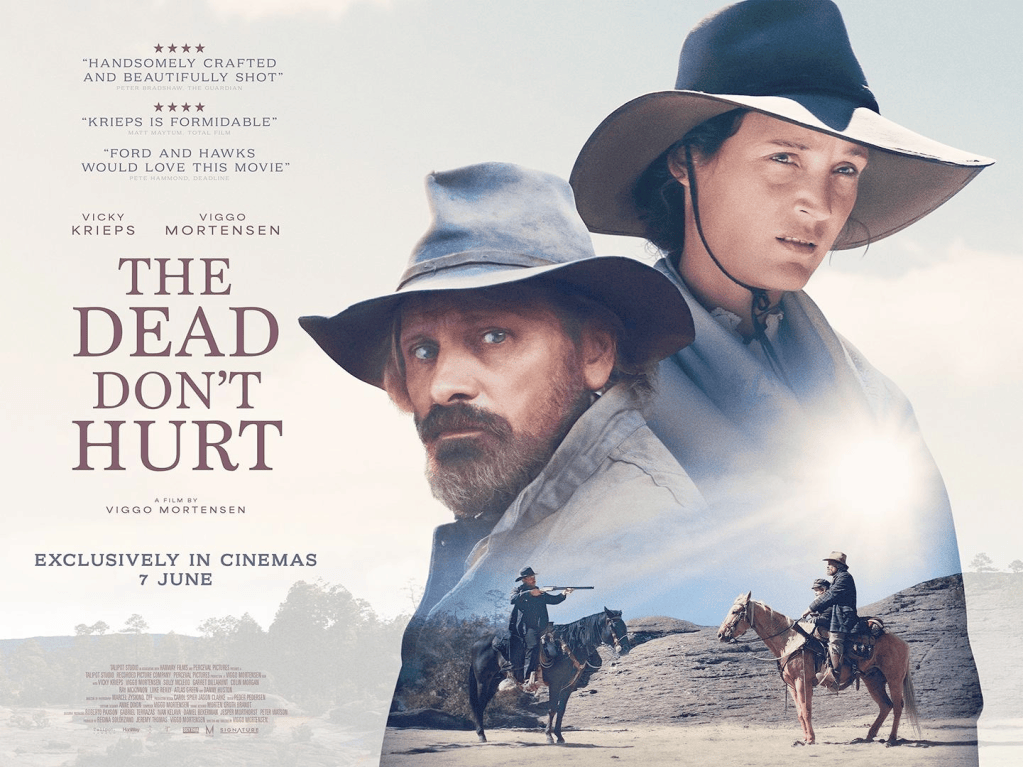
The limited experience I have had with the OG westerns of resident dirtbag Clint Eastwood and the Japanese reboots of said westerns in Kurosawa and then the “neo-Westerns” of the past thirty years (films like Wind River from 2017, 3:10 to Yuma from 2007, Tombstone from 1993; the melodic and earnest True Grit 2010, gritty and self-serious Revenant, the sleepy, slapdash Ballad of Buster Scruggs, sleepier Hateful Eight, transcendent and labyrinthine Sisters Brothers, violent and diverse Hostiles 2018, modern-retelling in Hell or High Water, classic No Country for Old Men, and confusing Power of the Dog) are that they are generally myopic visions of, paraphrasing the Rollingstone writer Mikal Gilmore, brutal white men doing brutal things to others, and in some ways Viggo Mortensen’s The Dead Don’t Hurt is very much of the genre. (Spoiler:) The female lead has a cliched sexual assault, compounded by a syphilis KO later for good measure. But it is also true that The Dead Don’t Hurt is very much sensitive and alive to the violent themes of its predecessors and not very interested in promoting their most toxic aspects, the supremacy of good over evil through violence, the glorification of the good fight and the rest.
When I first heard about this movie, it was billed as a kind of “anti-Western,” which fits it nicely in the Silver Age of its contemporaries, and there are four aspects of the film that make it very much the sensitive and thoughtful offspring of its rougher kin: 1) the skepticism of violence and the efficacy of war, 2) the focalized perspective of the female gaze, 3) a brittle and soulful score composed by Mortensen himself, 4) and the cosmopolitan, intersectional stories that occupy this space traditionally reserved for an all white (or satirically white, in the case of Blazing Saddles) story.
On violence: TDDH’s take on violence is encapsulated in a brief exchange that Vivienne and Olsen have when he returns after the end of the Civil War: “How was your war?” she asks, unsentimental, flat. “Long and not what I expected,” he responds, after every platitude that he used to convince her of its moral high ground previously. The pronouncement, leveled at a war as nobly regarded by progressive liberals at this time, is daring and subversive. And in this moment when there is little if any room for anything but full-throated support for war in all of its forms in Europe and the Middle East, atrocities by allies and aligned partners be damned, after the briefest of pullbacks from American military adventurism during the early days of the withdrawal in Afghanistan, TDDH’s skepticism of a Just War cuts through so many layers of political opportunism. It sort of has a Vonnegut-esque ring to it:
“You were just babies then!”, she said.
“What?” I said.
“You were just babies in the war – like the ones upstairs!”
I nodded that this was true. We had been foolish virgins in the war, right at the end of childhood.
“But you’re not going to write it that way, are you.” This wasn’t a question. It was an accusation.
“I-I don’t know”, I said.
“Well, I know,” she said. “You’ll pretend you were men instead of babies, and you’ll be played in the movies by Frank Sinatra and John Wayne or some of those other glamorous, war-loving, dirty old men. And war will look just wonderful, so we’ll have a lot more of them. And they’ll be fought by babies like the babies upstairs.”
So then I understood. It was war that made her so angry. She didn’t want her babies or anybody else’s babies killed in wars. And she thought wars were partly encouraged by books and movies.
So I held up my right hand and I made her a promise: “Mary,” I said, “I don’t think this book of mine will ever be finished. I must have written five thousand pages by now, and thrown them all away. If I ever do finish it, though, I give you my word of honor: there won’t be a part for Frank Sinatra or John Wayne.
“I tell you what,” I said, “I’ll call it ‘The Children’s Crusade.’”
She was my friend after that.
War in TDDH is loss, it’s a waste of time, the premature death of a hopeful relationship, its test, irreparable harm, diversion, the abandonment of a sanctuary.
On the female gaze: the entire second act of the film is devoted to seeing the world through Vivienne’s eyes after Olsen leaves for the war. We see her take a new job, tend to the farm, stand up to bullies and reap the rewards of that courage, and then we watch her choose to press on instead of running away, wait until she can explain herself in person to Olsen. The visions of knights, Joans of Arc visiting Vivienne as a girl and as a woman punctuate each act of the film, and her own childhood pronouncement that she wishes to fight like a man, like Joan does, is tempered by the ways in which she must adapt and recover from that same violence.
Lastly, the relationship between Olsen and his son Victor is so perfectly drawn, from the first scene where he’s helping push soil into his mother’s grave, to the very last showstopping scene (more about it at the end). The way Vivienne smiles when Olsen returns from a swim after an argument is so hopeful, even as we are accutely aware of the final outcome of their relationship, a sham trial and abrupt departure from the town they made their family. Not to mention that the film is almost entirely in Dutch and French. All of this gives the impression that TDDH is more than the sum of its constituent parts.
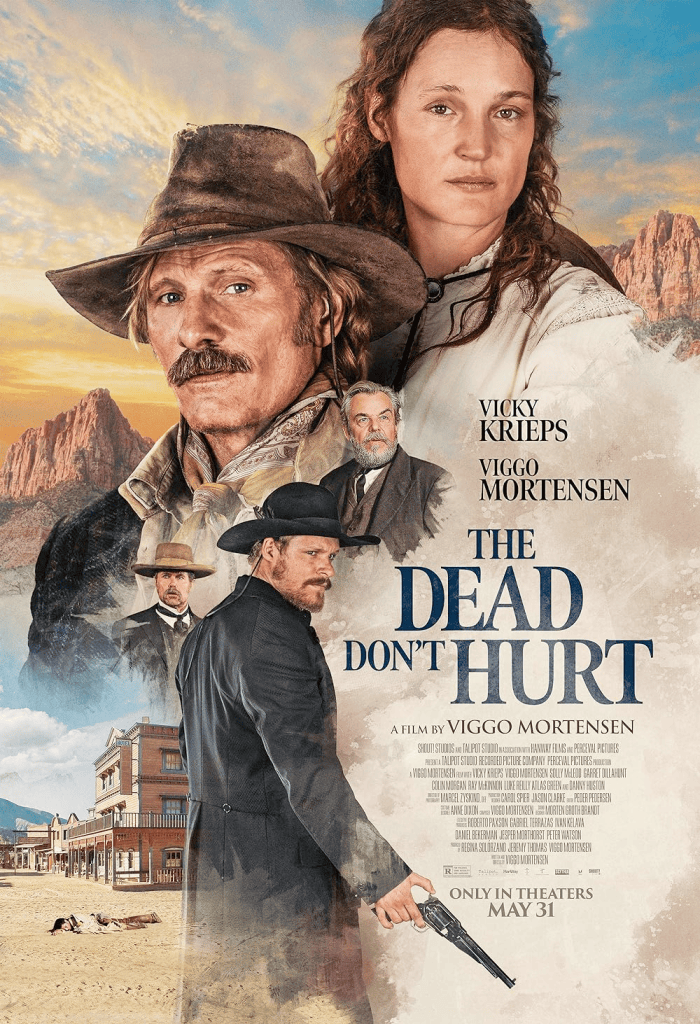
One surprising gripe I have about the marketing for this film is this poster I came across while writing up this review which gives away the ending, something I find in mesmerizingly bad taste.