
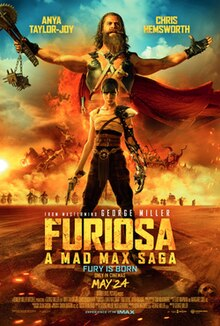
Mad Max Furiosa in its second weekend lost to the Garfield movie, which should tell everyone everything they need to know about the way that this film has performed financially. Critically, there’s lots of praise for this inventive, fast-paced epic. I ended up seeing it twice during the long weekend to understand what I liked most. The way I’ve been describing this movie to anyone who will listen is it’s not a good movie it’s five good movies, and also that it finds a way like its predecessor to combine the high-octane macho energy of gearheads with feminist themes and sensitivities, which should really come as no shock if you had seen Fury Road, a film that tapped into the energy of the #MeToo movement and capitalized on a larger-than-usual female audience attendance to ride into the sunset with huge financial success. By comparison, Furiosa was largely passed over by female audiences, and I think in some ways this makes sense as a consequence of the cultural moment that the film finds itself in–the backlash to #MeToo in full swing and a democratic president in office make the chance for another feminist road warrior film to catch fire a lot less likely (Fandomwire has done a good job of digesting several different sources explanations for the film’s failure at the box office despite excellent reviews).
One way to talk about this movie is to think about it in terms of its structural divisions, the five neat chapters that organize the narrative. Part one, The Pole of Inaccessibility, has been written about as the sleeper star of the film, consisting of one sprawling hunt sequence staring Charlee Fraser (co-star of the Sydney Sweeney/Glen Powell Shakespeare adaptation Anyone But You film last year!) as Furiosa’s badass and vengeful mother and the gifted Alyla Browne with an assist from deepfake tech playing the young Furiosa. If memory serves there isn’t any music in this first sequence, which makes it even more intense by emphasizing the spareness of the desert and the desperation of moment. Silence is employed by Furiosa in a number of different ways. Despite a lot of the initial press around the startling number of lines that the title character has in the film (30!), the film finds a way to bend around Anya Taylor-Joy’s magnestism. She’s not just a sexy lamp, and in this way, I think probably the most original commentary I can bring to this analysis of Furiosa is to talk a little bit about the way in which its classically inspired script and cinematography employs a feature of the Achilles-Odysseus dichotomy in its dialogue for Furiosa and Dementis.
The film is replete with references to the classical world: Dementis in the trailer asks Furiosa if she has the courage to make her revenge “epic,” likewise the trailer calls the events of the film Furiosa’s “odyssey,” the punishment for a character’s insolence is to be dragged by motorcycle much like Hector by chariot around the walls of Troy, where he fulfills the infamous and infamously unfulfilled curse of the Iliad in which soldiers’ corpses become carrion for dogs and birds. In the seige of Gastown, Dementis’s ploy is to construct a Trojan horse, Dementis’s beard is red like Menelaus’s, the weapon of choice for the warboys are javelins, and so on. But probably one of the first things one learns about the differences between the Iliad and the Odyssey is the difference between the protagonists of these two stories in terms of speech (entire books are written about it, often). The Odyssey is majority dialogue, whereas the Iliad is mostly action. There’s twice as many lines devoted to direct conversations in the Odyssey than the Iliad (more than a quarter for the Odyssey and around 13% for the Iliad). More than that, speech is oftentimes associated with femininity while action is associated with masculinity. Achilles is our man of action while his chatter counterpart, Agamemnon is equivocating and weak. Odysseus, first appearing as a minor player in the Iliad, does not engage with the world by action, but spends most of his time getting himself out of binds by talking. He talks, sometimes too much, to the women he meets, the monsters, to children and kings and gods, and then he retells those stories in detail (with meaningful discrepancies!) in the course of the Odyssey.
Which is to say that in the course of Furiosa, Furiosa very clearly takes the role of the Achilles character, brave and idealistic, fighting against the prevailing attitudes which trend toward more pragmatic and venial motivations, while Dementis is a classic Odysseus, chatting his way even in his last moments in hopes that he’ll be able to talk is way out of a pickle.
Stowaway (Chapter 3) contains in it the only really extraordinary road war, which is fascinating because it really puts into perspective how much of Mad Max: Fury Road is one, long road war sequence. The visual poetry, dynamism, and inventiveness of the combat in this sequence really shows the flexibility of Mad Max as a template for storytelling, the way in which it allows the filmmaker to borrow a visual language from the previous film(s) and then improvise on those themes with new features, all without requirement of prior knowledge.
Homeward is the standout chapter for me (4), although I think the magic of the film is that every one of the five chapters has something extraordinary going for it either in terms of the ensemble performances or in terms of the expectation-breaking plot. Four establishes our love story and then does a switcheroo on us in terms of expecting the worst for these star-crossed lovers, a kind of optimistic turn which we first see in the rescue of Furiosa in Chapter 1, which reminds me of Rick Remender’s best writing in Low, a comic that always pits optimism against the forces of nihilism.
Beyond Vengeance (Chapter 5) features some of the greatest speeches by Dementis, his similarities to our main character and the ways in which his trauma has stunted him in ways she has overcome. “I did it for her,” he says, poking her shoulder, repeating, “I did it for her,” in an earlier sequence, and here when he realizes that his executioner is someone worthy of inheriting his legacy, he’s relieved, happy, even.
Mad Max: Furiosa has something for everyone and it transcends many of the problems of prequels, sequels, and franchise films in general. On your way to Garfield you should give this movie a chance and it’ll pay off with every additional viewing.


