
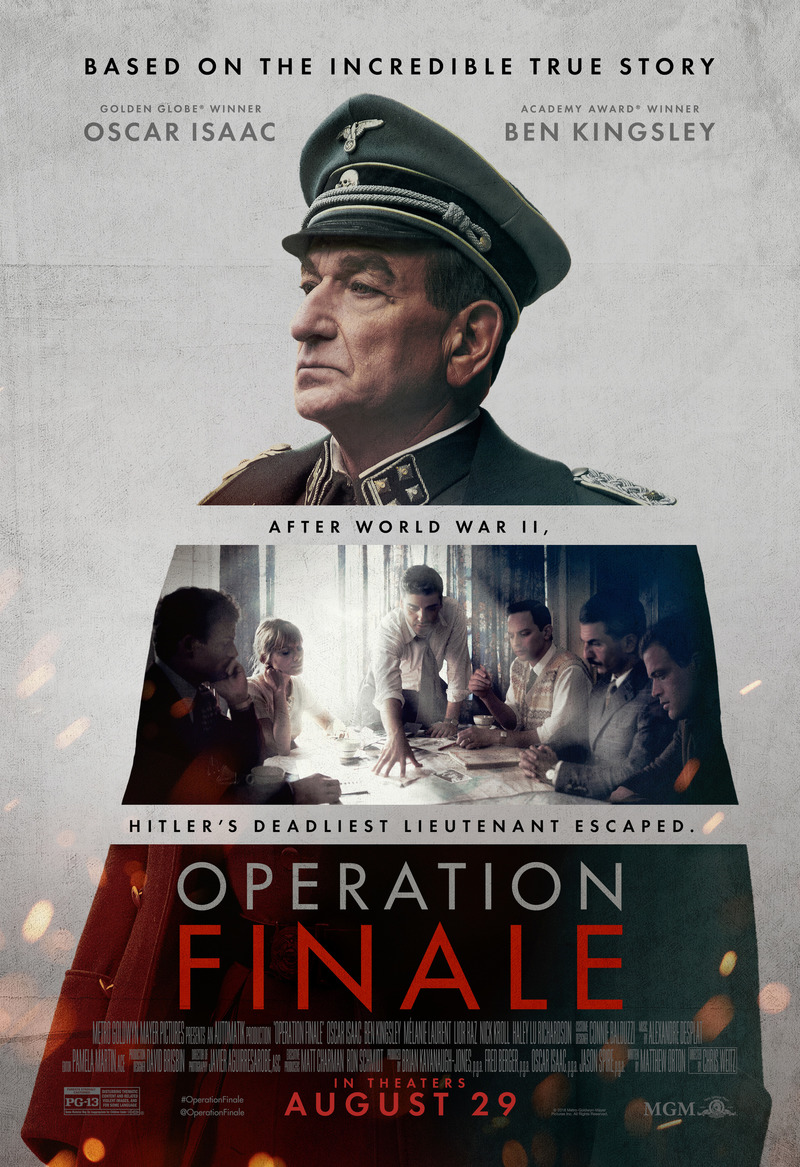
The day my friend and I went to see Operation Finale, there were maybe ten other people (octogenarians) in the theater with us on opening weekend, and two of them fell asleep and snored loudly through the rest of the movie. The edges of the screen were weirdly cropped and prevented us from reading some of the subtitling and seeing the head of the speaker, especially in wide shots. Felt hard to tell if it was as AMC’s fault or just an accurate reflection of the quality of the movie.
It’s mostly just one prolonged interrogation scene, with Ben Kingsley doing what he does, doing accurate impressions and saying mundane things that sound provocative because he’s Ben Kingsley. Oscar Isaac does an admirable job with a fairly shitty script. The way he rehearses his lines in the opening scene before the door opens on a German family’s Christmas festivities is kind of brilliant. (He does another sort of subversive bit of metatheater while repeating his lines on the side of the road just before Eichmann’s abduction.) But aside from those two performances (sorry, Haley Lu Richardson, I loved you in Split and Edge of Seventeen), the cast is stuffed with a lot of people who seem pretty bland. The overall effect is that of a low budget made for television movie.
The villainy of the Argentine-Nazi collaboration relies on the audience’s belief in two contradictory premises: the Nazis are capable of great evil even in the 60s, but they’re too incompetent to stop a commercial airliner from taking their highest ranking officer to stand trial and they have no reliable network of informers on the ground to help track down a small group of abductors from a foreign nation. It’s sort of the Thanos problem all over again. The action of the film cannot occur without him being too weak to effect the changes he wants to over the world, but the stakes aren’t high unless he’s strong enough to resist the good guys for a prolonged period of time.
Why is there so much drama around the fact that Eichmann won’t sign a letter to leave the country of his own volition? Why doesn’t someone drive him over the border at any point in the course of the ten days they’re stuck in town so that they can fly him out of Uruguay or Peru or Brazil? So much of the film feels like it’s supposed to be a taut, ticking time bomb of a thriller, but it ends up being a series of forced feeding sessions between Eichmann and his captors.
I foolishly thought from the trailer that this film was going to be a little bit like one of my favorite comic books in the past few years, Seven to Eternity, written by Rick Remender and illustrated by Jerome Opeña. Story takes place in a fantasy world where a dark figure called the Mud King has ensnared free states into being part of his evil empire by offering them their heart’s desires. (Spoilers ahead.) When he’s captured by a rag-tag band of misfits, the story shifts gears into a deliciously tense Defiant Captive journey plot in the style of the Western adventure:
 Remender and Opeña’s story is still one of the most thoughtful fictional meditations on the politics of the Trump era that I have come across in the past couple years. A lot of Remender’s work since 2015 has clocked a shift in popular political attitudes, even as I think a lot of artists and analysts were expecting a very different outcome from the 2016 election.

Operation Finale should go down as another example of how Oscar Isaac can squeeze water from rocks, albeit exceptionally boring rocks. If you’re not a completionist, there’s no reason to go. Operation Finale never really thought past the cleverness of Mossad agents trying to capture one of the masterminds of the Holocaust, leaving the film’s second act uneven and slow.


2 Comments