
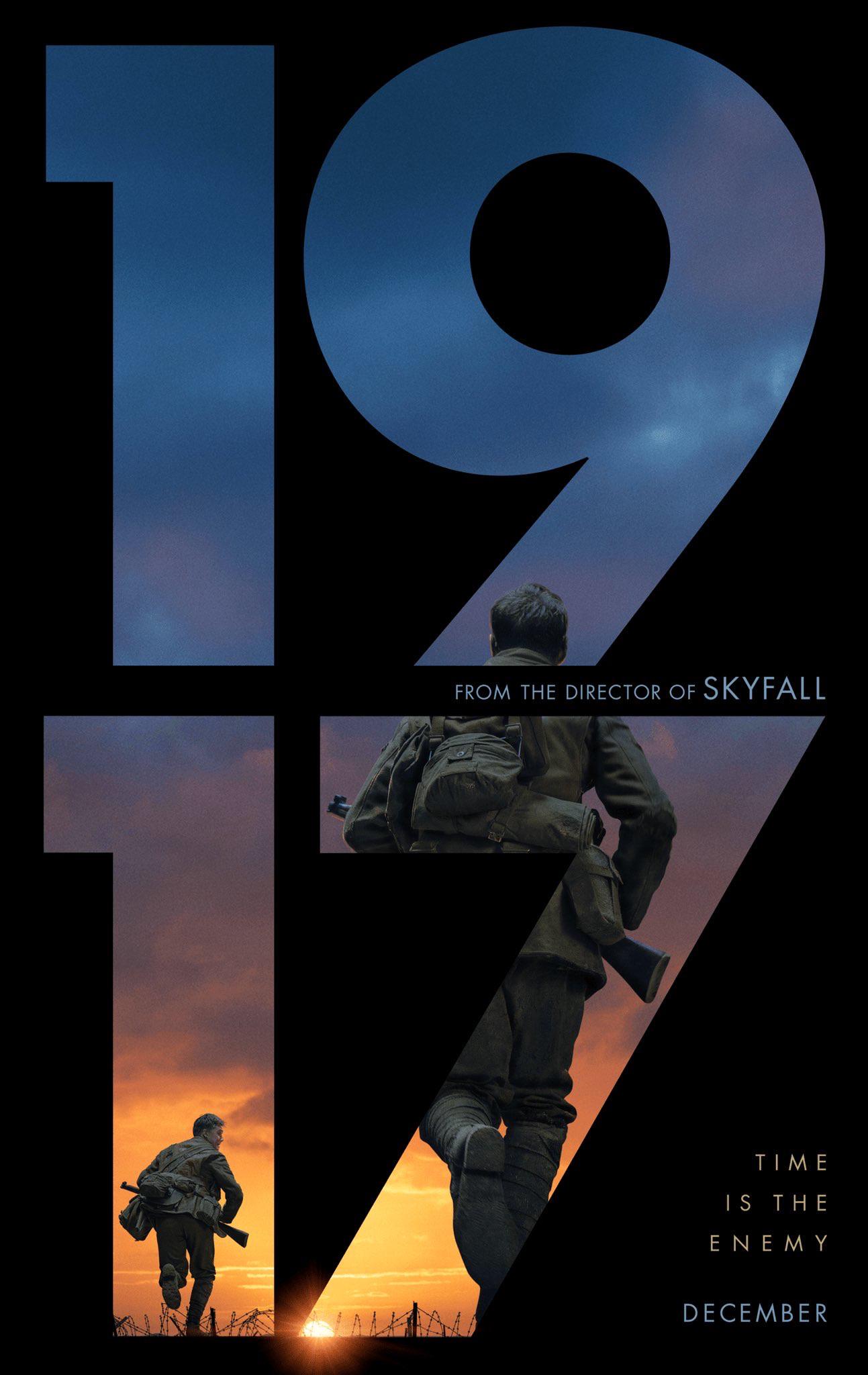
1917 was designed to make you feel really, really sad and hate rats more than you already did, but the fact that it has received so much critical love I think requires us to think more deeply about whether or not it understands contemporary cultural anxieties relative to the other films we have had on offer this year. We’re doing a full review with spoilers.
Saw this movie a couple weeks ago with Wife and Friend after we heard its nomination for Best Picture and all its accolades from the Golden Globes. Sam Mendes’s take on the war film genre isn’t especially novel, but some of his approach shows that an update was a long time coming. When I think about war films that Wife has seen and liked, I think most about Brad Pitt in Fury, which has this incredibly out of place and tense dinner sequence you don’t see coming slapped in between epic tank battles and incredible action sequences. Wife was charmed by the indefatigable Pitt being ingenious and resilient and definitely not just copying his character from Inglorious Basterds. And then last year there was the minor disappointment from JJ Abrams’s Bad Robot production company, Overlord, which I’ve written about before. We have settled, in this longest war in American history, on a decidedly skeptical view of the efficacy of violence, rolling our eyes at patriotic speeches in favor of dramas of brothers-in-arms helping one another in the face of an uncaring bureaucracy: 1917 fits nicely into that zeitgeist of nihilistic skepticism. It is a war film that for the most part does away with any heroic shoot-em-up scenes.
After our first protagonist, played by the fabulous best-friend Dean-Charles Chapman from Blinded by the Light, dies in a particularly grisly way, stabbed in the belly by a German pilot as he tends to the pilot’s burns–this death reduced Wife to tears for the next two hours–she said to me, “I don’t want to watch anymore,” and when I asked her if she wanted to leave, she said, “No”–talk about complicated feelings about a movie–the focus shifts to our new main guy played by George MacKay. MacKay spends most of the rest of the film running ignobly as fast as his feet will carry him through the rubble of bombed out cities, scurrying past patrols with stormtrooper-like aim, even pushing his way past his his own men after his arrives late-but-not-too-late to the first wave of soldiers being sent off to certain doom. Lance Corporal Schofield (MacKay) is set up originally as the grisled vet who’s seen worse days at the beginning of the film. LC Blake moons over Schofield’s participation in a storied past battle and cannot seem to understand how and why Schofield might have lost his medal from those days. Schofield seems like he is destined to die in order to create stakes for the growth of our young idealist who needs to grow up in the 48 hours it’ll take for him to reach the new front and save his brother, but instead, the film inverts our expectations by gutting the innocent younger brother character before the mission has really even begun.
Even Schofield’s finest hour, his shoot-out with the sniper after receiving way, way too much advice from a very chatty Mark Strong, is bookended by a bit of a slapstick moment from the trailer where he’s knocked back down the stairs as he comes upon the injured German. The glamor of his kill is undercut by the way that his fall disrupts the continuity of the take and possibly dooms the mission, as an inexplicable amount of time has passed while he’s been out.
The objective presentation of corpses in 1917 is an accomplishment. They are not used as spectacle or in order to evoke moral outrage, rather, they serve to strengthen a sense of disconnect between soldiers and their humanity. Blake stares as curiously at the carcass of a dead horse just before No Man’s Land as Schofield does when he’s making his way through muck and accidentally shoves his arm chest deep into a human corpse. The Germans are wasteful but clever, ingenious, cunning, and miserable. They eat dog meat in beautifully constructed barracks. They slaughter cows where they stand in fields and the (fabulously diverse convoy of) British soldiers cannot help but note the cold calculation that leads to such waste.
Schofield’s sudden dip into the river would have been a pretty standard juxtaposition of the madness of battle with the peace of nature, cherry blossoms coating the surface of a calm stream leading into a lake. It would have recalled Blake’s powerful pronouncement about the cherry trees cut down at the farm in his final scene: when the fruit rots and the seeds sprout, there’ll be more trees than ever here. But that added twist of the knife, having Schofield tearfully clamber over floating corpses to get his footing is really what ties the two experiences together: not only is the river a means of connecting us with Schofield’s memory of his friend or a haven from the chaos, but it is also littered with dozens of indiscernible bodies of young men from both sides, blocking the “sieve” from his bedtime story to the child in town. Only now, the sieve is not a ship unready for sea, a symbol for the hopelessness and cruelty of powers beyond these young men’s control, but the men themselves are the sieve.
Probably the laziest scene of this film is by far the scene with the child and girl taking refuge in a sub basement in town. Everything about it, her begging Schofield to stay, tending to his wounds gingerly, her helplessness and gratitude when he hands her the milk, it all feels like it’s been recycled to give the audience a break from the non-stop single-take action. Two arguments against hating this scene are MacKay’s delivery of the nursery rhyme, but honestly, the song is so quiet that it’s hard to hear and even if you could hear everything he’s saying, it doesn’t actually feel like an appropriate choice given where he is or who he’s talking to. The second variation on a theme that Mendes seems to make is the decision to indicate the girl’s lack of connection to the child: she is not the mother, she’s no one’s mother, she’s too young, and she is simply trying to do her best for a stranger given the circumstances. She has become a trope because someone needs her to be one. It’s almost too easy to roll your eyes at the earnestness of that notion, to excuse Mendes for reaching for the obvious even if he’s tried to distance it ever so much from the obvious.
Andrew Scott is by far my favorite cameo of the film. The breezy way he asks Blake and Schofield to toss the flare guns back as they die and the way his men are so wildly off about what day it is, only minutes from the back of the troop column is perfectly absurdist comedy, but comedy with a bite. Benedict Cumberbatch’s role is incredibly overhyped. Strong makes it seem like Cumberbatch is going to be so hungry for battle that he’ll ignore the order or do worse: “make sure there are witnesses,” but it doesn’t take much more than a raised voice for Cumberbatch to call off the battle. His acerbic little monologue “today they tell me to retreat, but next week they’ll tell me to charge” does cast his foolhardiness in a grim light. Far from being a true believer or a rogue general, he’s someone entirely exhausted by the fickle nature of his superiors, their uncaring and unattached orders–not his!–will ultimately doom these young men. That dark twist is surprising, but doesn’t necessarily redeem the flatness of his overall cameo.
Generally, I’m pleased with the direction, the cinematography, the action, and the pacing, but I don’t see what is so innovative about this form of storytelling or even its cultural significance relative to some of the other films made this year. It’s a film made up of an almost entirely white cast, bankable English stars whose cameos are either awkwardly long or puzzlingly short, and its only female character’s actions are basically 1) act frightened, 2) care for stranger’s baby, 3) thank soldier for milk, 4) unsuccessfully ask him to stay in her hovel. I want to resist making comparisons to Dunkirk, because I don’t want to inadvertantly compliment Dunkirk by placing it next to another film on the same level of slightly disappointing, but what I will say is that the structural complexity of Dunkirk enabled it to tell a much less conventional story. 1917 is a little bit trapped by its own cinematic limitations.
Might be worth following up with AV Club’s discussion.


