
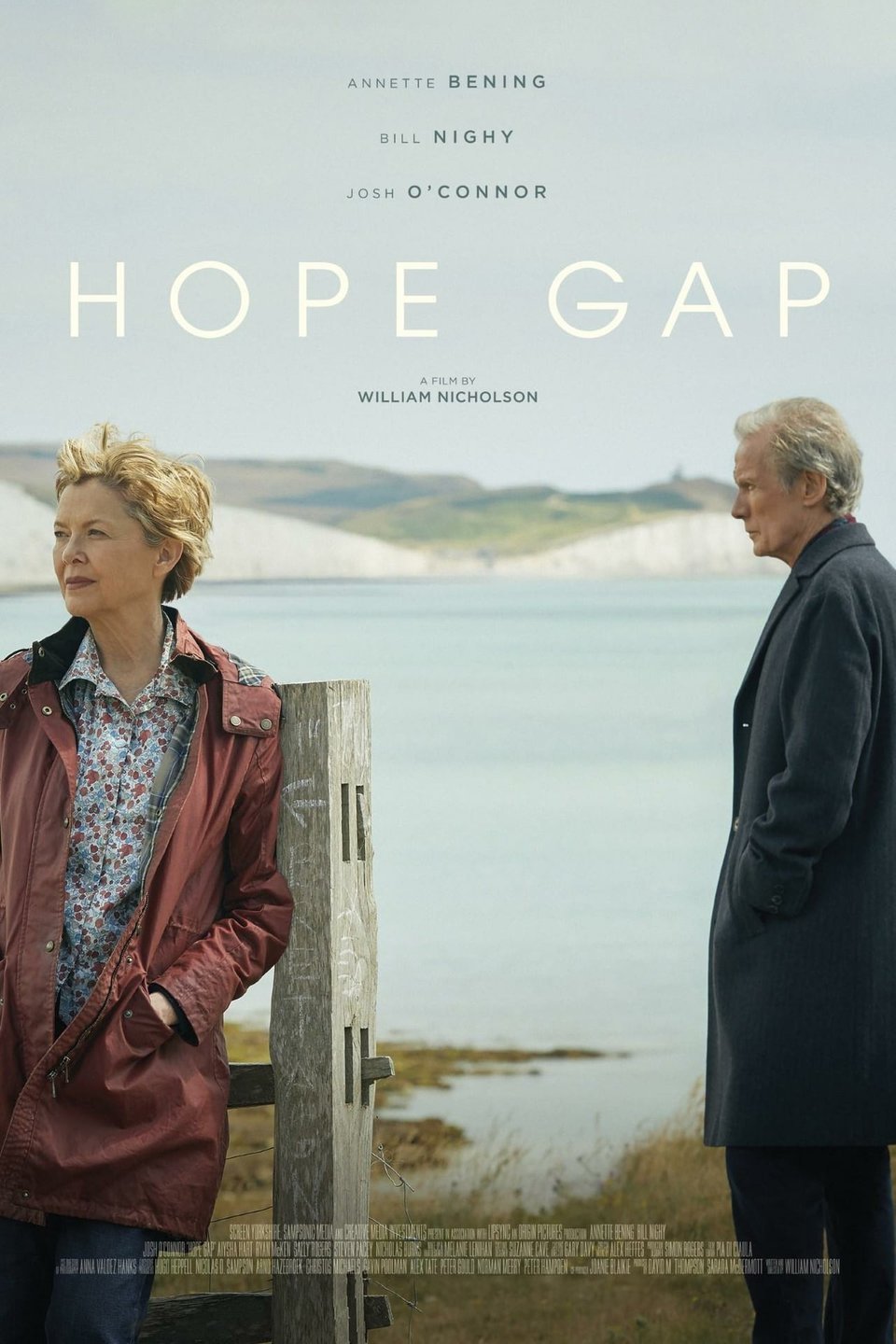
In a lot of ways Hope Gap is a deeply hipster love story, despite the fact that the couple is in their late 50s/early 60s and their young adult son is not a hipster. Annette Bening feels everything really, really hard, the emotional equivalent of a middle schooler dropping acid for the first time, while Bill Nighy’s Edward is a fumbling, bumbling man of few words, whose emotional intelligence is not quite adequate to explain what he sees as the true source of his own unhappiness and the reason for the relationship’s slow decline. The film is a little top heavy with poems. By my count there are at least four full poems recited in voice overs and meaningful close ups with shots of the ocean from overhead. One Rossetti recitation is a lot for any movie, but three is really playing with fire. It feels a little bit like The Sun Is Also A Star in that way, or, on a bad day, like Queen & Slim. But when you start musing in the first two minutes or so about whether or not Grace is metatheatrically calling attention to the movie itself as a “lonely impulse of delight,” we are almost definitionally in the weeds.
There are some laugh out loud moments in the opening act. The way that Grace steamrolls through the dinner discussion of theodicy shows off how breezy and strong-headed she can be: how she smiles at her husband and asks, “Explain to him why there is suffering in the world” elicited some giggles from the crowd. Nighy’s visceral discomfort in the opening scenes at home are a source of humor in themselves. When Grace gushes at her romantically unpaired son Jamie, “I can’t bear that you’re unhappy,” and he balks, she adds, “We’re happy,” a comment which her husband swallows. These moments are clever early bits of comedy that transform as the story progresses and it becomes clear that our initial impression of this nearly 30 year old marriage is not one of quirk and opposites attracting, but rather one of dysfunction and denial. The thing that Grace fears the most for her son, that he is “doing the same thing every day” in his apartment by himself drips with irony when the other shoe drops and it is Grace coping with the death of her marriage.
The conversations early in the house feel like a stage play with stilted, tidy language and convenient turn-taking. Grace demands, “Say something real.” Edward sputters in the act of setting the breakfast things for the morning after hours in advance, then he momentarily recovers by turning the tables on his wife by accusing it of being her “problem,” which leads Grace to lash out violently, surprisingly. This moment, in retrospect, is a blunder by Edward, a step on his way to being more honest with himself and Grace about the reason why they cannot resolve their differences. There’s another moment only poignant in retrospect, when Edward tries to talk, when prompted, about his recent obsession with Napoleon’s deadly winter retreat, the way that men were left dying in order to save the rest. Grace thinks this is just more of his “wikiing,” but in his roundabout way, Edward is trying to broach the subject of their relationship, the way that he views its slow collapse like a paper boat circling the drain. The scene at the end when Grace brings Edward’s figurines to him closes the loop and gives us a tighter sense of her growing understanding of her husband’s situation.
Napoleon’s march becomes a central motif of the story, especially the end of his historical lecture to his class of high school students, “They thought this an ‘accident.’ No one looked back.”
Grace’s sense of moral outrage at the death of her marriage, her stubborn intransigence and spirited resistance to divorce serves as the wind that keeps this story sailing. “Your father committed murder, even if there’s no blood,” Grace insists to Jamie. Puzzled by her son’s unwillingness to choose sides in the divorce, she asks, “If you saw a man beating his wife, would you walk on by and say ‘It’s not for you to judge?'” At times, Grace seems to play the cool, reasonable wife, dealing with an uncooperative, uncommunicative husband, who is escaping the commitment to his marriage, as when she calmly insists for her husband’s new phone number rather than using their son as a go-between, “I’m not a lunatic or a criminal. I simply wish to speak to my husband.” Yet in the same breath, she seems to imply her son’s non-judgement is a kind of culpability in a moral wrong, “Have you tried” talking him out of it? she asks Jamie, as if it falls on him to convince his father to see reason. Grace’s pendulous moods do the emotional work for a frustratingly inscrutable husband, in a similar way to Ralph Fiennes’s character in A Bigger Splash, a few years back.
Nighy’s Wrong Train monologue is maybe my favorite of the whole film with Bening’s “Would I get more if he were dead?” tirade at the solicitor’s office in a close second. Josh O’ Connor, who plays Jamie, has a lovely moment of indecision on the cliffs when he gives three contrary pieces of advice to his grieving mother: first, to call him before she offs herself, then, that he wouldn’t wish her to live longer than she wanted while in pain, and finally calling her “the explorer further on,” which is the final image of the film as well.
The ending elevates this movie to the next level, but in some ways, it feels like a pretty conventional teen romance movie with slightly older actors. I wish there had been fewer scenes with the adult son hogging the emotional space, because it feels like he was brought in to hold some of the weight as a surrogate for the millennial audience, when really all we want is to see two old, confused people grope around in the darkness of their middle age for some stability when the rug gets pulled out from under them.
This was my first feature at Cinequest 2020! Very excited about the rest of this week’s offerings.


