
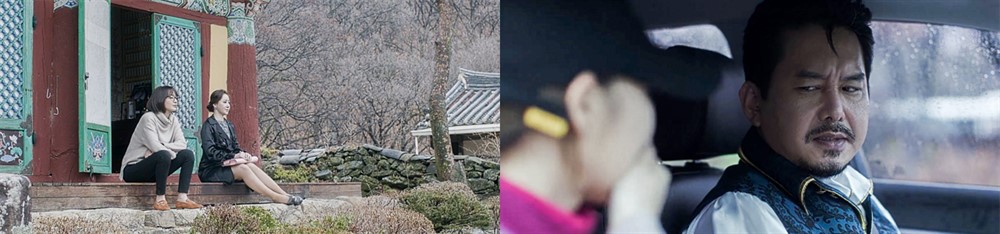
Go to Kill by Nam-won Park, my first movie of the Cinejoy 2021 Film Festival, does not clear the bar for a polished piece. The subtitling is pretty sloppy throughout and the score is part blooper reel and part melodrama, but never feels like it’s been given more thought than can be found on the basic kit of film editing software. The problem really is that Go To Kill is, and I’m spoiling nothing of your ninety minute viewing experience that isn’t spoiled by sitting through the whole thing, at its core, a movie about a poor woman’s fruitless attempt to murder an innocent rich lady whose entire life is told through flashbacks and conveniently-timed interviews. Instead of actually killing her, the Gosu succeeds in terrorizing the rich lady and her physically disabled son.
Physically disabled son? you ask? Oh ho ho, yes, this movie is all about problematic depictions of people with disabilities–they mostly roll around mute under the expert care of delinquent doctors. The private Korean healthcare system would be the villain of this movie if it weren’t for the fact that Gosu and her vengeful but ultimately ignorant neighbor Mi-yun are plotting a revenge killing of a former college friend. There also happens to be a comatose husband living in the only bedroom in the protagonist’s home, but no matter, he is not important except as a plot device for her mounting debts.
What about a romance plot? you ask, stupidly. Yes, there’s one of those too. You see, even though the neighbor friend Mi-yun has been wracked with guilt and anger over the suicide of her deeply indebted husband (Where are those debts from? Who knows? Why would a wife have records of where her husband owes money?), she also might fall in love with her North Korean nEiGhBoR who’s a bit of a hunk and still remembers his basic training, which might come in handy if someone wanted to learn how to murder an innocent rich lady–what could go wrong! Sorry, I meant to write, what couldn’t go wrong.
Death is cheap in Go to Kill. Just about everyone in this movie has an untimely death or an untimely death-by-disability, which seems a little bit worse. The North Korean neighbor lost his wife. Mi-yun lost her husband. Gosu “lost” her husband. The rich lady “lost” her son. At one point, our protagonist and technically-the-person-we’re-supposed-to-root-for Gosu, compares her sick husband to a sleeping octopus, which definitely scores her Good Guy points in my book. But these deaths are treated as minor setbacks on the path to true happiness–I think that man who’s been giving me murder lessons is maybe giving eyes at you, Mi-yun! It comes as no surprise that the climax of this movie is never realized and instead we’re left to pick up the pieces of a movie that neither commits nor admits that it wasn’t really sure what it was going to be from the start. The twists–if that’s what we’re going to call them–seem like sloppy attempts at lessening the consequences of past events while also ratcheting up the tension of Gosu’s resolve, but ultimately it removes the stakes and makes Gosu seem more and more like she’s probably the Bad Guy.
If this movie has any merits, and it doesn’t, it’s that it remains firmly in the realm of telling stories that pass the Bechdel test, but honestly it might’ve entirely been on accident that this happened. The incorporation of random characters like the ex-broadcaster-turned-novelist who shows up–apparently–to dig up exposition and get into cat fights on the street with wealthy entrepreneurs really makes it seem like there wasn’t really a captain at the wheel to this ship.


