
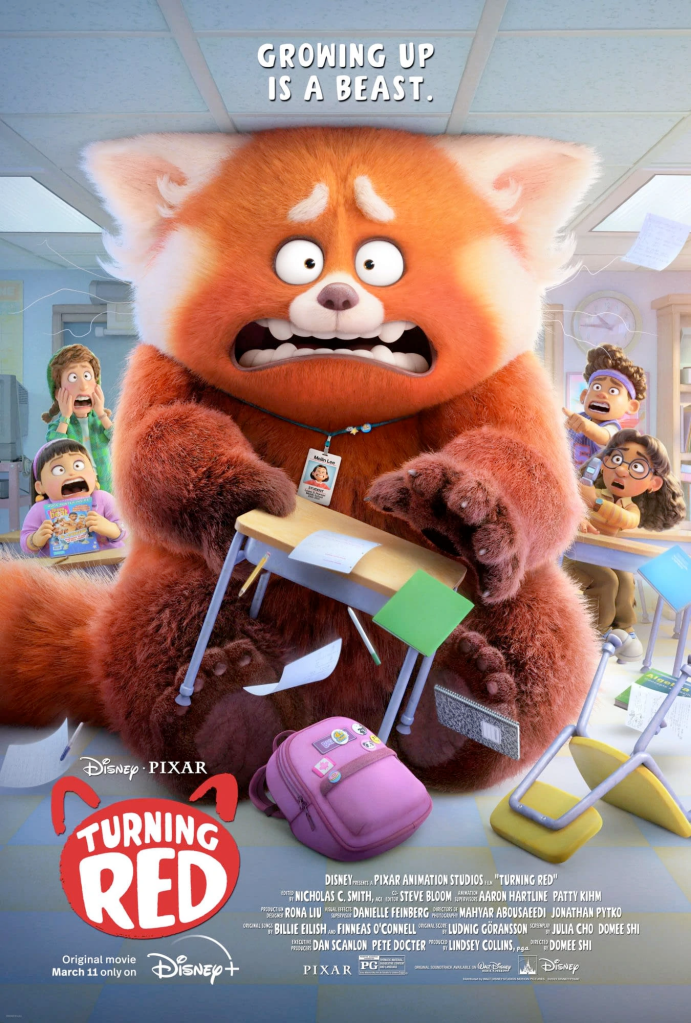
If it turns out that this pandemic is book-ended by two original Pixar movies, I won’t be surprised. One of the last films we saw in theaters before everything hit the snooze button was Onward, that extended road trip short that turned into a full on movie. Turning Red in our household billed itself as the first Canadian Pixar film and for a while I had referred to it secondarily as the first Korean-American Pixar film because of Sandra Oh’s role, but I learned after watching basically that I was mistaken and that Sandra Oh is as capable of playing a Chinese woman as Simu Liu is of playing just about any ethnicity he wants. If we’re going to have a (brief) discussion about the discourse around that one random review that said this film wasn’t for the man who reviewed it, I guess I’m confused about what he found so specific to the Chinese/Asian experience? If anything, the depiction of Chinese heritage in Toronto was cartoonish. How many people do you know that literally live inside of a temple-museum used to educate tourists about their culture? At least in Mulan, the plot has the decency to couch the family shrine into a more natural setting.
Wife and I sat down to watch this, prepared that it might be a multi-day affair because of the little tyrant who lives in the house with us. What struck us besides the fact that this movie was almost exactly set in our contemporary childhoods is that watching tweens on screen can make you feel physically unwell from cringing so hard–also that the expressive comedy style of Turning Red hits us right in the gut. We loved the demonic possession turn to the way that Mei starts drawing her fantasies, the absurdist dream montage that follows shortly after when she’s undergone a trauma so awful that even Wife had to admit it was the worst thing she had ever seen in her life. The metaphor of Pandafication for puberty is rich with slapstick. In so many ways this is the horniest of Pixar movies since Luca, I suppose. Mei and her friends swoon and stalk older boys and draw them shirtless, cradling them in their arms, gyrating, and declaring their unabashed lust. There are some recent spiritual sisters to this film in Eighth Grade, which went far enough into the sex and sexuality of tweens that it became effectively unwatchable by that cohort with an R-rating.
The movie has moments that depart from the repressed nerd in middle school storyline in fresh ways. Mei’s mother Ming Lee has–spoiler–a transformation of her own, one that’s alluded to gently by Mei’s father Jin, that squeezed “MEI’S MOM IS A KAIJU” out of Wife.
I do have some minor grievances with the durability of Turning Red’s metaphor that I’d like to get in the weeds about for a moment here. The uncontrollable urges, the emotional rollercoaster, the hair, all of those graft well onto the monstrification metaphor, but at a certain point the movie shifts into a grifter storyline, where Mei and her friends pimp the coolness factor of the red panda to earn money for concert tickets, and what exactly is the direct tenor to that vehicle? I’ve wracked my brain on this for a while and the only thing I can think is that maybe the upside to puberty that the panda form is intimating is physical attractiveness or female sexual power, and her increase in popularity has to do with her confidence, control, and ownership of that power? But it gets kind of icky to take the memorabilia and photographs of the Red Panda to any logical conclusion as metaphor. I think returning back to this movie with a critical eye is going to age badly in the future, probably.
And on this point of metaphors, what does it mean that some women repress the panda and others accept it? What kind of lesson is that, that it’s OK to repress your sexual power? Wife says that this isn’t the right parallel, and that actually the act of repression or rejection of that choice is about choosing to subjugate personal desires for the good of family, but then why are some women’s pandas so much bigger and less convenient to hide than others? It hardly seems fair that someone who doesn’t flatten the neighborhood when they change is asked to perform the same sacrifice as someone who poses such a greater danger comparatively. And lastly, on this point, I think it’s kind of crummy that Mei never comes clean to her mom about the mental exercise she goes through to change back into her human form–she should have to explain that she thinks about her friends not her family, because that really changes the math on whether or not her values line up with her mother, and since her mom is in the position of making and re-making the decision of divorcing her panda, she should have full information.
Nick Cho, star of the popular TikTok “Your Korean Dad,” has influenced a lot of my thoughts about the feelsiness that Asian dads in pop culture seem to wield. I have been tossing around some ideas about the low expectations of Asian dads for a few weeks and I think that I’ve created a matrix that covers all types of Asian dads in pop culture. On the X-axis is “Accent”/”No Accent”, which I think might also read as “First-” or “Second-” Generation, following NYT reporter Jay Caspian Kang’s thesis on typology. When asked on the Political Gabfest a few months ago what kinds of categories are most important when thinking about the Asian American community he says,
Yeah, I think that if the biggest change is generational between first generation [and] second generation immigrants, that second generation is much more liberal and much more votes Democrat at a much higher rate, the older generation tends to be much more, I don’t know, bootstrapping? I mean, that makes sense, right? That’s why you come to the United States in some ways. And if you come to the United States and perhaps you buy into some of the ideas about America and also, you know, there’s a good chance that nobody really helped you very much if you’re an Asian immigrant who came to the United States, right? And there’s not that much concern about that population. And so I think that generationally is the most important way to think about [categories].
Jay Caspian Kang, No Mojo Edition, Slate Political Gabfest, Nov 18, 2021
On the Y-axis is “Good” and “Bad” Dad. To be clear, the bar is set so phenomenally low by lazy pop culture representations of gruff, inscrutable, emotionally absent Asian dads (had a friend surprise me with a definition recently when I asked whether or not a dollar should go farther or further–he says, “farther” is for physical distance, “further” is for metaphorical distance, and “father” is for emotional distance). Sometimes, the emotionally inexpressive, repressed Asian with accent dad is good, like in Kim’s Convenience.
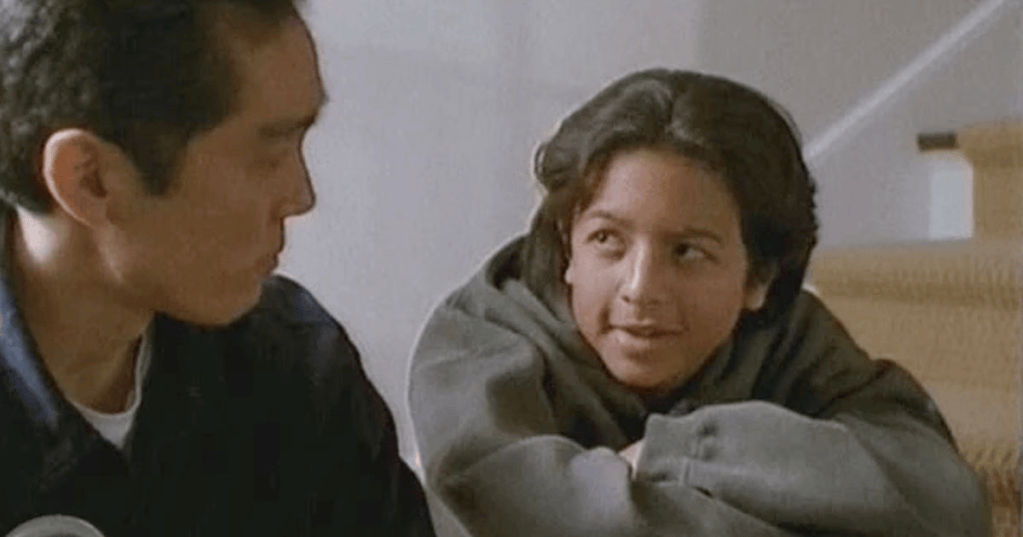
Sometimes the “No accent” dad is not synonymous with “emotionally expressive, liberal, progressive” dad who’s “liberated” from the stereotypical repression of his immigrant upbringing, like in Disney’s racially confused and very entertaining childhood classic, Johnny Tsunami. Yuji Okumoto portrayed a new kind Asian dad in Johnny Tsunami, a third/fourth+ generation American that really was just a different shade of the emotionally repressed Asian trope from decades earlier. Okumoto’s character exemplifies some of the interesting linguistic and cultural elements of the Asian diaspora in America, while lacking The Voice that actors played for laughs in the 80s to the early 2000s.
Nick Cho’s Tiktok Korean Dad meme is a form of the Generation X and millennial Asian dads from second and third generation of immigrants, which occupies the “Good” and “Without Accent” quadrant of the chart.
As does Awkwafina’s dad from Nora From Queens and Fresh Off the Boat.
Tiffie Starchild from Black Nerd Problems has some adjacent media criticism for your eyes on the topic of bad (Asian) dads and Avatar the Last Airbender.
In Turning Red, we have a Kim’s Convenience example–“good, with accent”–though it seems like it would be even more stereotypical if Mei’s dad had detected her love of the boy band was going to be something that she couldn’t shake and he had secretly saved and purchased the tickets behind his wife’s back. I think that would’ve kind of undermined the confrontation that Mei and her mother have ultimately which is why they had to roll it back, but I invite you to use this chart in your own exploration of Asian and BIPOC dads in pop culture in general to see how well it applies or what changes you have to make in order for it to work.


