
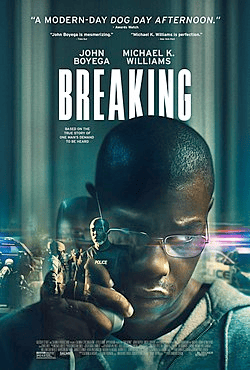
Breaking is John Boyega’s venture after the superstardom of the Star Wars franchise struck him like lightning in a field and Michael K Williams’s last movie before his death, which seems like a recipe for a truly riveting performance, and yet the movie is weighed down by fidelity to its biographic source material. The film doesn’t know what to do with itself in the final act and scuttles its resolution because it hasn’t rested on a single narrative for itself. It seems at first like it might be a Hell or High Water plot, where the Bad Guys are actually the Bank, and boy would you have an easy time doing that with the likes of Wells Fargo in 2017, but ultimately the heist is notable in its smallness: a young veteran holds up a bank in order to shame the VA into paying him his $800 check that is, in fact, owed to him, but is held up because of a predatory scheme by his former university.
This is not Denzel’s Inside Man (2006). There is no master plan, no legerdemain, no third act to reset the perspective, no surprises beyond the cloying smallness of this act. “Everything you do right now matters,” the hostage negotiator played by Williams tells Brian Brown-Easley (played by Boyega), just before his choices are taken from him by a nameless, lineless tertiary character. The inattention of officials in the government bureaucracy and the police response to the hostage situation are subtle and alarming: a sniper watching the story unfold on his phone while he prepares his shot, his partner feeding him peanuts, guys scrolling through their phones like they’re parents killing time at a playground on a weekend morning. In that way, it feels oddly reminiscent of the most haunting footage of the police response at the school in Uvalde, and in that sense, there’s some intentionality that might elevate the direction, but for the most part, the structure and plot are really a vehicle for Boyega’s character study.
Breaking is a trauma plot, replete with flashbacks and righteous speeches by oddly generous and understanding hostages and Boyega himself, which seem to justify his every action. But for all its richness with Easley, Williams’s negotiator character is underutilized and poorly sketched out, as are his hostages, whose methods of escape are weirdly teased while never amounting to much. The talented Nicole Beharie plays the manager with passion and some range, but she’s trapped emoting over the phone to a (second?) 911 dispatcher for almost every shot of the movie. The ubiquitous and talented Selenis Leyva, who plays Rosa, has an even worse draw, spending most of the film frozen in place in front of the clerk counter or huddled under a desk taking cover. One especially odd choice in terms of highlighting our hostages’ agency is a scene in which their escape attempt is thwarted by a quick shot of one of the women frozen in fear, urinating on the floor, which seems humiliating and unnecessary considering the alternative of… not doing that.
So little of this movie makes sense and it’s hard to recognize whether that’s because of its slavish fidelity to the source content or some kind of unimaginative screenwriter’s flights of fancy. For example, at one point, Boyega goes off to be by himself after having successfully received phone credits to call his daughter on his personal cell. He’s been able to call her for free on the work phones the entire time, but maybe it’s the fact that he doesn’t want the bank workers to overhear his conversation? But then why call his family on the work phones earlier in the movie? What precipitates the switch except that it presents the two hostages with an opportunity to escape, and gives Boyega a chance to pray with his daughter who has–weirdly–slipped away from the FBI agents at her house and her own mother in order to answer the phone on her personal? cell? phone? Why are there so many damn phones in this movie?
There are moments of brilliance in Breaking that I would be remiss to pass over: the script contains within it the glimmers of a truly absurdist wit when Boyega demands everyone, including the X-Men, come down to witness his crime, or when he knowingly demurs from coming close to any windows to negotiate with any police. Similarly, little things like the way he throws himself on the bank teller when he suspects an explosion is a nice little way to quietly paint Boyega’s character as virtuous and selfless. Ultimately, Breaking contributes little to the genre besides the tropes of an unfeeling bureaucracy and a racist police force, which are already staples. It does not advance or add to the story of Lance Corporal Brian Brown-Easley, and strangest of all, Wells Fargo comes out of this looking good for a company that was probably at least as culpable for human suffering as the VA at that time and any other. What a weird set of decisions that brought these actors together for this story.


