
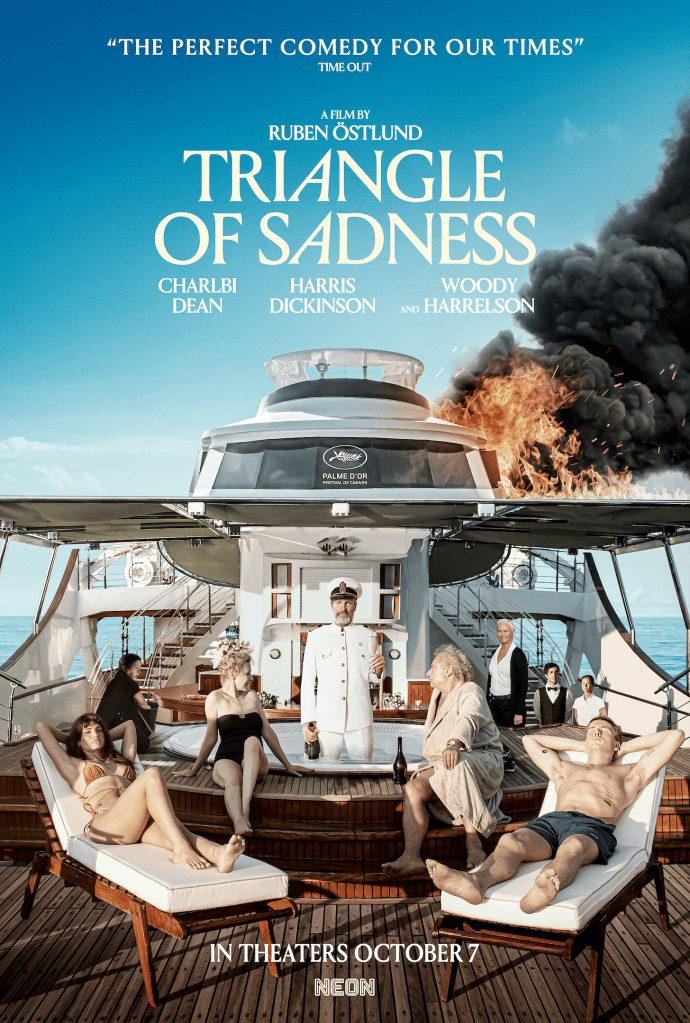
Triangle of Sadness wants you to think about hand grenades and mass starvation while you stare at some very hot people on a fancy cruise and for the most part it does it well.
Part of the immense pleasure of this movie is trying to categorize it within a family of its peers. Is it supposed to follow from a series of Serious Indie Allegories taking place on trains or highrises? In which case Snowpiercer and, er, Highrise come to mind. Mother! comes to mind only insofar as a mental gag reflex that I can’t control. Are we to compare it with previous Palm d’Or winners, like Titane? (Titane represents a clear departure from pandemic sterility: the sweaty, sloppy, sticky rejection of quarantine, a banger of a second act to Ducournau’s Raw, and takes the maximalist approach on telling diverse stories about sexual identity. Triangle is more self-reflective and immediate, even if it’s less original in its script and politics.)
Am I comparing it to other bone dry comedies, like The Dead Don’t Die‘s cricket song-inducing deadpan or the absurdity of The Lobster or Parasite‘s goofy and sometimes creepy social commentary of the rich and their hangers-on? The Favourite found fun ways of poking fun at the privileged while safely ensconcing itself in a period drama–and then ditto that to Phantom Thread, The Beguiled, and any number of indie darlings, so where does that leave us? Against all those comedies, there’s so much lost to the shared experience of quarantine and the lack of self-consciousness by the rich and powerful during two years of lean times and the stark contrast of obeying or ignoring restrictions.
Maybe the allegory most closely aligned with this social commentary on the pandemic and environmental catastrophe is a Netflix film Wife and I never actually finished, because our hairless dog insisted on “being outside” and “seeing the sky while on vacation in a tropical paradise,” called Don’t Look Up! Comparing McKay and Ostlund’s sense of humor and their execution of satirizing wealth and inaction might be interesting. The comparison shows how much McKay relies on celebrity cameos to make his jokes land, while Ostlund’s oddly sweet and certainly entirely unoriginal first act (“Yaya and Carl”) is peopled with young, beautiful upstarts. In tone and setting, Triangle of Sadness actually feels a little more akin to television like HBO’s White Lotus or Netflix’s Yellowjackets, which is really and truly Lord of the Flies with the pandemic in the rearview window. The point being, Triangle has a lot of ways in (satire of models: Neon Demon; trendy foreign satire of millennials: The Worst Person in the World), including a delightful and understated cameo for the second half of the Second Act by Woody Harrelson, without whose name, this movie probably would’ve had to labor a lot more to get coverage beyond Venice, I suspect.
The heart of the film lies in two major scenes, which don’t spoil too much of your enjoyment. The first is the real-life representation of the This is Fine meme in the form of the Captain’s Dinner, which in its entirety follows the trajectory of Yasmina Reza’s play God of Carnage, down to the projectile vomiting. If you haven’t had a chance to see Reza’s adaptation with Tony Soprano, you should pencil that into your next week’s required theater viewing. Everything about the pomp and circumstance of the dinner and the events leading up to the dinner are counterbalanced by the Tacitean grotesquerie of the events that follow. It’s a nice focal point for stakes to be built against, a pressure cooker moment that leads to unexpected questions like, who, exactly does the Captain’s character represent in a precise accounting of allegorical characters? Is he the well-meaning, politically correct liberal with his vicious rule-enforcing to the intense drinking game that follows with the Russian oligarch? Is he a should-be political figure, cowering drunk in his room, but suddenly presentable when absolutely pressed?
The second scene that the film organizes its energy around is the moment in the lifeboat in the third act in which two characters talk about their relationship. It bookends a conversation in the first act, which is all about the taboo of money and the sexual, sometimes transactional nature of financial/romantic relationships and refocuses an early conversation about the tactical positioning of sex and gender roles for the sake of social media followings, and by extension, our own parasocial relationships with cultural tastemakers online. That trite conversation, filled with platitudes, even in the desperate moment the characters find themselves, shines in the glow of Ostlund’s favored comic effect, the mundane conversation in absurd setting.
Triangle of Sadness juggles several metaphors at once, about social media, environmental catastrophe, and gender politics, while exerting a great deal of self-control not to tumble beyond some rabbit hole of artistic self-indulgence in script (Friend says, “This was all the cringe and none of the secondhand disappointment that I was looking for in Amsterdam”).


