
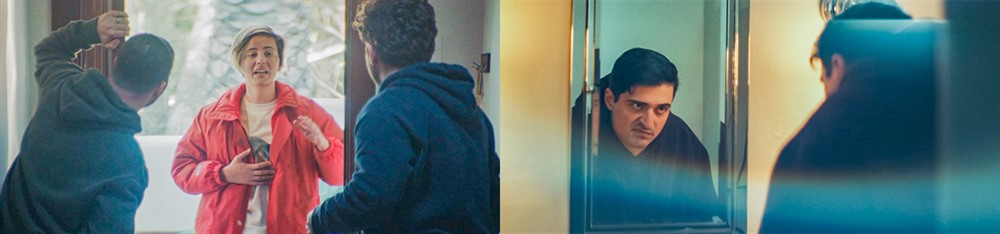
Daddy premiered as one of the spotlight films at Cinejoy this week, one of the top-billed films for the festival. It’s the brainchild of Neal Kelley and Jono Sherman, who wrote, directed, and co-starred as part of the four-man ensemble cast. Daddy imagines a world in the not-too-distant future which requires men and women to enter into retreats of indeterminate length and structure before gaining approval to have children, which is where we find our cast of characters gathered in the first act. There is no explanation for why this is the case, whether it’s overpopulation or some sort of eugenics program approved by the freedom-hating people of America. We know that the policy is widespread and relatively new, since one of our main characters has tried to have children the old-fashioned way before. But it still grates a little that so little of the conversation explains the motive force behind the entire action of the film. It doesn’t even seem like everyone participating really wants to have children, maybe just the option to have kids? If anything, it seems like a writer’s shortcut to assemble four guys who are baby-curious into a house together to muse on masculinity and the imagined values of fatherhood. It’s a neat little metaphor at first, the retreat’s aimlessness mirrors the helpless and rudderless feeling of the first few days, weeks, and months of being a father, but the longer the movie goes on, the less it fits neatly into that original premise. Paranoia sets in, in-fighting, cabin fever, which I guess are all still nice metaphors for co-parenting, but if so, it’s positing a kind of comically bleak statement about the efficacy of fathers.
Daddy’s script skews theatrical, has the stilted and philosophical qualities of Waiting for Godot, the pregnant pauses and grand statements, unfinished thoughts, every reference is ornate, classical, cerebral. In a house full of dudes, there’s nary a mention of sports teams, no pop culture at all, no movies or music or culture at all, really. And that’s the thing about Daddy: what it’s lacking is often more apparent than what it has. In an ensemble of four, it’s remarkable how similar all of our men in this satire of fatherhood are: cishet, white, bearded bros working in “resource acquisition” and “oil.” There is no talk of diversity, seldom talk of women, besides the way that they nag or miscarry, reduced to their roles as markers of maturity over male counterparts. When a new character, played by Jacqueline Toboni, finally stumbles on screen, her introduction into the mix hardly adds to the monotony. She provides no further background, and though she makes some gestures at going it alone or the distinctions between the pressures on men and women in the process of procreation, it’s brief and garbled and ultimately undermined by the form of her exit. Not a year out from the Supreme Court decision overturning Roe v Wade, a movie that imagines a world of harsh restrictions on a woman’s ability to procreate feels like it ought to have a lot to say about their personal liberties and the immensely unfair cards they are dealt before, during, and after giving birth, but most of that is missing, because the film wants to be a commentary on the bumbling, violent, hyper-masculine pissing match of four strangers in a cabin more than it wants to be a meditation on parenting.
Daddy is long in the tooth even at an hour and a half. That would be forgivable if it didn’t take itself so seriously, but there aren’t many moments when the script winks knowingly in between the sage pronouncements about the right thing to do and the reasons why one’s relationship with their father has permanently spoiled them. It feels like a bit of a hostage situation, four actors in a house who don’t know each other very well and aren’t not keen on having a good time.


