
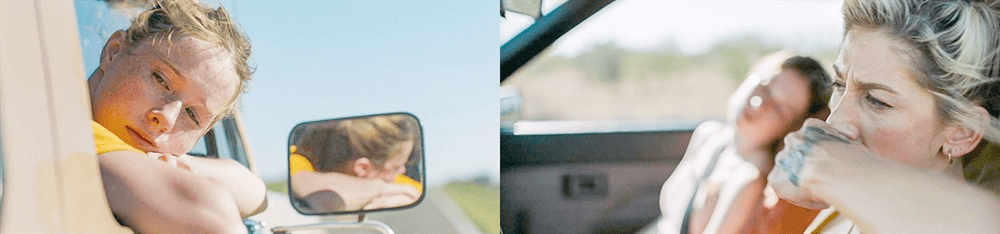
Beatriz Sanchis wrote and directed The Gigantes, which is premiering in the US at the Cinejoy film festival. Starring Samantha Smith as JJ and Andrea Sutton as Esmeralda, Gigantes tells the story of a teenage girl who hitches a ride to Baja to find her father. It’s not quite an opposites attract story and not quite a coming-of-age roadtrip, but in the distance between those genres, Sanchis finds ways to create compelling characters without fitting them into nice boxes. Sutton shines as a young teen trying to do right by the charismatic, beautiful woman she’s found in a bad place at her birthday party. Sanchis’s episodic adventure contains some deft surprises and paints complex emotional moments that resolve nicely in the third act.
Spoilers after the jump. The construction of sexuality in The Gigantes is quite skillful. JJ plays a blonde bombshell that flirts and drinks wherever she goes, but she talks openly about the ways in which her insecurities play into those behaviors. You feel the push and pull of her coping mechanisms as JJ sees the consequences of her actions have on her young ward, all the while we circle closer and closer to her final confrontation with the wayward ex-lover she’s been calling to no answer since the first scene of the movie. Messages from co-workers and friends plant the seed early of his unfaithfulness, so too does his absence at his house and her long perusal of his things. Their reunion is sexy, bittersweet, and unresolved as she recognizes her place in the life of Esmé.
Esmé development is even more cleverly constructed. Sanchis has the camera trained on her for two early scenes in which JJ is harassed by and then her own mother flirts with a man at her birthday party. The second question after “How old are you?” is “Do you have any kids,” which goes unanswered – hanging in the silence is the sudden thrusting of Esmé into JJ’s life, the surrogacy of parenting, and the slow reveal of JJ’s own complicated feelings about her mother as she grew ill and died. Esmé spends a lot of time staring at JJ herself, which at first I think can be read more generally as her appreciating the confidence of an older, pretty woman, which is why the scene at the cantina where they’re staying is so interesting. We get to see a trans character repeat almost a mirror scene of JJ at the birthday party with a transphobic patron (very much in the same vein as an early scene in The Power of the Dog, actually). The essential difference is the age of the waitress, who then ends up sitting next to Esmé for the rest of the scene once JJ goes off to flirt with the guy who’s carried them across the border and acquired a new form of transportation. “You were crushing hard!” JJ reads accurately as she drags her out of the waitress’s bedroom. “I saw the way you looked at her!” And, as if to confirm Esmé’s queerness, we get the moment when they reach JJ’s ex-boyfriend’s town, and they spend the night on the beach, an exquisite (with some resonance to an equivalent night beach scene in Moonlight) slowburn of awkward teenage puppylove, which by all rights makes this movie almost undistributable in the US beyond some film fesitvals (the intimations of possible sexuality of a minor and queer romance plot). Sanchis does this well though, leaving the camera to subtly reveal those messy feelings of infatuation, frustration, and relief. There are even some ways in which their final scene together shows the ways in which JJ knows she can use the spark of Esmé’s infatuation in order to misdirect her. “I’m not letting you come to bed smelling like that,” is the last thing she says to Esmé before taking her money, calling the cops to collect her, and leaving.
The movie does a good job in general of creating mirror scenes in the dialogue that manifest themselves later, a description that promises a visual, the giant seguaros, the horses on the dunes next to the ocean, the house where JJ’s ex lives. Similarly, the twist in the second act of Esmé revealing that her dad is not, in fact, in Baja, but has died – and later, revealed to have committed suicide – gives the film a new burst of fatalistic energy that brings it home in the final act. The entire first act feels doomed because of the ways in which it seems so impossible that these two will be able to cross a border while being sought after by police. In the second act, one there is no father to leave the kid with, JJ is suddenly caught in an impossible decision, where she’s promised that she would take care of Esmé but cannot really take on a surrogate mother role. The way in which she saves Esmé best she can in the end is messy but better than the alternative shoe-horned ending where they roll off into the sunset together. Esmé’s father’s struggle with depression and suicide is a mirror to the first scene of the film when she is self-mutilating, so the way that JJ so expertly navigates advice on how to become a young woman (mirroring the speech Esmé’s ham-fisted mother gives at her daughter’s birthday, populated with no friends of Esmé’s – “I hope you become a woman some day”).
The Gigantes is full of acheing and horniness and it does not shy away from telling difficult stories.


