
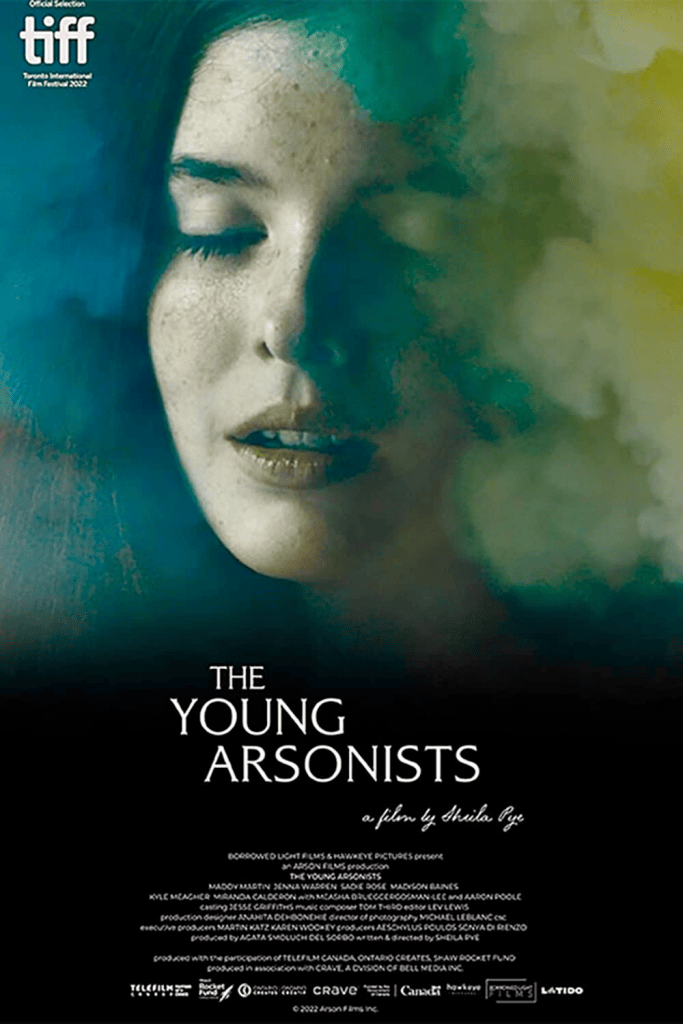
The Young Arsonists is at its best when it is haunting. Sheila Pye’s coming of age story about four girls from 1987 building a clubhouse for themselves out of the abandoned childhood home of one of the girl’s is full of tropes–girls on their periods, girls self-harming, girls dealing with suicide and abuse, girls being mean to one another, but it also contains within it two or three brilliantly original and devastating scenes that remind the viewer that it takes just a few moments of surprise to create something that stays with you like a ghost.
The Young Arsonists is told primarily through a pair of friends, Veronica (Jenna Warren) and Nicole (Maddy Martin). The construction of their characters and their relationship is taut with little moments of friction and intimacy, their stolen looks, a kiss in the darkness of Nicole’s dead brother’s room, a hand placed over a hand on the gear stick, build a picture of a fledgling queer romance, but the story is fraught with moments of cruelty, like the way that their awkward, shy friend Amber (Sadie Rose) fakes a suicide in order to scare Veronica after she’s bullied Amber into a short hair cut, or the way that no one asks Veronica about her abusive home life, left to fend for herself with creepy extended family. In many ways, the free-wheeling plot is fairly conventional for the first half of the film, but there are these two moments that I think catapult this movie into a different stratosphere but which require some spoilers.
The first such scene is part of opening of the winter sequence, after Nicole’s trusty dog, a stalwart companion in the first act, is accidentally killed by a security guard who’s out patrolling Nicole’s abandoned childhood home where the girls are squatting. There’s some intervening scenes, a moment at Veronica’s home, a moment when Nicole accuses her unemployed father of being responsible for her older brother Seamus’s death, after having very sweetly assured him earlier that he isn’t responsible (a mirror of a mirror scene from when she assures her younger brother that he isn’t being ignored by their parents because of his [unspecified and probably imagined] involvement in the accidental death of their older sibling). So, we have those moments and then we cut back to the house. Nicole is on the floor of her brother’s room, smiling, petting her dog, and we see the facsimile of her brother sitting on the bed in the background when there’s a knock at the door, and suddenly Nicole’s eyes are filled with fear. She stuffs the corpse of the dog under her bed and lies, “I must’ve accidentally pressed the lock,” before opening the door a crack to Veronica, who can smell the stench from outside the room, asking her if she would like to go for a swim.
The effortlessness of Nicole’s lie, the way in which she gets so fully immersed in her fantasy world, the absence of checks to prevent her from having the dog in her room like that, all of it illustrates such an intense measure of loneliness and pain that she’s keeping hidden from her parents and her friends.
So, when in the very next scene, Veronica stays back from the swimming hole in order to cut herself and ends up in Nicole’s room looking for her blades, we have this perfect moment where Veronica discovers the dog while looking to harm herself, and then while processing that hidden pain that her friend has been experiencing, she finds her journal, one of the narrative tools that the movie uses to let Nicole talk to her dead brother while she’s doing voice overs for the audience. We can read Nicole reflecting on that kiss between them from earlier and also expressing her fears about Veronica’s treatment at home, and lastly her reservations about spending time with Veronica. Nicole is overwhelmed with anger and she trashes the place, but the moment that makes this second scene so iconic is that when the girls return, she says with a straight face, the development corporation people did this to send a message. They’re the monsters. And she uses it to try to convince the girls to try her way of resisting: now and until the day of our death. Nicole is unwilling to participate but when she returns, the girls have stripped down to their underwear and are preparing for armed, violent resistance. They’re willing to die to protect this sanctuary, based on a lie.
The effortless with which Nicole and Veronica lie to one another, the way Veronica can grin through her promise to return with a car to take Nicole away, all of it is gut-wrenching. The Young Arsonists finds ways to touch the darkness. It’s messy, but these moments of fantasy and alienation surpass any arguments about the story’s cliches. The lack of resolution is a mark of Pye’s restraint and her skill, not weakness.
Now and until the day of our death.


