
When my friend got married this past weekend, he wasn’t excited about it. He, like me, has never understood why anyone gets married for reasons other than immigration. I think, because he holds something idealistic close to heart about marriage, which is that he wouldn’t love his partner any more or any less if they lived together without being married, that he could very happily settle down, buy a house or rent for the rest of their lives, begin the treacherous and challenging road of raising a family with all of its pitfalls and hidden traps, that they are just as likely to grow apart, just as likely to find themselves in an untenable position, just as likely to wake up one morning and decide that they no longer know one another or want to know one another, and that their abiding commitment, their, as Dan Kois has reflected, capacity for forgiveness might at some point run out at some inexcusable choice, some ill-planned or inconsiderate decision that stacks on top of a pile of innumerable foibles that were left undocumented until that moment when they’re seen in their entirety. I asked him what he wanted to do once he was married and his only request was to watch a movie with me.
He got married in the way that I most feel kinship, with just your closest family with little pomp and circumstance, the best food that you would never buy for yourself, and at some point in the near future–maybe–we’ll share some time with the newlywed couple and tell them stories about how they first appeared to us and some of us will make big pronouncements about their perfect symmetry, the ways in which they complement one another like no one else we can imagine, the way that he has reflected on more than one occasion that the sexiest thing she does is talk science at him while they’re at a conference together, how thoroughly smitten he is with the fact that she is fluent in another language, how they vacation together without any friction whatsoever which is the hallmark of true love–wasn’t it Bill Murray who said if you really like someone go, ah here it is:
Take that person and travel around the world. Buy a plane ticket for the two of you to travel all around the world, and go to places that are hard to go to and hard to get out of. And if when you come back to JFK, when you land in JFK, and you’re still in love with that person, get married at the airport.
I don’t have the emotional capacity to playact the role of dew-eyed cheerleader for this or any couple. I know that as easy as it is to fall in love that it’s difficult to stay in love and it’s impossible to make someone else feel–anything. So when I reflect on what to do or say about two people I know well who decide that they want to be together in that formal way, for whatever reasons they arrive upon, I think I’m mostly fairly unreliable, unprepared, and unarmed. What’s the secret? What’s the fuss? So what can I give two people as weird as these two in terms of advice, assurance, inspiration to live their most aspirational lives? My father’s advice was to take showers together, as often as possible (a rule I haven’t lived in years since becoming the chief bather in the family for the gremlin), and that as long as it does not cause permanent structural damage to the house, your spouse should get what they want, which I hear jangling in my head more often than I would like. But for you, you who read every and any book recommendation you’re given within a 96 hour period, you whose eternal optimism found an immovable object in David Sedaris’s preternatural grumpiness, what better to give you than an indicator? So my indicator for you in this most special of weeks is 50%. That’s the increase in the amount of happiness that the average hetero females feels in the first year of their marriage compared to 4 years before they’re married or single. Nevermind the fact that four years into their marriage they’re back to their baseline and never mind that men on balance have lower levels of satisfaction than women generally, or that their happiness actually increases by quite a bit more after four years, unlike their female counterparts. What’s important to remember is that in the next twelve months, you are going to be crazy happy. 50% more than you were about five days ago, in fact!
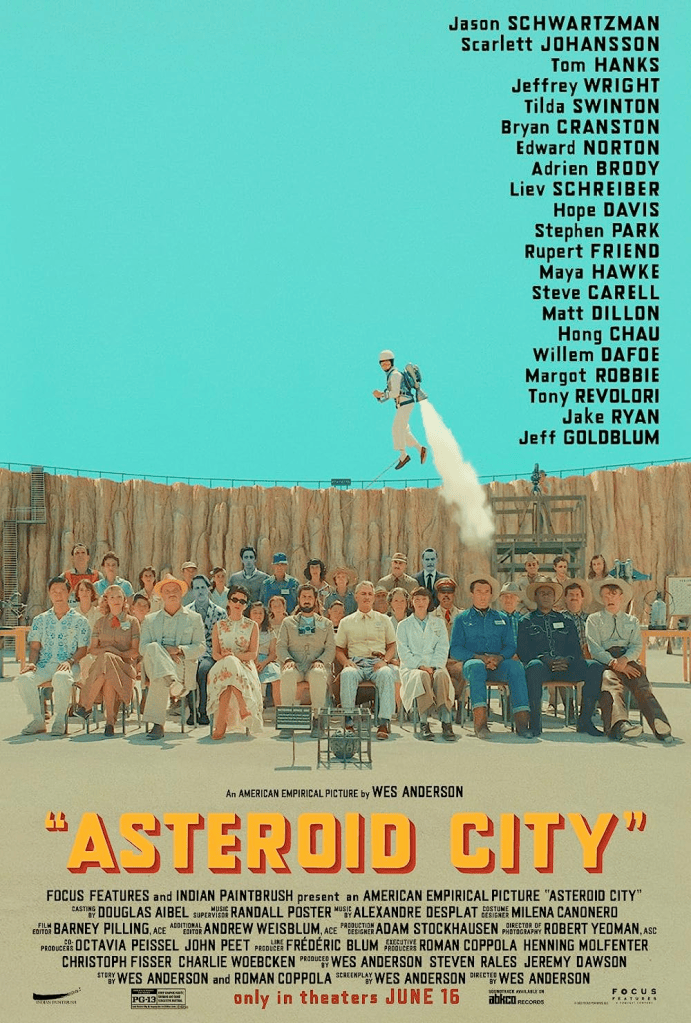
Asteroid City is a return to form for Wes Anderson. Probably the most amazing parts of the movie are the child actors who are tasked with some of the more morbid humor, the dialogue that trips over itself and elicits spontaneous laughter. The endless ensemble and cameos still dazzle, but the storylines that are the most electric are the children and teens who occupy central space. Friends who came with varying levels of acquaintance with Anderson’s style were split on what extent to which the fourth-wall breaking was satisfying or enervating, though I think that the level of formalist structure in this film is a lot more appealing than French Dispatch, for instance.
The general’s speech is a thing of beauty: an autobiographical, prose-poetry summary of his life capped by the observation, if you didn’t want to live in a world this chaotic, you shouldn’t have been right now.
Some spoiler-y questions: Does Augie fall in love too quickly? It’s only been three weeks since his wife died and only a few years of treatment for her mysterious disease. His father gives his tacit approval at the end which seems to absolve him of any guilt. If your dead wife’s dad tells you it’s good, you don’t really have to answer to anyone else, right? And if that’s not enough your dead wife by way of Margot Robbie tells you to move on and “find a replacement” while you’re taking a break in the fire escape in the final act, which feels a little too Creusa appearing to Aeneas in a dream. Midge tells Augie that they are both extraordinarily damaged people seeking one another out because they recognize their kind in the world. She says that she doesn’t feel guilt because of how badly she was treated by her father and brothers and uncles as a child, alluding there and elsewhere (“They did. They do. Like it, I mean,” confusing her adoring fan’s question about who had beaten her) to domestic violence. That sticks with me, but also it makes me wonder to what extend the romance of Asteroid City is tainted and a little melancholy. Among adults there are so few pure erotic relationships. Parents attend without their spouses. I don’t think we even see a married couple from start to finish in the play part of the movie itself, and when you start zooming out to the second and third layers of the Our Town-type structure of the story, the director played by Adrian Brody is in a rocky relationship with his soon-to-be ex-wife, Polly Green, played by Hong Chau. The writer played by Ed Norton is in a kind of tragic tryst with one of his former actors. So, what are we to do with the Augie, so quick to fall in love again, and so loathe to tell his children about their mother’s death?
Another question: is the gay subplot of the actor playing Augie and the fictionalized playwright Conrad Earp so compelling? It doesn’t really go anywhere and it doesn’t really come from anywhere? So so much of the rest of this movie is decidedly hetero, which is the price of admission for a Wes Anderson movie, but it doesn’t actually feel that gay? To paraphrase writer and star of Fire Island Joel Kim Booster’s observation about gay romances, it feels a little like they took a hetro love story and replaced the lady with another dude, only here there’s some sense that the gay kiss is supposed to feel like a twee twist. I’m sort of painting Anderson in a corner here, because he either gets criticism for putting it in or criticism for not, but I feel like there’s a third way where he doesn’t do it so shittily and we all are impressed and happy that there was something explicitly gay in what is probably the gayest straight directorial aesthetics currently working today.


