
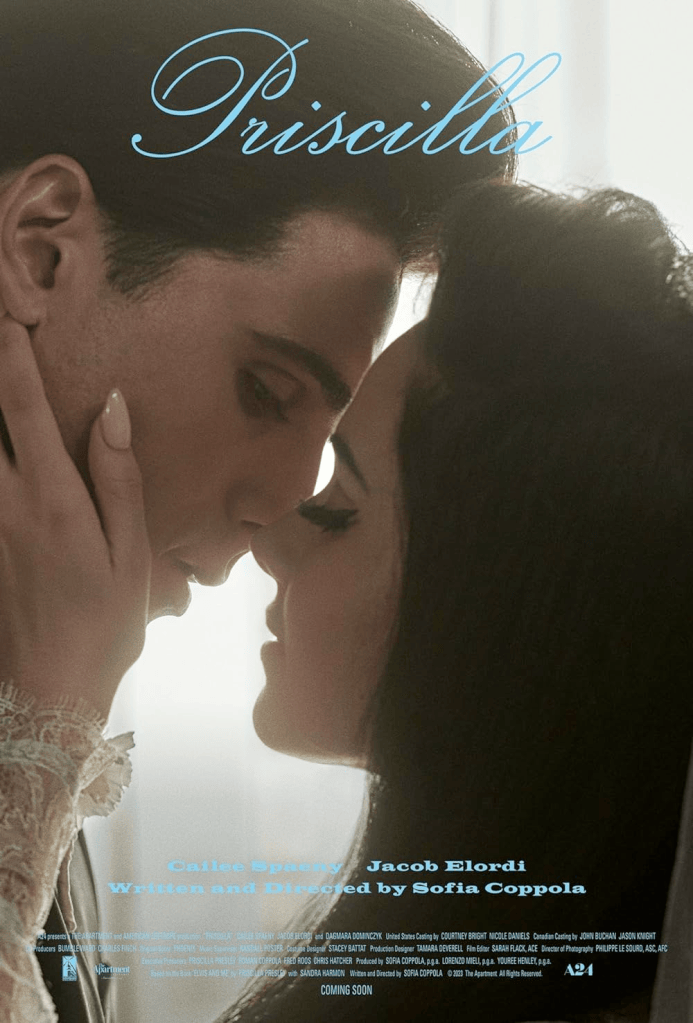
Sofia Coppola’s Priscilla is subversively and gloriously unsexy for a story about the meetcute between Elvis Presley and Priscilla Beaulieu and their catastrophic marriage. Lots has been written about the fact that the wonderfully unsettling Jacob Elordi (of Euphoria fame) and his pound of bacon a day habit and Sam Adam’s wonderful side-by-side of the last sixty years of Elvis movies, so I’ll write briefly only to talk a little bit about expectations.
I come to all of this a novice in Elvis and Sofia Coppola. I’d seen bits and pieces of the Baz Luhrmann film while visiting my in laws last year. My MIL has taken up watching movies as a form of meditation in her early years of retirement and will fully finish two or three in a single day. She’s a beast and I idolize her except for the fact that she has literally 0% recall when it comes to any details about these movies after she’s finished beyond “Yes, I saw that,” which makes me continually grateful for the space to reflect here. And in terms of SC, I ran through the list half an hour before our showtime with Friends and noticed that I had really only ever seen The Beguiled, which was one of my favorite movies long ago and far away for the year (before?) we started this blog.
I had kind of assumed that the fact that Elvis had met his eventual wife when she was 14 and he was 24 required a lot of tasteful editing and massaging of facts in order to make him not a creep, that inevitably a clear-eyed review of the story would require a lot of underage sex with Elvis, but quite the contrary! Which I think is what took me for such a loop. The opening act of Priscilla flirts with two contradictory aspects of her life when she meets Elvis: her youth and more specifically the kind of isolation and alienation that comes from being a young teenager completely cut off from your friends and any kind of social net on the one hand and on the other the unvarnished thrill of first love, the attention, nervousness, longing, and ache that comes from desire imprinting itself for the first time.
In some ways, Priscilla seems like a spiritual rebirth of a film like Palo Alto (2013) without all the behind the scenes baggage, or a smarter, more fun Licorice Pizza, or if you’re really just looking for a spiritual sibling, maybe something like Flower starring Zoey Deutsch, Adam Scot, and Kathryn Hahn (2017). Cailee Spaeny does such a wonderful job of playing up the nervousness and bald-faced bravado of a teenager discovering an older and much more powerful man’s interest and making decisions on the fly to maintain his interest, disguised as affection. Elvis comes off as a strange combination of playboy and tender, diffident moon-eyed lover. He calls her “little one” and tells her casually that it’s either “me or a career,” tells her how to wear her hair and what colors to wear, jarring moments of control that Priscilla takes in stride, blinded by the intoxicating (but brief) moments of physicality they share.
There are early indications of the kind of toxic relationship they’re to share with one another, and Coppola takes pains to play these moments neutrally, making them at once erotic and unnerving: the casual way he offers her stimulants to stay awake in class after their late night dates, the thoughtlessness with which he leaves fan letters around his room, his skittishness around having her accompany him on shoots but also in public just about anywhere. Priscilla exchanges one form of isolation for another, indulges in the fantasy of being a kept woman, someone’s secret much in the same vein as Don Draper’s short-lived dalliance with Sylvia in season six.
But missing from their relationship is the erotic payoff that Priscilla craves. At first it comes off as pseudo-chivalry on the part of Elvis, maybe a way of teasing his problematic control kink later, but as the second act arrives, it becomes increasingly clear that Elvis has no intentions of doing much of anything with Priscilla besides confiding in her on the phone while he’s jetsetting the country, canoodling with Nancy Sinatra and the rest of his costars. The scene that would probably most seriously redeem him in the eyes of a young Priscilla is his eventual weakening of resolve which results almost immediately in the birth of their first child, but that scene is completely elided in this film.
Coppola is not interested in their sexual relationship, which appears to have been frustrated and sparse, riddled with long periods of dry patches related to mental illness and drug abuse, but also his easy access to more mature (legal) women on his tours and a complete lack of accountability on his part from any of his friends or family. Elvis is mercurial, peevish, but also shy, indecisive, and childish, a man unused to being told no, annoyed when he does not get his way. This is the crack in the door that helps me to understand this story as part of a larger commentary on the dating prospects (perceived or real) for young women in America today, the sense of disconnect from peers, the expectations of discretion and complete availability, the lack of emotional development in their male counterparts, the hunger for female connection, familial warmth, and its alarming absence. In that sense, Priscilla feels surprisingly appealing to generation Z, who by all measures appears to be less interested in sex in life and pop culture than their generational peers, with the occasional exception for the dissociative pout. Probably the most spicy scene in Priscilla is actually one that feels surprisingly modern: a private photo shoot between the two using a Polaroid while they play with costumes, an endless cycle of risque outfits she’s assembled, presumably to pique his interest. It’s a moment of mediated eroticism that feels very much at home for a generation that so often flirts through the exchange of photographs at a distance, either by choice or by government edict (quarantine).
Priscilla checks all of the boxes of a strained and doomed romance. In terms of historical dramas, it hits at just the right place for this moment, like Kristen Stewart’s performance in Spencer which came out three years to the day as I write. It’s not sexy, and that’s the point.


