
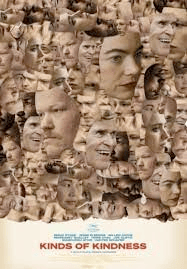
I’ve had a couple weeks to be able to process this movie since it first came out. It is Yorgos Lanthimos’s very, very quick follow up to Poor Things with a lot of returning actors (Willem Dafoe and Margaret Qualley), including Emily Stone, fresh off of her Best Actor Oscar. The film is organized as a triptych (three part story) anthology using the same set of actors, shuffling their roles and relationships in each successive story, much like American Horror Story I’m led to believe? Overall, the film reminds me a lot of a Spanish-language film from a few years ago called Wild Tales (2014) and Roald Dahl’s creepypasta short stories, like Man from the South. More on the structural symmetry of the movie and how it can help you to appreciate the script more in a moment, but it’s connected to understanding the way that the dialogue develops over time in the movie.
Something distinctive about Kinds of Kindness is the way in which the dialogue is stiff, stilted, stylized, descriptive, repetitive, and deadpan, a bit of a cross between the tripping-over-itself fast-talking humor of Oscar Wilde’s Importance of Being Earnest and a mumblecore tongue-in-cheek Wes Anderson movie. Awkward phrases are borrowed and adopted by other characters (“nine minutes,” “chocolate cake,” “awkward for all of us,” etc). The full effect reminds me of a concept in poetry from Richard Hugo called the “triggering town,” the way in which a poet can find herself mired in a single concept or place and then moves from that initial “station” to a new place by hitching their engine to a new image or metaphor. The script of Kinds of Kindness lacks movement but not in a way that leaves the story floundering, more like it’s laying in wait for the big turn. Which leads me to the other tool for thinking about the way to read Kinds’s triptych structure.
There’s this formula that Christopher Priest outlines for every magic trick in his book The Prestige: 1) the gambit, 2) the turn, and 3) the prestige. In the first part, the audience sees the magician offer a game (think the ball and cups routine), and the turn is the trick that we all come to expect (the ball isn’t in the cup that it clearly should be in, or the number of balls changes), and the prestige is the dazzling conclusion (the balls are FIRE, etc., etc.).
In each successive act, the audience is primed with specific expectations about the pacing and tonal shift. I think that Kinds of Kindness’s stories (Death to RMF, RMF is Flying, and RMF Eats a Sandwich) all follow a similar pattern. With spoilers in mind, take the second act: man is coping with the sudden disappearance of his wife (set up), she returns, clearly having experienced some trauma unspoken, BUT husband doesn’t believe it’s actually her (turn, see also the sex tape revelation), and the wife in the doorway (prestige!). The stories revel in their prestiges: think of the (spoilers) extended dance sequence in Act Three and the dog photos in the end credits of Act Two. Because each act borrows its characters from the story before, the stories build up, there’s this psychic and lexical accretion that limns the script over time. The third act is the most pregnant, most resonant, echoey in its dialogue, themes, and mirror scenes: the way that a character asks if someone is listening at the door, when in a previous act he is precisely the one doing so, the proliferation of dreamtalk, slaps to the face, the looming spectre of motherhood or the struggle with pregnancy.
Kinds of Kindness probably would pay off from a second viewing just to see the ways in which the first two acts are developed by the third, and there’s a few sight gags in the credits of the second act that are worth the price of admission, but ultimately, I think these stories fit really nicely into something neo-Gothic horror stories. The Shirley Jackson fans among us will surely swoon. One Babadook split over three acts.


