
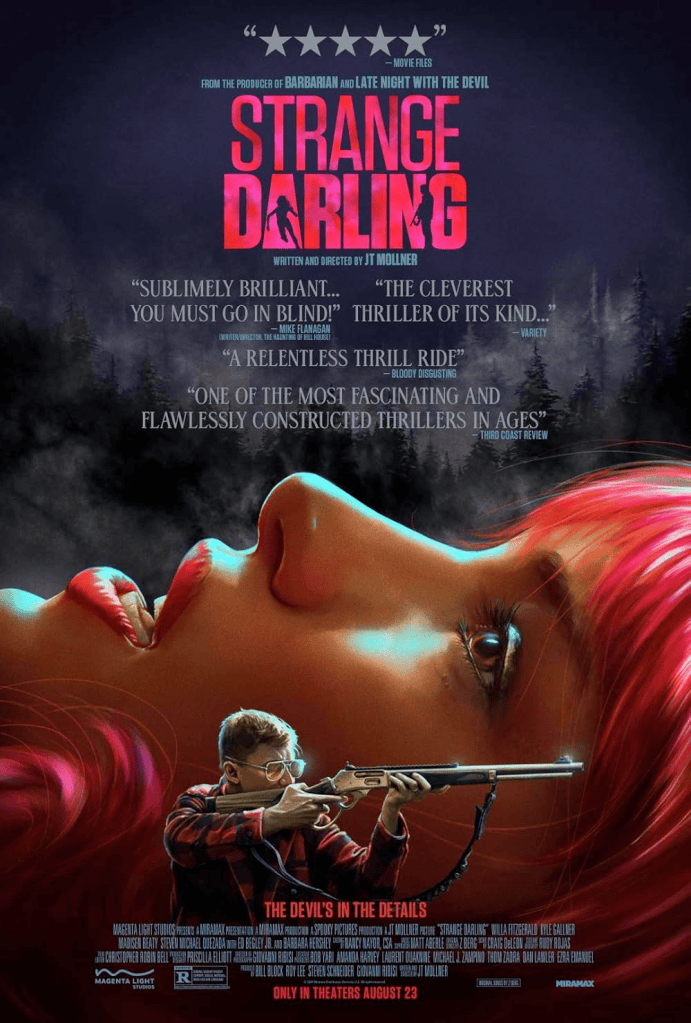
Strange Darling was a startlingly entertaining romp in the mountains. The experience of seeing this film was thirty minutes of stifling giggling at the pretentious the chapter cards and staring blankly at some intense late-movie trauma happening to barely established characters and then Friend turned to me and posits a truly insane proposition which comes true followed by about forty-five minutes of leaning as far into the screen as possible because I couldn’t take my eyes away.
SD is deeply indebted to and drawing from–almost parodizing–the Pulp Fiction/Quentin Tarantino structure, down to the retro 35mm film, the retro typeface, the achronological storytelling organized by chapter cards, bearing a significant line or joke from the scene. At first, this structure seems a little silly in its structuralism, but after the first two acts allow for the slow build up and the solving of our first puzzles in the movie, Darling turns into a slow burn, the erotic in “erotic horror” genre billing.
Darling, without saying too much about its plot, is the Cascadian Gone Girl, a hall of mirrors filled with twists and turns to misdirect the audience and reward the Easter egg hunters. You have to give it up to a movie that has so thoroughly insulated itself from criticism of female objectification and yet still gives the audience permission to unproblematically root for the killer, or without guilt cheer on a man hunting a young woman through the mountains. Torture and all manner of nastiness suddenly seems fair game in a way that makes the film feel edgy but also impish and sly.
The craziest part of this movie is a cooking sequence toward the end in which the movie devotes an inordinate amount of time on Ed Begley Jr making quite possibly the most sumptuous breakfast ever: an entire stick of butter along with bacon and eggs and then another stick of butter to make pancakes that are used to sandwich the aforementioned proteins before adding whipped cream and jam and syrup and I’m sure I’m leaving out a stick of butter somewhere.
Friend suggests there’s a way for us to start the story out of order while also giving us more of an emotional foundation for watching these characters (Friend also arrived after the first title sequence but I don’t really know if that would’ve assisted). Neither of us care much for the epilogue. Otherwise this little darling is an interesting love letter to Tarantino and The Love Witch aficionados.


