
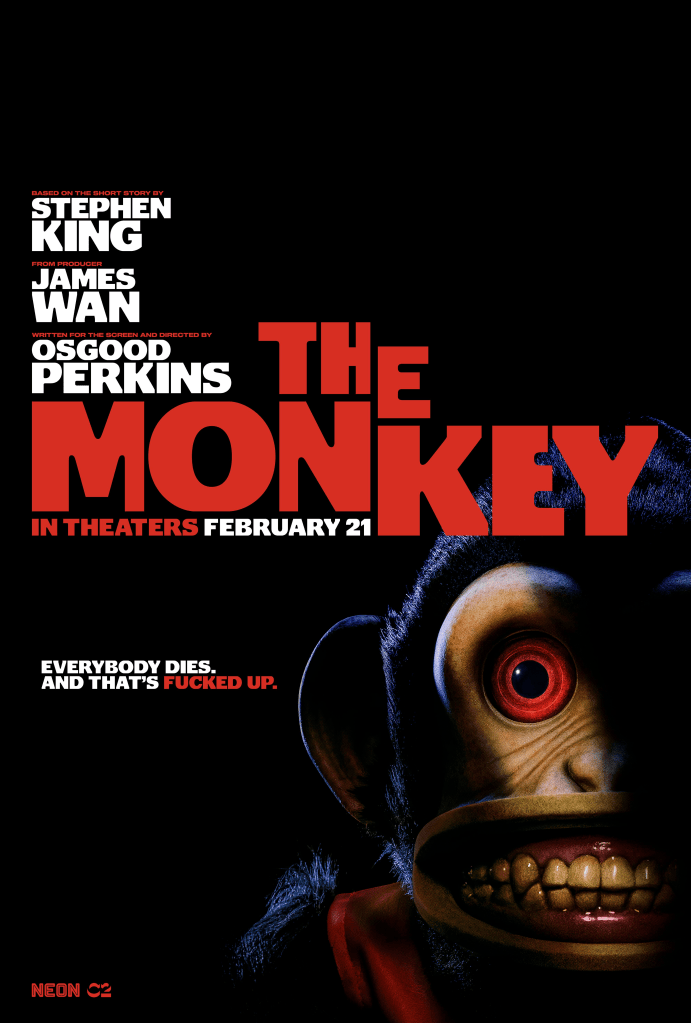
Osgood Perkins has garnered so much goodwill by creating Longlegs, Neon’s most successful film of all time, and its followup was eagerly anticipated for a variety reasons, not least of which the ad campaign for this movie consisted almost entirely of notes they received from rating advisors who basically gave them a laundry list of edits required to prevent the film from receiving an NC-17 rating which could potentially doom the financial success of the movie. Perkins talking about the ways he forged personal connections with the script and plot feels like the way in for anyone who wants to fall in love the director–in which he was able to convince Stephen King that his second pass over the script to make it more lighthearted or the ways in which he connected his autobiography of having endured the death of two parents in exceedingly strange circumstances (his father from AIDS and his mother who was on one of the hijacked 9/11 flights) led to his spiritual connection with the simple premise of the film, which is that an evil monkey kills people in absurd, almost cartoonishly Rube Goldbergian ways.
The Monkey has no platitudes about death and its purpose in our lives. It is purposefully skeptical of a higher power, even as it espouses many infernal ones, and buries a simple seed of joyful nonchalance in the face of evil as only a nihilist can. I ended up seeing an early showing of this movie before the wide release with Friend about two weeks before the birth of his first child, and the discourse on parenting and fatherhood felt portentous. I’m still not really convinced that The Monkey has anything to say about what it means to be a father: there’s some posturing at explaining how absenteeism is a bit of a fakeout for a more supernatural explanation for emotional distance, but for the most part, it feels like the film has found a way to give Theo James his flowers by giving him twice as many lines as an actor usually gets in a film, and at best it might describe the way that we grow apart as siblings when disaster strikes.
When I mentioned that I was seeing this movie to Bestie, she asked if it was the monkey from Toy Story 3, which reminded me that Stephen King’s monkey is in fact THE ONE AND THE SAME MONKEY, which led to us watching basically every Toy Story movie in order with the minion over the course of two weekends, and this scene continues to be among the absolute best, along with the Fluffle Truffle? the Fluff Tackle? Whatever those two carnival prizes do in TS4 that made Bestie laugh each time. The Monkey is the spiritual successor to films like Cabin in the Woods, as Friend noted when we debriefed afterwards and it charts a course for camp horror as path forward for the genre, a kind of rejection of the self-serious Ari Aster approach.


