
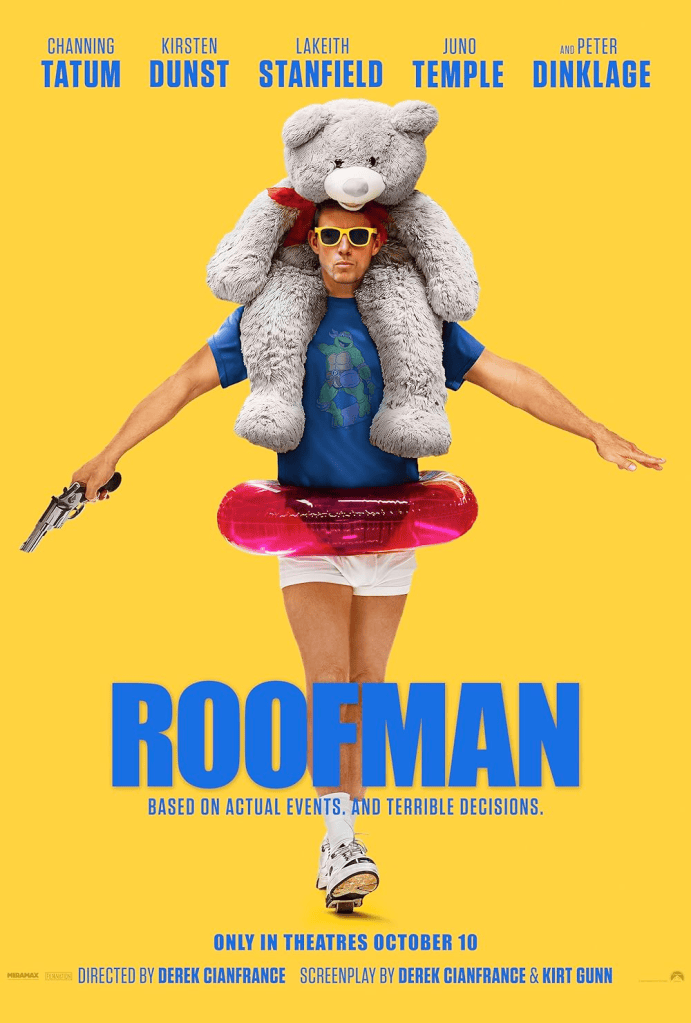
Roofman works as a dramatized “based on a true story” biopic because of the strength and charisma of its leading man and its stacked cast of heavyweights and new upstarts. Fully our jaws dropped to the floor when none other than Ben Mendelsohn stars as the random church leader in the little town where the Roofman chooses to re-establish himself. The talented and subtle Lily Collias from Good One finds herself in a bit role as “Sister #2” and that’s before even talking about Peter Dinklage making his umpteenth appearance in a film this year, Lakeith Stanfield and a much underused Juno Temple mostly around for the odd joke or deus ex machina here or there, and Kirsten Dunst playing the straightman at all times.
The real problem with a Man in Small Space plot is that your man in a small space doesn’t get a lot of time to reflect out loud about his motives and anxieties. It’s why so often Man in Small Space is on the phone, as in Locke with Tom Hardy (2013) or Phone Booth with Colin Farrell (2002), or worse yet they’re perpetually flashbacks, which I assume is what Deadpool did in Buried (2010)–all of these culminate into a 2025 horror film that seems interested in poking fun at some of these tropes called Buried Alive, but who knows.
Anyway, the shenanigans at Toys R Us are mostly quite fun and watching Channing Tatum crawl through air ducts and steal candy while dodging cameras is basically what we wall signed up for, but there’s also some space for some millennial nostalgia and the odd pop cultural reference here or there. For the most part, the charm of Roofman is the way in which the movie does not tag, editorialize, or focalize his self-destructive tendencies: the way that he eventually replaces his previous family with a new one, the way that he disregards repeated insistence that he not go overboard with gifts or presents, the way that he cannot help himself from pursuing a desirable life through unsustainable means. The movie does try to make him into a sort of Robin Hood type character, stealing from wealthy corporations and giving to… himself, which feels a little like a broken version of a story that wasn’t based on a true story but did the same trope a lot better, Hell or High Water.


