
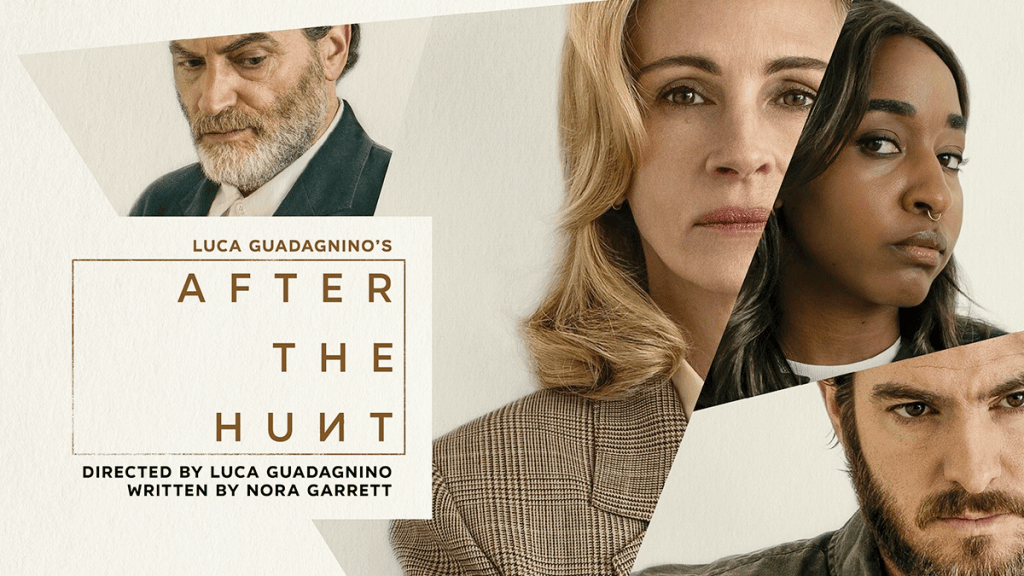
After the Hunt was a movie I resisted every time I saw the trailer, because it represented for me a genre of movie that is absolutely anathema to the things I enjoy: meditations on cancel culture, the hypebeasting of sleepy collegiate English departments, and he-said-she-said plotlines. The 2021 Netflix limited series starring Sandra Oh and Jay Duplass typifies all of the things about this obviously recycled plot that feel tired, faux edgelord, and devoid of any artistic merit.
The “controversy” underlying the cancellation of an overly sympathetic professor played by Jay Duplass is a fundamental misunderstanding of the way that liberal-leaning students actually behave in elite universities. Although, The Harvard Plan podcast does make some gestures toward the way in which admin at elite universities (on which Pembroke is modeled in the show) have been weirdly apolitical in their gormless and narrow-minded censorship of politically active teachers on both sides of the political spectrum.
More often than not, as Harvard historian Jill Lepore has written (in 2017 following the publication of her book These Truths, but also more recently this year in her timely reflection on these same themes), the levers of censorship through the establishment of “safe spaces” is much more often used and abused by conservative student activists on campus and conservative lawmakers, very often educated at the very elite institutions that they now deride.
Which is all to say that this is a genre of movie that I am pretty skeptical of, and that being said it was one of my favorite movies of the year. Politics aside, After the Hunt is a dizzying story in which every scene is left uneditorialized, ambiguous, quantum-like in its interpretation, and successive scenes reshape and re-interpret the motives and decision-making of each previous moment. The ability for a movie to maintain this level of ambiguity for the entirety of its story is really something to appreciate despite the utter catastrophe of its critical reception and box office performance. Spoilers ahead.
Some of my favorite decisions have to do with the shots that linger on a character well beyond the normal time one would allot to a gesture, which I can imagine might be ponderous to someone coming in to resolve any and all of the issues I’ve cited above. But for me, the character study of the ensemble is electrified by the oftentimes wordless expressions they make at one another in the course of the film. Take the opening scene at the dinner party at Alma (Julia Roberts) and Frederick’s house: Eric Kline, playing Alma’s husband, faux-startles at the use of the word “bullshit” by one of the young grad students who thinks he’s a hotshot railing against the politically correctness of academia by questioning the credentials of Alma, as it is slowly revealed that she and Hank (Andrew Garfield) are both up for tenure. Kline’s wink is stretched out for so much longer than one would normally do so as a gesture of cat-like intimacy and playfulness. We’ll learn later than he has been starved for affection from his wife, yet he patiently waits for her to rekindle to their marriage while he keeps lighthouse in her emotional absence. This moment of intimate playfulness is actually a much-longed for oasis that he has been craving, but it may also be a mirage.
In that same scene, Eyo Edibiri’s Margaret, whom we know from the trailer will claim some kind of sexual indiscretion on the part of Hank, engages in an accidental, awkward kiss with Frederick as they’re saying boozy goodbyes, but no one else witnesses their messy moment, because at the same time Hank plants a kiss squarely on the lips of Alma in front of the remaining guests, intentionally and intimately. These two gestures juxtaposed against one another pose a challenge: what is the nature of Hank’s relationship with Alma? Why are they so comfortable? What is the nature of Alma’s marriage? Are we being too sensitive in the way everyone says goodbye? Why are we spending so much on the conclusion of the party itself, where no politics are discussed?
Julia Roberts appears in almost every scene of the movie and yet so much of her performance is about masking her emotions, about her reserved nature, what her husband describes in a particularly exemplary scene as “unfeeling”. Which makes moments when Alma does emote all the more thrilling, as in the next scene, when she and Hank meet for spontaneous drinks and Alma breaks out into laughter in response to something Hank says and utters a self-deprecating phrase like “nobody panic” in such a comfortable and disarming way that indicates how safe she feels with being herself in Hank’s company. The long smile from Andrew Garfield’s Hank in the bar while she’s speaking fast mirrors the kind of intimate wink we get from Frederick in the party and places narrative weight to the visual of his bemusement when a different director might more simply keep the camera on the person speaking. In that scene, Alma off-handedly reveals to the audience she has the phone number of a student which seems like an unusual admission to make but Hank acts like this is pretty normal or at least unremarkable. But one of the most striking and interesting choices in this scene is the slow way that they leave the bar but the camera remains trained on the location even after their exit. Guadagnino’s patience with silence, expressions, and the continuous shot makes for serendipitous moments of insight into characters and relationships, as in the next scene when we see how Alma deals with her husband after deciding to blow off dinner to hang out with Hank.
Alma (Latin for “nurturer”) asks her husband about work and he rattles off a series of off-color observations about his patients that would verge on unprofessional if not given in confidence of a marriage, e.g. I have a “teenager who hates me”. The scene is an excellent example of how a scene in After the Hunt can mean itself and its opposite. After coming home late and intentionally missing dinner plans that they made at home earlier that day to spend time drinking with Hank, Alma asks her husband if she seems cold and reserved, and he responds by saying no, you’re not cold reserved–or unfeeling, offering up another description of her that she has not proposed herself, which litotically suggests he may, in fact, think her all of those things at times. This sort of reversal of a previous scene or the backwards logic of dialogue happens throughout the movie, e.g. the way that Alma admits that she was challenging Margaret in the first scene even though she doesn’t cop to it until later.
Little things like the way that Hank mimes feeling stupid once he’s been accused by sticking out his tongue and moaning as if he’s developmentally delayed is such an off color expression, politically incorrect and perfectly intimate as a way to express frustration to someone who won’t misinterpret what he’s doing. Or the way that the University Dean lets his hair down in the meeting with Alma after appearing like some stentorian admin concerned with the public fallout of a high profile professor receiving a complaint from a student of a sexual nature, the toggling of his politically correct inquiry to his pouring of a drink during work–even how he pours Alma a drink, someone who seems increasingly unable to take care of herself, who shouldn’t be drinking at all (see the way her husband dutifully leaves an aspirin at her beside every morning after she’s had one too many). Alma is weak-willed, enabled, selfish, but she’s also loyal and shrewd.
There’s this little gesture that Alma does to Hank that’s so subtle but so indicative of their intimacy, the way that they so awkwardly perform professionalism while also interacting intimately as only clandestine lovers seen in public can, as when Hank confronts Alma for not sticking up for him in her meeting with the Dean in the previous scene. He’s shouting at her about how he’s been fired without review and making a scene in the hall of the department building while students record him. Hank knows that she hasn’t told the Dean his crazy theory about Margaret’s plagiarism as the motive for her disciplinary complaint and she shoves him away from the students by his shoulders, this physical act of frustration that one can only do if they know the other person is not going to resist. At the end of that scene Alma goes to seemingly check on Margaret who’s made eye contact with Hank, but by the time she gets there, Margaret is gone, and then when she looks for Hank, he has disappeared as well, and it’s unclear who she’s going to run to in that moment because she’s playing everything so close to her chest, saying the right thing to everyone she encounters, telling them what they want to hear.
“Why would I trust a therapist who violates her patient’s privacy?” Alma asks after she’s received what seems like crucial information to understand the complaint made against her friend Hank. Her work colleague seems like she’s breaching her professional code in order to extend an olive branch to Alma, but Alma only reads it as a dangerous character flaw, a self-destructive critique that alienates someone who appears simultaneously interested in the issue as a bit of office gossip but also as it might endanger Alma’s own prospects at tenure. This whole conversation? Happening over drinks in a bar. There’s this phrase that one of the characters uses that indicates how intricately composed a statement of polysemy can be in this movie: “I almost feel bad for him,” which one could diagram for awhile. A phrase which expresses both sympathy but also a distancing of oneself from that feeling of sympathy.
In one of the few scenes that does not feature Alma, we get the same sense of that unstable emotional reception of the events as they unfold. Margaret’s genderfluid partner consoles her for apologizing about congratulating her for support she’s receiving for her ambiguous assault and then kisses her kind of erotically.
Alma’s reaction to finding her secret trove of photos out of place is to instantly burn all evidence is such an interesting element to her character: someone who would sooner destroy everything that brings her joy rather than have any weak link in her armor. There’s a moment in the final act when Alma confronts Margaret in a blistering monologue which is masterfully composed to heighten ambiguity and reveal Alma’s mindset, which is so often occluded. In the capstone to her critique of Margaret’s privilege, she throws in “You probably lied about Hank too,” as if the rest of the monologue is not about it at all, as if she could hold those opinions about Margaret and still accept that maybe Hank did hurt her, which makes the criticisms even more damning.
The way the storytelling holds off on Hank’s appearance for fully like an hour so that he can return after so much antimony between the two women is disciplined and exciting. Instead of ping-ponging back and forth between he and she, we linger on Alma and Margaret for the second act. In that moment of Hank’s reintroduction, the way that Alma hands him his jeans belies the intimacy between them (he can fall asleep in her second apartment without his pants on) but also his rejection of a tacit offer. The slow way that Alma wakes up in the wharf apartment, the camera angle tilted in the wrong direction, over the covers, is typical of the continuous shots that Guadagnino relies on in ATH to create serendipitous moments.
One final moment in the epilogue that stayed with me is the intimate and aggressive phrase that Margaret uses when she’s showing off photos of her fiancée to Alma, where normally one would reservedly hold the phone and control which photos and for how long someone could scroll through your album, Margaret seems intent on showcasing her prize, flaunting it for her previous mentor and the object of her possible desire. It reminds me of that quote from the erstwhile canceled Bill Murray: “You can tell how boring someone is by the lack of fear in their eyes when someone is flipping through photos their phones.”


