
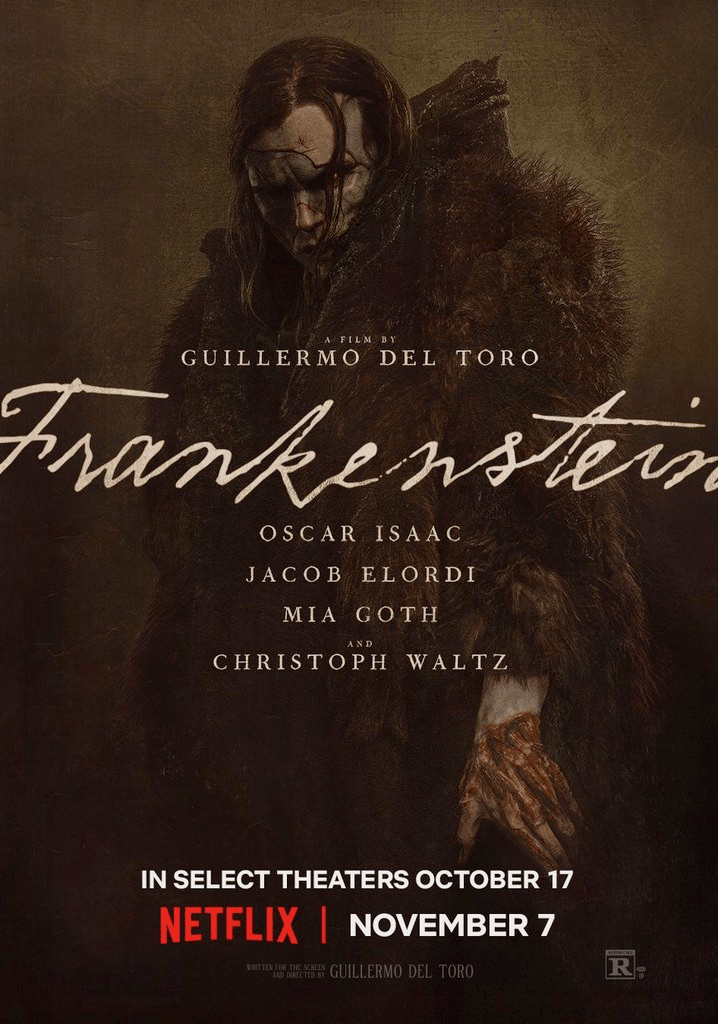
From this past year’s horror trends, I may have had my wires crossed about this adaptation of Mary Shelley’s Frankenstein, helmed by Guillermo del Toro and staring Oscar Isaac, Jacob Elordi, and Mia Goth. At some point it seemed clear to me in the course of the press tour for this movie that Elordi and Isaac were going to kiss, which is the big draw. Jeanette Winterson’s time-hopping meditation on AI is the gold standard for literary re-interpretations of the story and peak queer, but until someone decides to adapt Winterson to film, we are left with squeezing juice out of whatever rocks we can find.
I went to a packed showing of this movie (free tickets) directly before release and a few things were clear from the energy in the theater. One is that the film contains within it the necessary self-awareness for a campy viewing. The way that Victor responds when completely broadsided by a short-notice request from his financier on the night of his monster’s animation is so matter-of-fact and aggravated that the entire audience laughed. There are a couple of other places where it’s clear that del Toro is in on the joke when he serves up Isaac as eye candy for his thirsty fans: his naked bathtub discovery, the two or three instances in charged eye contact between the doctor and his creation.
Some of the most intriguing elements of the movie, besides the send-ups for Poe Dameron and company, are the way in which Oscar transforms himself for the romance subplot in the first act: the confessional scene is playful and elicits some of the first bits of levity for the story and the audience; the game that Victor plays with his sister-in-law in which he guesses her books is such a nerdy meetcute but also the first of many perfect touches for the romancing of a stand-in for Mary Shelley herself. Goth is set up to play a dual (maybe even triple role) as girlfriend and caged female genius in this movie, which breathes life into her performance in a way that must be an improvement on the original source text. “Now we share something in common, a prisoner,” is such a devastating line spoken in pure joy and conspiracy only to boomerang back in the final act. Even something as normie as ballroom dancing becomes natural and even necessary as an activity when Elizabeth and Victor are flirting. Somehow Victor’s repulsion for polite society is turned into an unconventional giddiness at their ability to use his brother’s engagement as (an almost Shakespearean) cover for their own romance.
Del Toro’s Frankenstein can be compared nicely with another contemporary adaptation being promoted for the first quarter of next year, Maggie Gyllenhaal directorian debut with Bride! (not to be confused with Bridesmaids or Bridezilla). That version of the movie appears to take as its inspiration Fritz Lang’s Metropolis aesthetic and place the creations into the Roaring Twenties complete with bobs and tommy guns.
In the promotions for Bride!, the violence of Frankenstein’s monster is front and center, as is his relationship with the manic pixie nightmare girl played by Jessie Buckley. In del Toro’s film, the earlier 19th c. period aesthetic makes for a safer fit with del Toro’s gothic horror aesthetic. I am sure that a lot of the hostile reviews of this movie have to do with the way that the movie feels like a copypasta of some of the greatest hits of Guillermo’s creepy horror vibe without any of the original storytelling, as in Crimson Peak or Pan’s Labyrinth. Add to that, the action sequences which seem to be the reason for the R-rating, are mostly pretty limp and restrained, not innovative in the way that other violent sequences have been from del Toro in the past. Whether the monster is swatting away men, as in the trailer’s often repeated ship attack in the weeks leading up to wide cinematic release, or the animal fights, the fight sequences are mostly uninspired CGI mess.
What makes the Elizabeth-Victor romance so enticing is the way that she seems to excel in her ability to find beauty in the gruesome: Victor apologizes when she comes to visit his lab and she only marvels at the work he’s been able to do, even gives him an insight he uses later to make an advance. Later, we get to see the way in which their tangled feelings of family, fatherhood, and “attraction” as Victor puts it, prevent them from being able to be kind or understanding toward one another.
In some ways, del Toro’s portrayal of the monster’s immortality as curse reminds me of a more contemporary author’s work, VE Schwab’s sequel to Vicious, Vengeful:
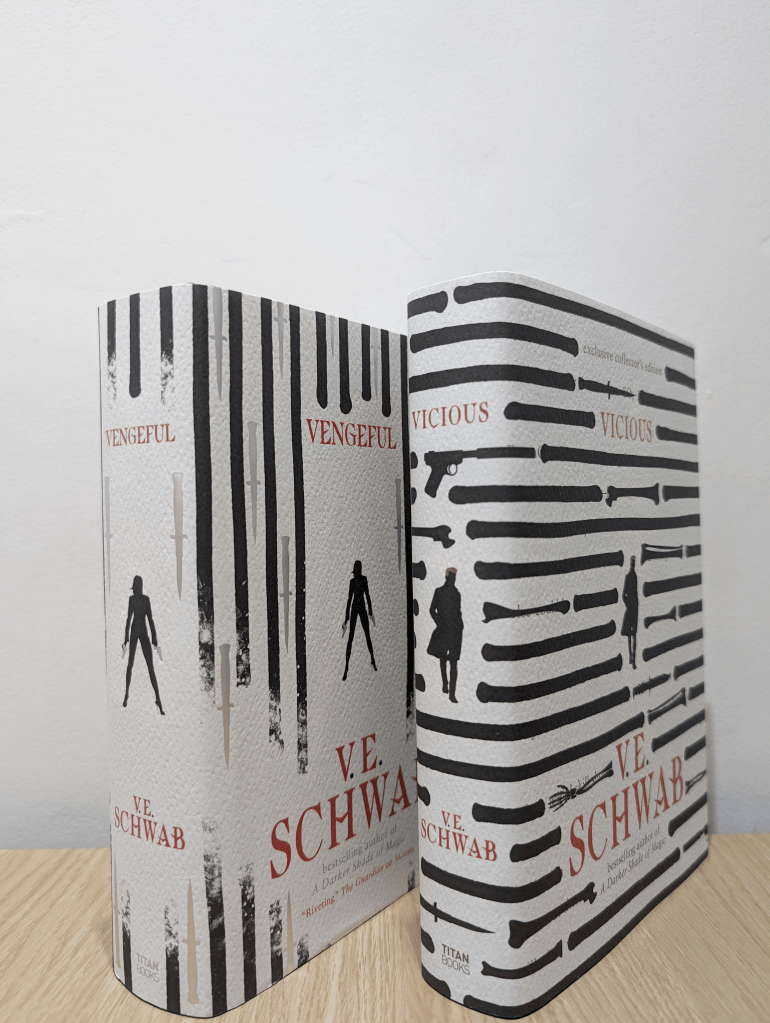
In that sequel, Schwab explores the “how do you kill an immortal” trope from the superhero genre, and all of the planning and failure that goes along with living in the world with friends and enemies who cannot be stopped.
The movie has some of the great milk chugs of this year, although that honor ultimately goes to Babygirl. It’s possible that some people will suggest the greatest contribution of his movie is the slickslickslick bonesaw ASMR , but I think probably this movie was meant to be seen in theaters and will for the most part be half-watched while people match their laundry.


