
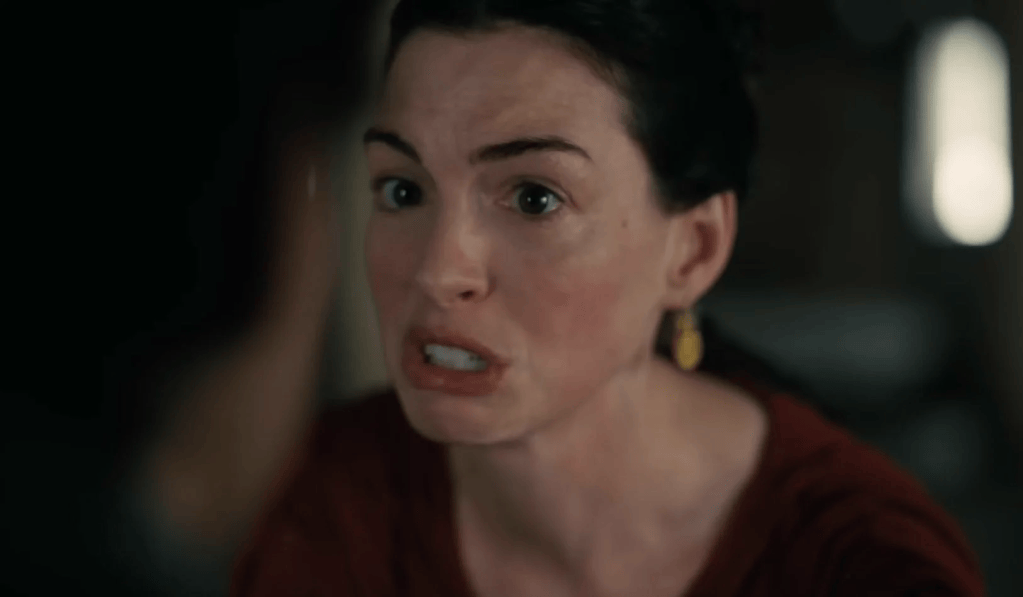
OK, so I’ve been holding back on this review for three months because this is probably the only time in my life anyone is going to ask for my opinion about a movie that I’ve studied fairly extensively and so I’ll give you the short answer and the long answer here. When people ask me what I think about The Odyssey, I shoot that question back right away to see how far in the weeds they are, and if it seems like they don’t want to hear someone push their glasses up on the bridge of their nose and talk about why the “poem was better,” I give them these four hot takes:
- The Menelaus scenes are great and his whole deal of emphasizing the Quixotic multiplicity of contradictory stories about Odysseus is spot on.
- The ending with the curse but reversed into a family vacation is nice touch.
- Girl dinner is the best part and the only actor who’s been brought up for any Oscar consideration.
- And, the music is all done in “Minoan style,” so it sounds WILD especially in the cave with the giant puppet–puppet giant?
If people want to get in the weeds (which they never have), I tell them this:
I’m still reeling from so many of the weird editorial decisions. We’re all in favor of a Nolan film that doesn’t crack 3 hours, but why have the Myrmidons (Ant People) but cut the Phaicians with Princess Nausicaa (the only woman that Odysseus doesn’t tell his wife about)? We get the cattle of Apollo but the Lotus Eaters get consolidated into Calypso? There’s no real mention about why Athena doesn’t tell Telemachus where his father is and that he’s on his way and will be back soon. Odysseus really doesn’t do much lying at all. He doesn’t even talk to the Cyclops, which is sort of essential to the curse of Poseidon, but it seems like the curse is sort of replaced with PTSD about the collateral damage inflicted on Troy as a result of his efforts. It all seems sort of patchwork and random how Nolan chose which episodes were meaningful and which ones can be combined or omitted altogether. But that’s adaptation, you lose some and you lose some. Except that’s not always adaptation and some of the best translations of Homer have been imaginative departures.
Before the Odyssey, I had a neutral to negative perception of the acclaimed translator Emily Wilson and her version of the Odyssey. I grew up with Mendelsohn and Fagles and Lattimore and Fitzgerald. I remember reading their translations while I was doing my translation homework for months and, earlier, before I learned Greek, poring over them during classes to detect the differences and maybe note departures from the original for stylistic reasons. Wilson’s translation felt self conscious, penned into choices by the poetic anxiety of having to depart from paths that others had taken previously, but also weirdly conservative and plain? On the spectrum of slavishly literal to experimental, the excerpts of the Odyssey (Wilson’s Version) that I had read didn’t sing like AE Stalling’s rhyming couplets in tetrameter of Lucretius’s De Rerum Natura and a far cry from Anne Carson’s treatment of Stesichorus or Sappho or Catullus (this review was written before Carson won the Nobel). And, to be clear, there are ways in which the most experimental adaptations of classical literature can feel excessive and only tangentially related to the source material (see Carson’s Oresteia). But when capable writers find a magic trick of translation (Davahna Headley’s Beowulf, MacLaughlin’s Ovid, all the shenanigans that Jeanette Winterson is doing in Weight and the Myths series in general) its repetition only makes it even more pleasant and full as commentary on the original and our contemporary selves.
Before I saw the movie, I mused with people about whether the movie would be more like Nolan’s Batman (source material but gritty, completely drained of all supernatural and cartoony elements) or Dunkirk (slow, boring). This is so much more in line with the Iliad, a poem where gods interact with humans from afar at best, invisible Athena holding Achilles’s sword in its scabbard as he tries to draw it in anger against King Agamemnon, metaphors for abstract human emotions. The Odyssey resists that treatment in so many ways: Athena talks to Telemachus, Cyclops is the son of Poseidon, the harpies are freaking women with bird bodies! So maybe he would put his own spin on the monsters and gods, something radical and strange, visually stunning and divisive, like so many of the translations of Homer that took big swings.
Take Alice Oswald’s Memorial (2014), which translates (only) the 200 deaths in the Iliad:
EPICLES a Southerner from sunlit Lycia
Climbed the Greek wall remembering the river
That winds between his wheatfields and his vineyards
He was knocked backwards by a rock
And sank like a diver
The light in his face went out
and
ILIONEUS an only child ran out of luck
He always wore that well-off look
His parents had a sheep farm
They didn’t think he would die
But a spear stuck through his eye
He sat down backwards
Or Christopher Logue’s War Music (published periodically from 1959-2011) which imagines a Trojan War with uzis and helicopters.
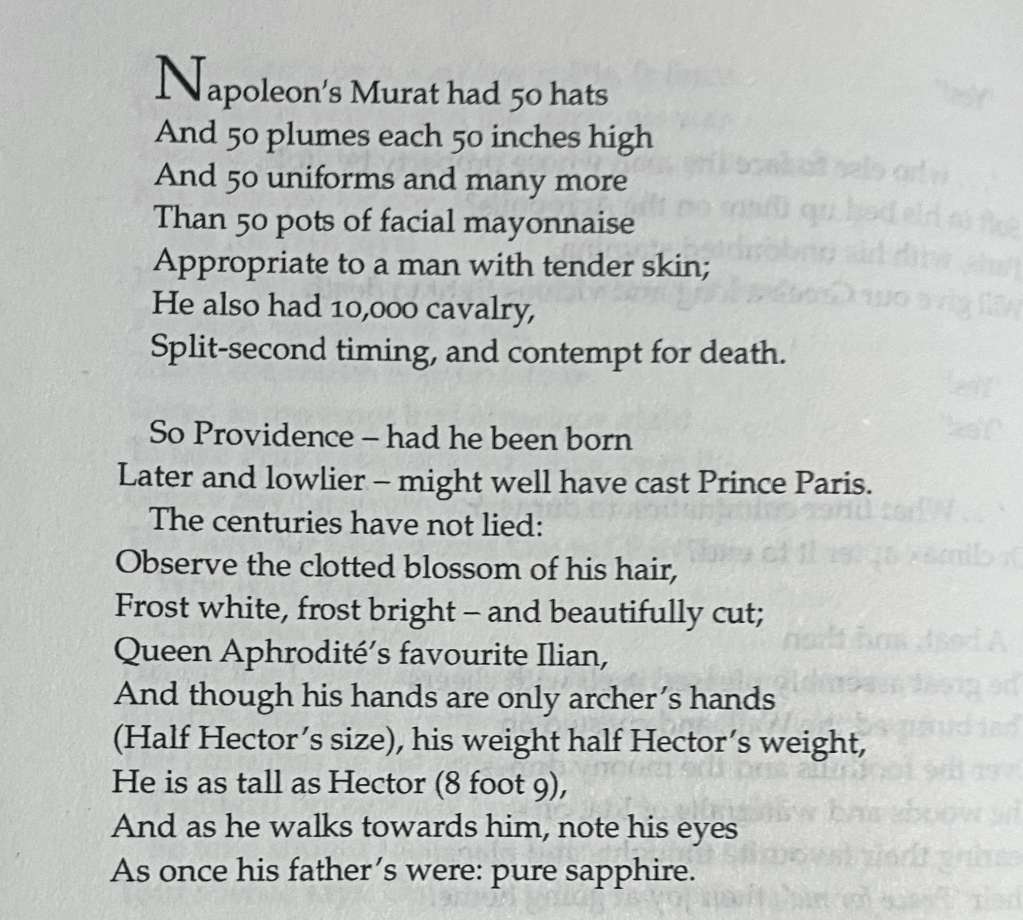
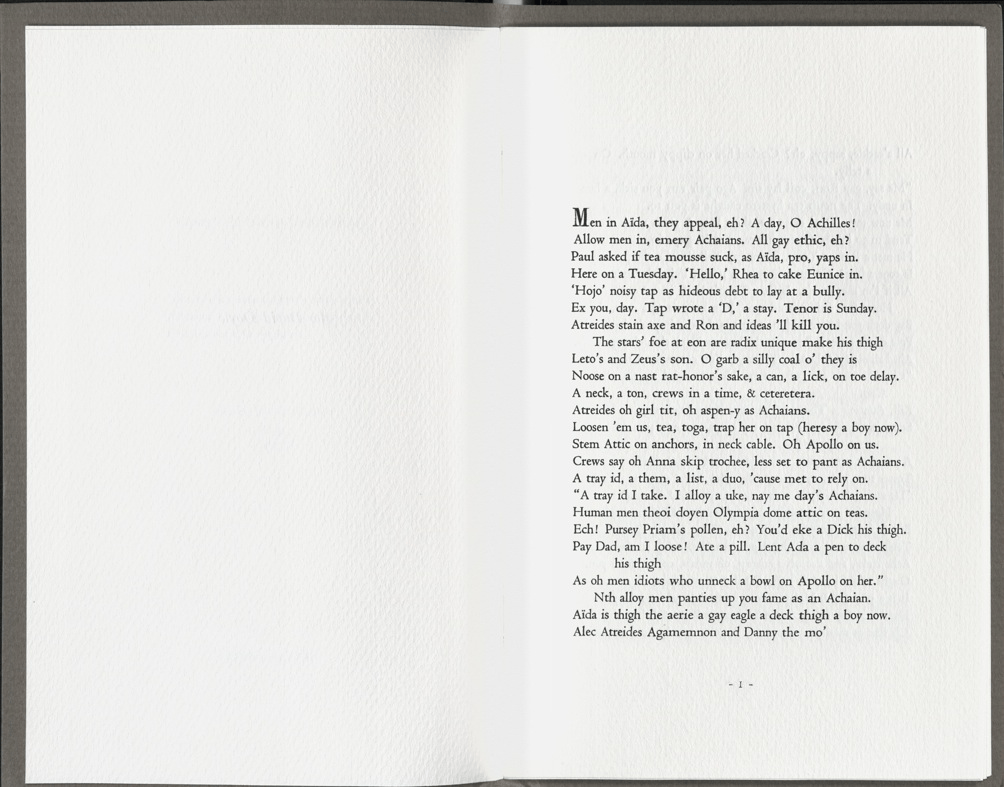
Or Men in Aida by David Melnick (2015), a weirdly satisfying homophonic translation of the Ancient Greek into English which really ought to sound more like gibberish than it does:
So, at the top I said that BEFORE this movie, I had sort of neutral to negative feelings about Wilson, all of that evaporated when I got to see her performance in the hot lights of social media in the first week of the film’s debut. Wilson sort of had two phases of takes on the Odyssey on social media. The first one, which was overshadowed by the second, was her long set of epigrammatic observations about how similar Nolan’s adaptation is to LA: the food looks great, but no one is eating, everyone wants to get rich quick and stay hot forever, etc. It’s really worth a read through for hot takes, and I can’t think of a single student in her classes who wouldn’t absolutely love this shorthand for the text she’s teaching (did I mention she’s translating the Odyssey AGAIN with fewer metrical constraints?). But then in the second phase of her assessment of the movie, the brazenness with which Wilson lays into Nolan, probably the last big budget adaptation of this poem to happen in her lifetime is such a satisfying rejection of pop culture hype when all the rules of polite society encourage bland, demure compliments. Or as one redditor, Central_Region put it:
I love that Wilson has used the entire world turning to her for either validation or rejection of Nolan’s movie as the opportunity to make the sort of post I’d chuckle while writing then post here only to get zero upvotes and a single downvote.
So, for me the enjoyment of this movie really comes from its discussion afterwards. From the spectacle of watching the world’s most famous translator light the world’s most famous director on fire for how bad he is at movies while we get to watch from afar. I hope there are a lot more movies like this even though I know there won’t be, like Odysseus, constantly retracing his steps but never quite finding home.


