
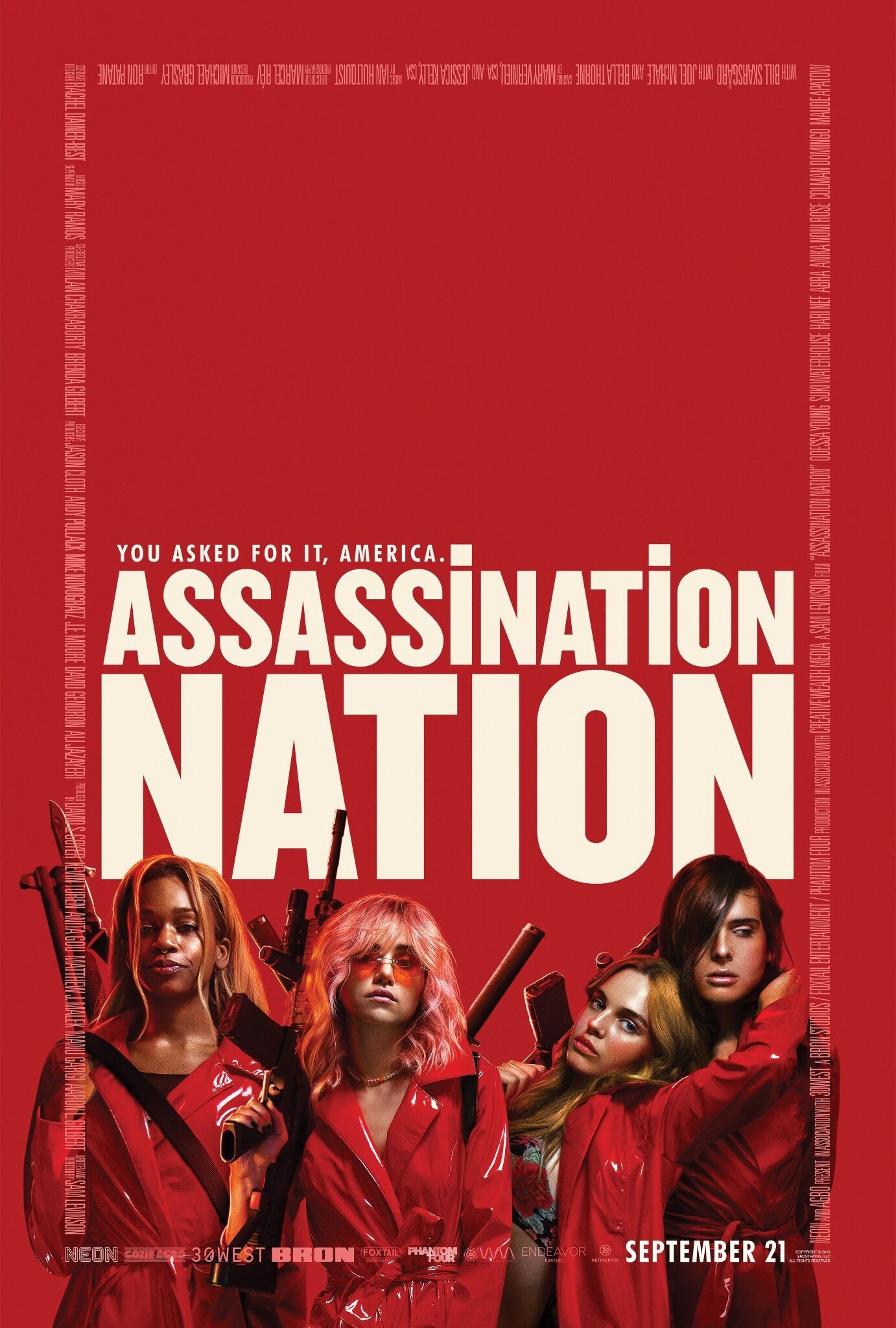
Assassination Nation is the next in Neon’s brand of sleek-looking films with a transgressive script that innovates the genre. It’s more Ingrid Goes West than Thoroughbreds, which is to say, there’s more discipline in its cohesive visual theme than its storytelling. The story itself is a thought experiment for our social media-obsessed, call out culture (a novel subversion of common tropes of these issues in political discourse): what if half a town’s population had its private data hacked and released for everyone to see? What shenanigans would ensue?
The film makes canny decisions about how to push the plot further without falling into the trap of navel-gazing for too long about the significance of its own questions. Instead, once shit goes down, we have our answer almost immediately: it’s women who suffer the most. That feminist read of the structures at play shielding men from the brunt of embarrassing data leaks and public criticism of deviant behavior sets up the wish-fulfillment action sequences of the second act of the film.
For a movie that’s about nuance and levelheadedness in the Age of Umbrage-Taking, there isn’t a lot of nuance about the controversies of Everytown, USA in the film. Strawman arguments and unambiguously evil characters abound: Lily is apoplectic when she cannot explain to her parents at the dinner table about why the female body is not inherently sexual or why a parent having a photo of her infant child in a state of undress is not that unusual. But we’re supposed to sagely nod our heads when the town loses its shit over that clearly widespread practice when the school principal’s phone is hacked. Lily is explicitly marked as eighteen years old, presumably to cut off any hand-wringing about pedophilia or even power imbalances in her extramarital affair with Nick (Joel McHale of Community fame). I’m left wondering, Why not? Why not let the audience wrestle a little bit more with the uncomfortable messiness of the characters’ private lives? Assassination Nation isn’t sterile or restrained by a long shot, but these fake controversies make it feel a little stunted, like it didn’t quite reach its potentiality.
The premise of Assassination Nation relies on our shared agreement about the pitfalls of social media and its schizophrenic influence on the development of young women, but the expression of these pitfalls is rote and (mesmerisingly) calcified. The protagonist Lily’s feelings about social media is monologue not dialogue. That being said, where Assassination Nation maybe expends too little energy examining the strained relationship between girls and social media, it expresses one aspect of that fraught relationship, hypersexualization, in iconic ways.
One of the film’s greatest contributions is in the first half hour, in its update to our depiction of a certain subsection of upper middle class American girls’ social and romantic lives. Assassination Nation is unapologetically sex-positive in the vein of last year’s Flower. Depictions of teenage erotic relationships are detailed and descriptive without being pornographic fan service (I think? I could be wrong about this? I can’t tell what’s subversive feminism and what’s just playing into misogyny anymore, if I ever could): Lily’s constant text drama in early scenes with a mysterious “Daddy” character, even as she’s struggling with an unsatisfying, awkward, banally emotionally abusive teenage boyfriend, is electric and tense. We have the suggestive caption as she puts two fingers in her mouth and shows off her underwear in a text, “Do you wanna pull the trigger Daddy?”, but we also see it as foreshadowing for the hyperviolence that’s to come. Bex’s queer sex scene with the captain of the football team captures the emotional rollercoaster of young love between teenagers not entirely comfortable in their own skin. The two subsequent sex scenes, featuring Lily, first with her boyfriend, and second with her would-be savior, are complex and emotionally dissonant, perfect and poetic analogies for the range of sexual experiences of teenage girls. Lily’s discussion of her nude drawings in the principal’s office is a smart exchange that makes for a good opening salvo against anti-feminist hypocritical bullshit.
Of the roles created for the four actors at the center of the movie, not all the characters are equally fleshed out. Bex (played by Hari Nef) and Lily (Odessa Young) give outstanding performances. Em fades in and out, with some iconic moments toward the climax, but shockingly Sarah (Suki Waterhouse), who plays the lead in one of Wife’s favorites from a few years back, Bad Batch, doesn’t have much of an arc, or lines, or screen time. After a while, I started questioning if she was really a member of the friend group or if I was confusing Lily’s character for two different people. No, Waterhouse is actually in this movie, she just spends a lot of her time silently sucking on lollypops and trying to stay out of the way of the action. Bella Thorne (and now I’m fully out of my depth) makes a cameo that I think is supposed to be a bit of a big deal to a certain demographic of the audience and she’s fine. I don’t have a lot of perspective for what she’s like in real life, but someone told her to act like a prissy, thirsty Instagrammer and she nailed it. Doesn’t feel like the kind of debut that will necessarily make me excited to see her again though.
The film is eminently quotable. The “Don’t blame me: I just got here” monologues at the end of the film are imagistic and deft diatribes against the conflicting forces of pornification and subjugation. The home invasion scene contains images straight out of a teenage girl’s nightmare, and shows a path for future filmmakers to follow to create new scenarios of horror for a new demographic. There are moments when the shock value, especially of blood, rankles: I’m of the opinion that self-inflicted gun shot wounds on-camera are the sole province of unimaginative edgelords, which is why I’m not too keen on the first (?) season of Mr. Robot either. It’s the cheapest kind of scare and generally makes for a pretty boring visual in a film where visuals are usually so considered and fresh. The montage of “trigger warnings” at the beginning, the split screen storytelling at the party, the grainy video commentaries, even the scenes where the audience’s view is mediated through Lily’s camera screen gives us a new lexicon for showing action.
One of the most impressive displays of storytelling in Assassination Nation is Bex’s story arc. It’s one of the wokest depictions of a trans kid in any movie I’ve ever seen, even as the story shifts between girls behaving badly high school movie into gore-porn, revenge, action movie. Bex isn’t whitewashed or one note. Her queer identity doesn’t define her every line and yet she’s clearly comfortable discussing her feelings and doing so in a way that makes for interesting character choices: the way she responds to the Mayor’s conflicted personal and public personas (“he wouldn’t mourn for me so why should I give a fuck about him?”); the way that other straight members of the team flirt with her on campus. Even the culmination of straight white male animosity in the lynching scene still has elements of wokeness in it–the way that the misogynist dickheads on the football team still refer to feminine presenting Bex as “her” unironically and without malice. The story of Bex is one of rage and clemency, revenge and grace, and it’s refreshing to see a character like Bex be able to explore those issues so flexibly on screen.
I’m still not sure whether I’m in love with Assassination Nation or not, but there are enough fresh things going on in this film for it to have my full endorsement. There’s no need for any one movie to execute all of its elements perfectly and clearly Neon is in it for the long haul and will continue to throw jelly at the wall. Some things in Assassination Nation stick and cannot be unseen.


18 Comments