

Seven Stages to Achieve Eternal Bliss will make you feel like you’re having a panic attack, hyperventilating into a paper bag already filled with your own vomit. It has a mania to it that really only hits you about half an hour into the first act, when Claire, played by Kate Micucci, and Paul, played by Sam Huntington doing his “best Chris Pratt impression” as Friend put it, tumble into their own impressionable love affair with the Holy Storsh, a charismatic (and deceased) suicide cult leader. The energy behind this movie’s second act pushes Claire and Paul into decisions that don’t feel entirely earned or sympathetic. Seven goes from being about a couple of high school sweethearts from Ohio coming to LA to make it big to a movie about a couple of high school losers who’ve never really learned to grow up escaping the rotting corpse of Ohio for even the worst possible situation in LA.
I don’t think that there’s necessarily anything wrong with the actors or the concept of the story itself. These improv actors are clearly talented: Paul’s self-interview in the bathroom mirror is one of the funnier scenes in the movie and shows off Paul’s ability to be self-aware, not just dopey and hopeless. His rambling story about why the couple had to leave Ohio is an unexpected gem, and maybe my favorite gag of the movie (though Friend says this is where things really went off the rails for him). Other gets are clever deadpan, like the opening sequence when Taika Waititi trills a children’s lullaby in a warm voice, all about suicide. When the lyric drops, the title sequence, followed by an appropriately long and awkward intro sequence of production houses, starts with his voice overtop. Dan Harmon–it’s hard to tell from the production schedule–either newly returned from self-exile or well into his second chance in public life after a public and unusually introspective apology and positive response from his victimized coworker–threads the needle between gullible twit and pompous ass, so that we feel comfortable laughing at and with him in every scene. It’s a role that finds him more vulnerable, but still very well-suited compared to his voice-acting work on his crazy funny show, Rick and Morty. To be certain, the first suicide scene is a stroke of genius that may require multiple rewinds to stop laughing, but something about the last half hour of this movie doesn’t quite stick the landing.
I was forced to think back to some films that featured a large cast of comedians, staring improv actors, that featured darkly funny humor to try to understand some of the traits that these movies share and some of the ways that their similar aesthetics may have led this movie astray. First that comes to mind is 2016’s Don’t Think Twice, “that movie that Ira Glass plugged real hard on the radio for weeks that one time,” Wife says.
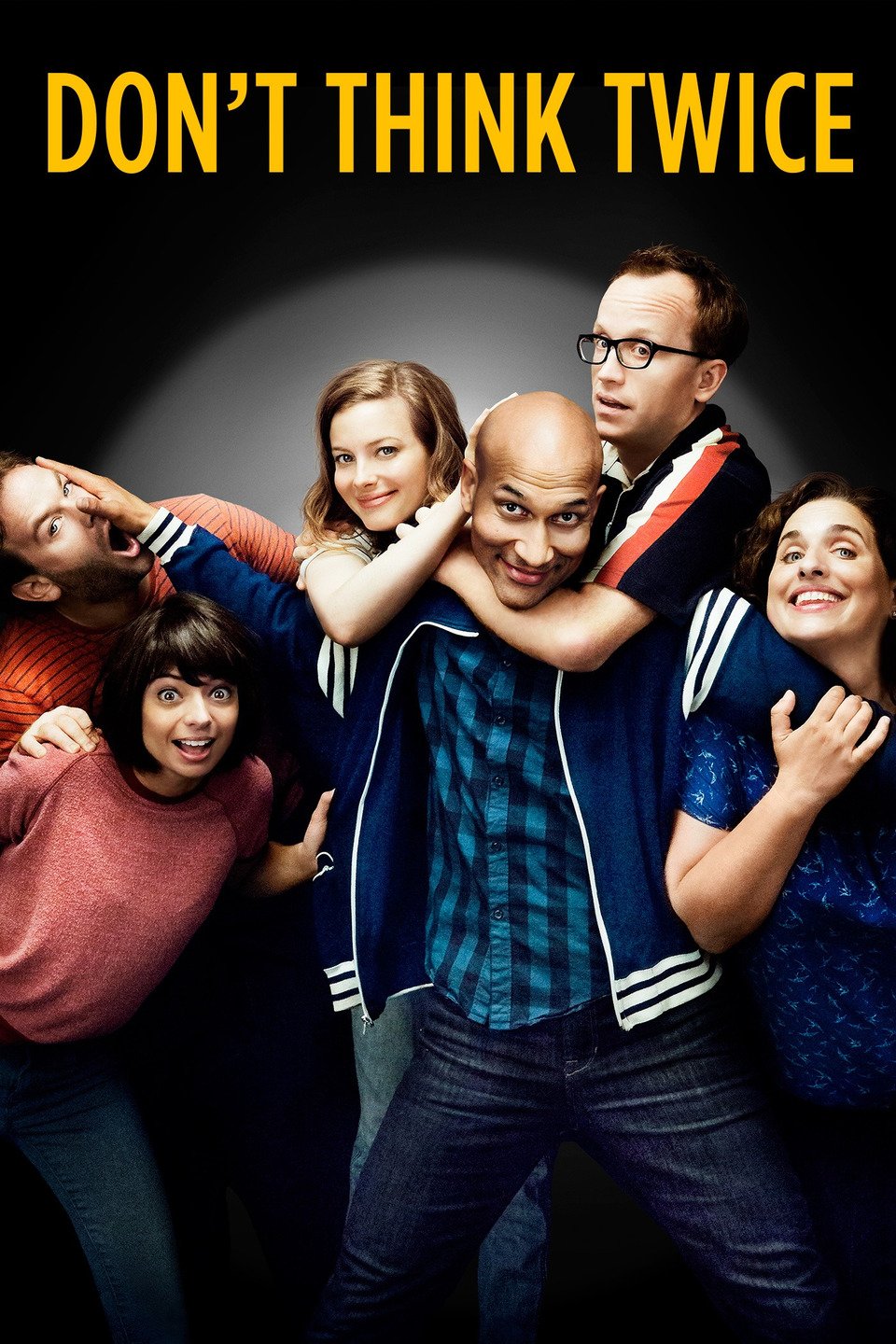
DTT tried cleaved too close to autobiography: the fantasy of commercially successful improv actors having to alter their relationship with their less famous friends in order to advance in their careers. Mike Birbiglia’s penchant for schmaltzy one liners and serious piano music moments doesn’t mesh well with the fast-paced stichomythic joke exchanges we’ve become accustomed to from the Judd Apatow and Gary Sanchez production houses. Keegan-Michael Key was fresh off of the end of his much-beloved and critically successful variety show and had the draw to bring audiences. Some of that cast, like Gillian Jacobs, was on the ascent as well, but for the most part, the movie couldn’t thrive on the nervous energy of self-conscious misfits searching for external validation while navigating stale romantic relationships that were better suited as platonic friendships. Too much of those concepts were present in Seven Stages and because Micucci plays such a similar character, the act feels a little tired before it’s even begun.
Claire’s conflict at work doesn’t do much to advance the plot either. She is at times “aggressively unsuited” for the work that she’s doing (Friend says), which is to say, it feels justly surprising when she stumbles upon a good idea for an ad campaign to forgive a gold-digging wife for an extramarital affair on her 96-year-old husband. That joke itself feels like it’s punching down in some obvious ways, which makes it feel a little like satire, but it’s hard to tell what it’s a satire of. Her own success in the workplace at her “dream job” never quite feels like a good match, nor does it generate the tension hinted at in the beginning of the movie when Paul tries to console Claire’s anxiety even as he’s clearly struggling with his own issues about moving to LA.
I think one of the reasons why I find this movie to be kind of meh is that it leans heavily on the suicide as plot device but asks us to forgive it this laziness because the story is about a suicide cult. The indie dark comedies Skeleton Twins staring Kristen Wiig and Bill Hader and Welcome to Me staring Kristen Wiig (again, both from 2014, oddly enough) both satirize mental illness and both of them dangle the extermination of one of their much-beloved characters as a reason to continue watching.
Wife objects to this characterization in Skeleton Twins, by the way, and she would like you all to know she likes this movie and recommends it to you. I don’t feel that great about the way that Seven Stages leans into its suicide cult by uncomplicatedly radicalizing its protagonists and then showing them in a final scene as happily riding a bus to heaven with all the victims they’ve ushered into eternal bliss. It doesn’t feel tongue-in-cheek. It doesn’t feel subversive, like the whole movie’s doe-eyed, golden retriever energy has been a sly social commentary on the silliness of cults. It just feels a little bit recycled, a little bit irrelevant and not especially urgent.
I’ve been killing myself (ahem) to come up with ways the plot could’ve tumbled differently and I think the conclusion I’ve come to is that I was sort of fine with one of the two of the couple defecting but the fact that both of them dive so deep into Storsh’s cult makes it hard to keep perspective on the tone of the movie. Friend says that Seven Stages isn’t quite sure if it’s a farce or a drama. Part of that, I think, could be solved if we spent more time examining Claire’s frustrations at work, and the way in which she finds release in the manic elements of her time at home inflicting violence. This emotional development is replaced with a montage, but it deserves to be stretched out and examined more objectively. Paul’s insane world-building is fine and acceptable in my opinion, but it works better if no one gives it any heed, if, like Milton in Office Space, he’s allowed to say absurd things and even follow through, but no one notices. What doesn’t work is that the jokes feel like they should either be more unscripted and spontaneous or less purposefully frenetic. The pacing is break-neck, but it always feels like we’re on tracks for this movie, like someone is trying to railroad us to the next distressingly dumb decision.
Seven Stages is peopled with excellent actors and a few truly genius scenes, but the story really starts to feel lazy and recycled around the turn of the second act.


