
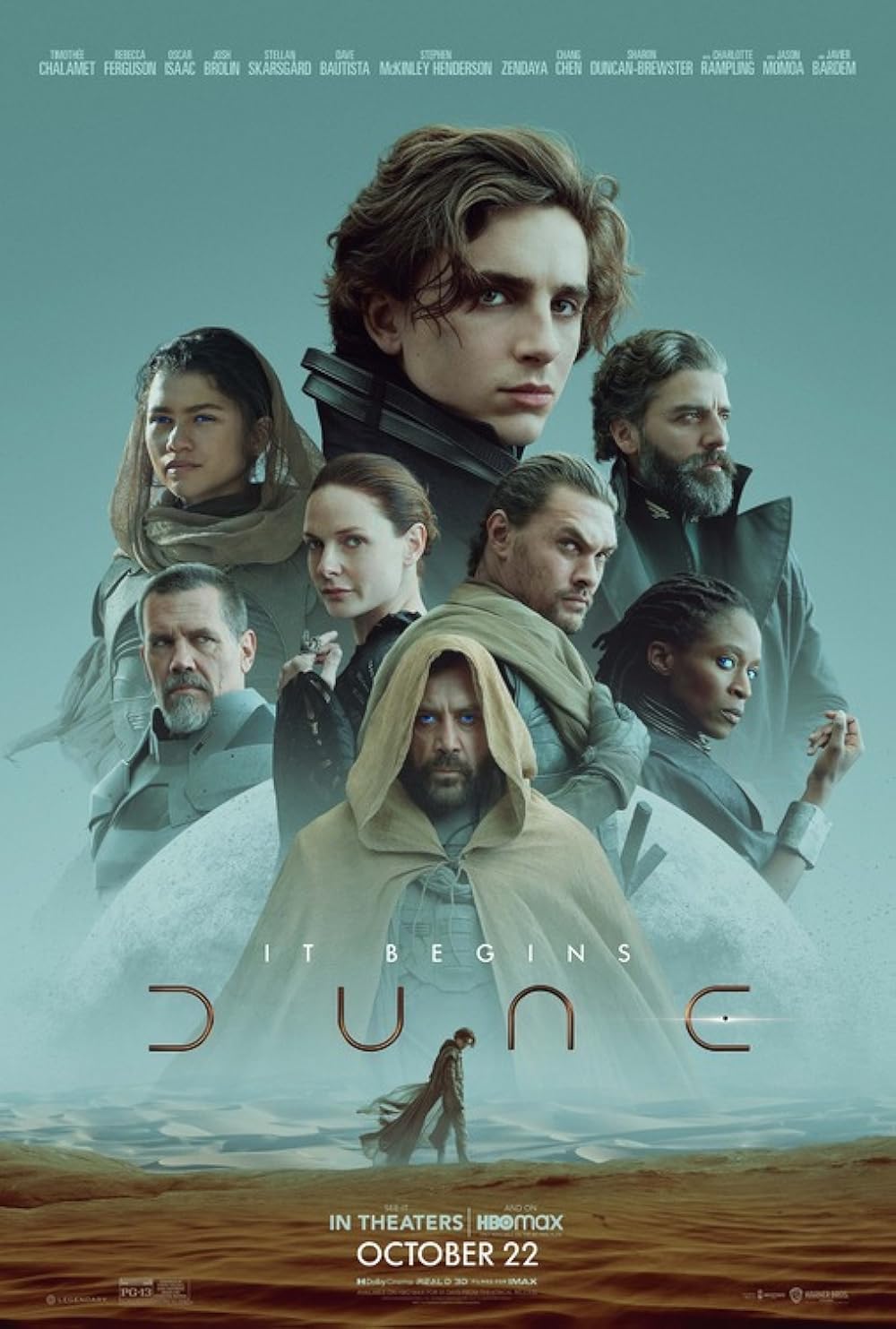
I’ve been putting off on writing a review of this movie for a few weeks mostly because I have had a hard time thinking about it critically. Dune was one of those series that I read when I was a teenager, between summer school classes for photography and Europe and the Modern World and while waiting for my parents to come pick me up. It seems like a lot of nerdy writers have fond memories of their first run-in with this finicky, deep, weird world. I remember reading the prequels cover to cover, which I’d picked up at the local Borders in my childhood hometown back when bookstores were a thing you visited on your route around the Cookie Corner to pick up pork hash and fried dumplings for a snack on Fridays, maybe after a trip to the Blockbuster. Not really understanding what I was engaging with, I probably liked the technical language and the geopolitics of it all, the way in which court intrigue met with space opera, and though a lot of my elders probably engaged with this material more through the Syfy series and the David Lynch aneurysm, for me the entry point into it all was the RTS Emperor: Battle for Dune.
The cut scenes for this movie, like with all Westwood Studio games from the early 2000s, were a thing of magic. Someone gave them a bananas budget and they went and found some solidly recognizable C-list actors–Worf from Star Trek, Michael McShane from Office Space, Vincent Schiavelli from Tomorrow Never Dies and Fast Times at Ridgemont High, the excellent and prolific voice actor Minae Koji–to lend their talents to a truly exquisite game that nearly always stalled out our little desktop computer’s tiny processor in the height of battle. When I went to see this movie for the second time last week, I brought a friend who had seen the Lynch film dozens of times and through listening to the way that he talked to my other friends, I realized that all of my sharpest memories of this franchise came from the 20 second cuts between the loading screen and the map for building your base. Reflecting on that more, I realize that the game was pretty off brand. It’s not a rehashing of any of the books as far as I’m aware.
In fact, one of the major houses, Ordos, according to one source is “never mentioned in the novels,” only a passing mention from the 1985 Dune Encyclopedia. Someone can correct me later about this, though I doubt it, because the only other person I’ve ever met who has played this game is a guy at work who goes to Renn Faires in his free time, and I had to stop myself from dropping everything I was doing to confirm that my childhood memories weren’t just a fever dream (fun fact, this is another name for David Lynch’s adaptation). I also recently learned that literally none of the characters are from the original novel.
Can we spare another moment to this game? Aside from the banging cinematics, the premise was essentially an all out fight among three Great Houses for control of Dune. You’d touch down on a rocky outcropping, set up your spice harvesting operation and then churn out your warriors, but there were all of these neat mechanics, like you could order troops to be shipped in by the Guild from off planet or in the campaign, your decision tree for where you would play next was non linear, or at least it appeared non linear, and when you did an especially good job in one part of the map, reinforcements would come from whichever direction you had completed recently, which–at least in my head–meant that you were weighing whether you should angle for a quick win or a decisive one, so that you’d be better prepared for the next battle. I think there was also some kind of mechanic where you could partner with the Lower Houses and acquire specific troops and weapons related to those houses. Also, the wormsign mechanic was really fun and ran you the risk of maybe losing your entire army in route to your attack.
This review of a movie fell off the rails a little bit, but I wanted to just mention that for the last two years my friends and I have been playing this deeply frustrating board game adaptation of Dune from the 80s, which has resulted in two different instances of grown ass adults leaving the house prematurely because they had fucked up in some embarrassing way. It’s essentially Diplomacy with asymmetric abilities and no dice rolling, so what I mean to say it’s nothing like Diplomacy except in that you play a faction and win through conquering territory. It’s been one of the mainstays of board games in my household for a while and despite my promises that we will never, never play the game again at the end of every 2-6 hour session, it inevitably becomes the thing that I end up returning to like a junkie. My current plan is to see how long it takes to alienate all 12 people who originally learned to play it and then cultivate new friendships to replace those alienated people into perpetuity. In the meantime, this has been one of the ways in which we were particularly sensitized to the movie.
I’ve read a fair bit of criticism about the movie since it came out a month ago and I get that there are several approaches to come to the movie with. When I went with friends, there was an assortment of people who went in completely cold and those who were super fans, and in some ways I think it might be more fun to have no clue what’s happening. I’ve heard from a fair bit of people including my mom that there should be a warning attached to this movie not to see it if you’ve taken medication recently or if your bedtime is usually about half way into the movie. I also don’t have a lot of analogs to the viewing experience in which you are allowed to choose for yourself if you’d like to watch this for the first time while folding laundry or while masked in a theater, which I think may have affected some expectation setting.
I’m gonna assume you’ve seen this movie by now and just say that I think that the two major strengths of this movie are its capacity for camp and its utter contempt for the action genre by which it was co-opted by so many video games and television adaptations. The major attack on Arakeen is over and done with in a matter of minutes with minimal heroic fighting. In a lot of ways, it’s an emotional sibling film to Rogue One, which also reveled in the complete obliteration of its star-filled (?) cast and crew. Friend said on his second laundry folding viewing, he noted a flag in the pacing after the Coriolis storm, but I looked for that the second time and disagree–you’ve got Duncan Idaho’s last stand and a major Fremen fight to close things.
My second strength noted was about camp: the silly, bulky black hats the Bene Gesserit wear, that mentat’s absolutely mesmerizing parasol, the borderline meme fights Jessica and Paul have in the back of ornithopter, screeching at Harkonnen lackeys, the Baron’s cowering on the ceiling like a lost child’s balloon–this movie is a font of very intentional muted humor that opens itself up to the meme. Camp was not something I was expecting for the first big epic franchise to launch in a while–usually films tow the line between taking themselves too seriously and having Important Things to say.
My prediction for a part two is the following: I think that much like what was successfully done in Endgame and the transcendent Dash and Lily, we might have a Shadow of the Hegemon situation, where we get everything from the Fremen’s perspective, specifically from Chani who was given weirdly high billing in the trailers for her approximate 2 minutes on screen. It seems like this would solve a lot of objections about the white savior narrative or the lack of female representation or the orientalizing of the Fremen or any number of critiques of this movie. NPR’s Throughline had a really satisfying recap of the movie with a specialist of colonial studies through the lens of Dune recently that I have to recommend. Just like the first movie spends a lot of time on the two Great Houses of Dune, you could easily toggle between the daughters of the Emperor, who are conspicuously excluded from this movie despite their central role in the narrative arc and previous movie adaptation, and the Fremen before meeting at the endpoint of the last Dune Part One.

All of the different actors being floated around in my cursory exploration of the Internet theories for Dune Part Two are really lovely, by the way: Florence Pugh, Elle Fanning, Anya Taylor-Joy, Elizabeth Debicki, are there any wrong answers? They could even manage another gender swap and float someone like the deeply gorgeous Nico Hiraga. I continue to maintain that my favorite part of Dune is anything that doesn’t take place on Dune, which is why I find the prequels so satisfying. I get the sense that someone noticed that in the choice to end the movie where they do with the introduction of the Fremen journey, so my hope is that someone will also be savvy enough to find a way to non-linearly tell stories that are building on a world that is very familiar to a lot of fans in surprising ways.
One of the things that a second viewing of this movie really gave me a new appreciation for it is the fact that Timothy Chalamet’s hair really is out of control in this movie and the story of Dune is the story of his hair becoming progressively unhinged. Not much else to say except that it’s hard, I think, to write a simple review of a movie whose impact has pervaded nearly all of American sci-fi for the last sixty years. You get bogged down in the poetic anxiety of it all, arguing about intention or impact and fighting against the hype and the backlash to the hype or you get lost trying to figure out what the fuck that weird opening credit moment is where the screen shouts at you with a subtitle about dreams and then you’re back to square one all over again. In the meantime, here I am, misremembering key plot points from a video game that I played in 30 minute increments whenever my brother’s were busy doing homework from twenty years ago.


