
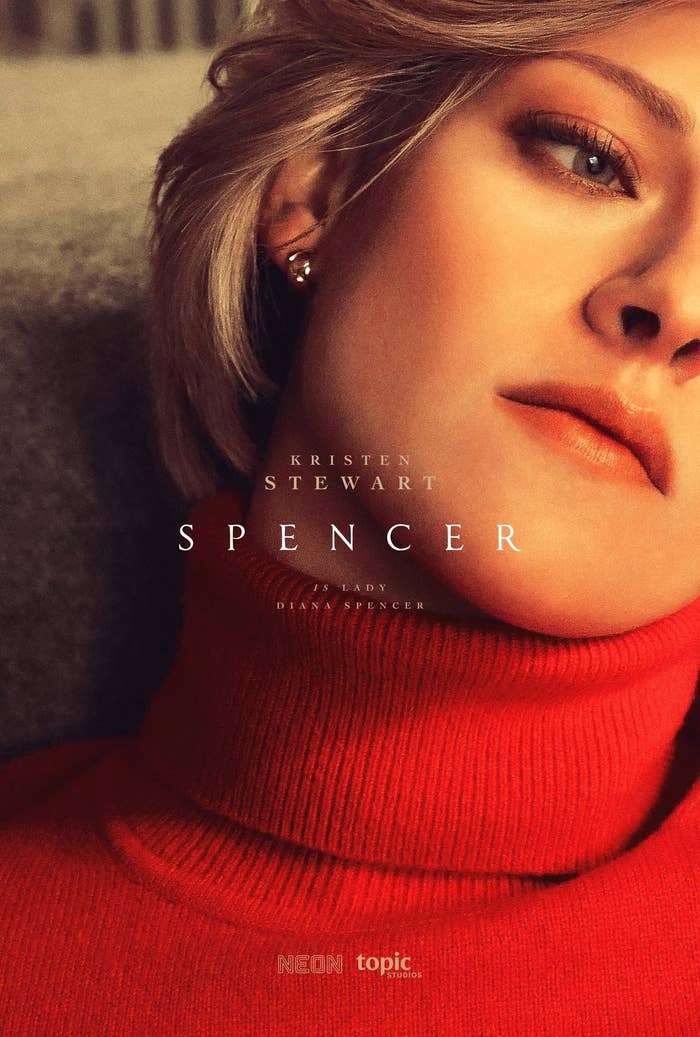
I had the distinct pleasure of a non-consensual simultaneous double double feature starring both Kristen Stewart and Emily Blunt on an airplane recently. The seat in front of me watched the first ninety minutes of Jungle Cruise while the seat in front of Wife started A Quiet Place and then followed up with The Happiest Season while the seat to my left watched last year’s Underwater. Meanwhile, Wife and I were successful in watching what is our PR for most minutes of anything in one sitting as of parenthood, while finishing up our improvised Harry Potter marathon which we’d started with her dad by watching Harry Potter and the Deathly Hallows Part I in hour long chunks over the course of three days. I mention this because it’s important to put into context first that my brain is so thoroughly mushed that I was able to watch five movies on top of one another without risking brain damage, but also holy fuck I miss when everyone had to watch one single screen at the front sometimes, how is this the best of all worlds? No, that’s not what I meant to say, what I meant to say was, I wanted to contextualize that I’ve seen a few Kristen Stewart movies recently. Wife had been talking about her interest in Spencer specifically because she’d read that it was an understated moment in time biopic, not a sprawling story like Rocketman, but something immersive and subtle, where names aren’t mentioned, “a fable from a tragedy,” the opening credits promise.
What you’re left with is what has to be one of the most American takes on the British monarchy, a wry satire of the stale, cold, sterile holiday festivities of the royal family as experienced by one Princess Diana and her two sons, who seem to be perpetually stuffed into their rooms, far away from the rest. Wife’s criticisms are the ones that I often level at shows like The Crown or movies like The King’s Speech, which try to dignify and dramatize the power of a regressive, moribund figurehead, a fossil from the ugliest days of British imperialism.
We stopped half way through this movie last night and watched the famous interview with Diana, which I’d never seen in its entirety, at least not as an adult, and Wife said that it humanized someone the movie had made unsympathetic through her repeated badgering of the staff. Her struggle with self-harm, depression, her husband’s infidelity, and alienation from the royal family are all eloquently articulated at a moment before these topics were de-stigmatized in public discourse. Stewart’s delivery and Steven Knight’s screenplay reminded me a lot of F Scott Fitzgerald’s character Daisy Buchanan, whose comic conceit is that she makes dark asides to no one in particular that only the reader really notes (at one point, for instance, she propositions the narrator, her cousin, or the scene where she mutters something about using an axe to open a window in the hot apartment her husband keeps for his mistress). Diana is perpetually being ignored, politely by the staff whose role is to defer and report, coldly by her husband, who regards the marriage as a charade. The movie is a structured a little like Fleabag’s stage show, a one woman show that tries to find ways for its protagonist to dialogue in fantastical ways. Her monologuing with the coat of her father or the various staff around the house, her brief and heart-wrenching moments with her husband at dinner–pleading with her to respect the work of the animals who’ve provided dinner by not throwing it up afterwards–or the day before he’s set to take the boys on a pheasant hunt, the contrived moments when each of the staff have their moment with her to display the varying attitudes of the Regular Man (the cook, the groundskeeper, the dresser).
Stewart plays characters that are wound tight especially well–think Happiest Season and Personal Shopper, where she is meant to feel awkward in her environment, a fish out of water, her fingers clenched in fists, her face a cipher. Stewart likes to play with silence. Despite the way that she used to be regularly derided ten years ago for her lack of emoting, she’s found a perfect challenge in Diana, someone endlessly graceful covering up some tremendous pain and trauma and all the mess that come with that. Stewart stands as a kind of queer icon in some communities, but she doesn’t often take roles that call for glamor in the way that Spencer does. Here, she has crafted a mesmerizing accent that’s nervous and smooth at the same time. Some of her best delivery comes from just about any moment she’s interacting with her sons, where she’s funny and frantic and heart-warming. The warmth with which she treats her children serves to emphasize the lack of warmth with which she is treated by any adults, and the little ways in which she pulls them back to normal makes clear how odd and unromantic the Crown really is.
Spencer is as much a biopic as it is an anti-holiday film. It shares some of its DNA in that sense with a movie like Knives Out, which more explicitly lampooned the politicization of family dinners in its drawing room discussions of immigrants and the help. Wife thinks that too much of Spencer is still focused on the downsides of celebrity to be truly mainstream in its appeal, which I quibble with a little. Spencer does care a lot about beauty and the attention of the press, but it’s also very explicitly removed from reality. It takes Diana’s last married Christmas as a jumping off point for some interactions between future ex, the children, and the staff, that allow for Stewart to perform her top shelf nervousness in some of the most dazzling, femme outfits, playing a tightrope act of maintaining her composure for just long enough to find a private space.
Some moments are standout in their weirdness: Wife thinks that the Anne Boleyn comparisons are heavy-handed, but isn’t as bothered by the Victoria stuff. I think the contrivance of royal history is entirely fair game considering how else is Diana supposed to be able to talk about the history of the monarchy without posing as a hobbyist of history at some point? For me the five minute dance sequence toward the end is probably one of the most jaw-dropping moments of the movie. Watching Stewart dance ballet in six to eight dozen dresses is the height of indulgence and I think where more than a few people are going to check themselves out, but I think it’s charming and weird. This American Life last week mentioned that this movie for all its attention to detail is actually kind of a hot mess from the perspective of birders, so there’s that.
Birders aside though, this movie was the first time that Wife and I have seen something new together in months, which will make it special and notable regardless of the quality of the source material.


