
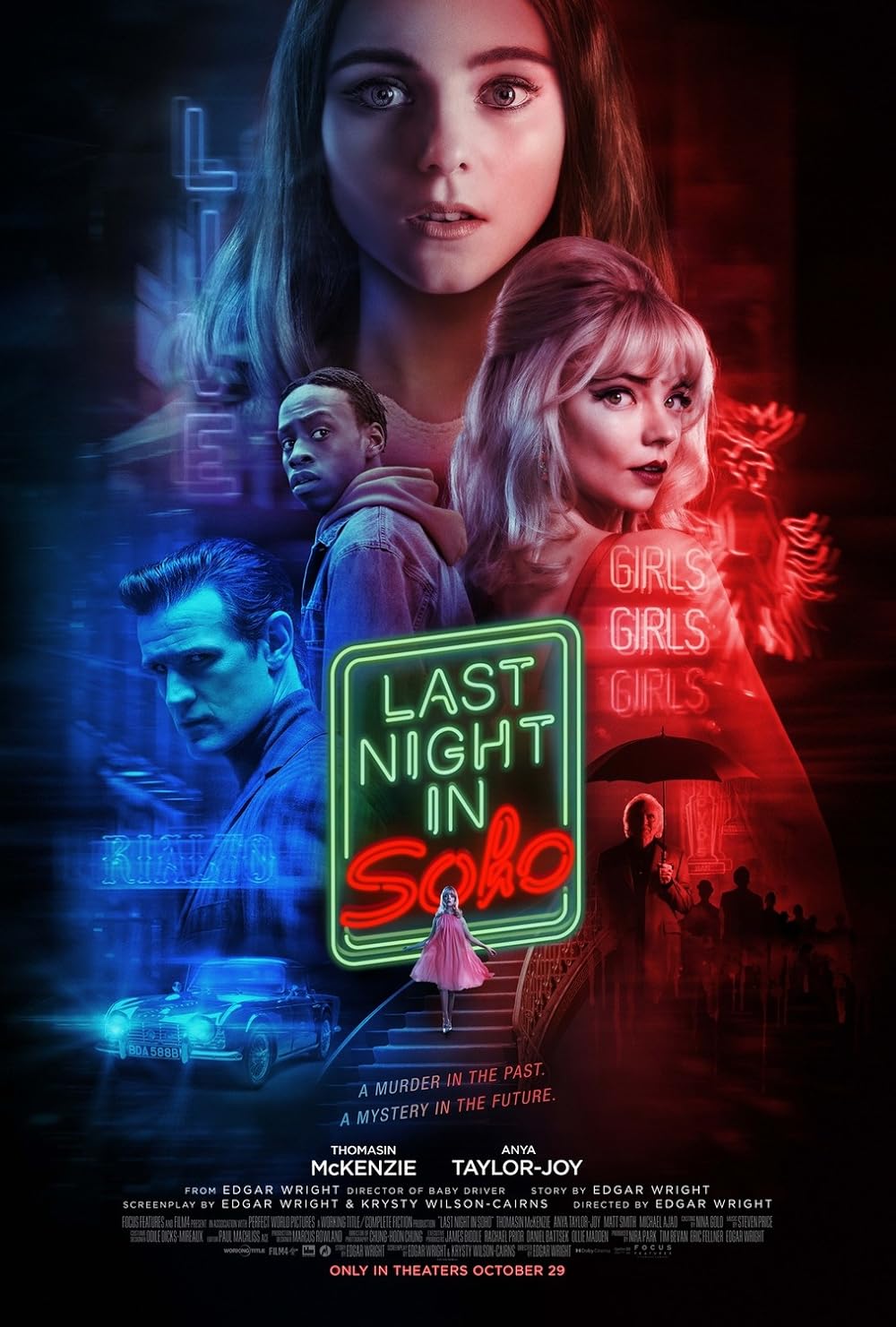
You don’t know what the fuck is going on in Last Night in Soho, because there’s no way you could, but that’s part of the fun. Wright’s film marks a new phase and I really regret not seeing this Halloween night.
The Golden Globes (weird this year, because they’re un-televised due to sudden recognition of racism) came out today and it inspired me to pick up a little on the films before the end of the year, though I have this sick feeling that the anticipation I had that this year would be an unusual bumper crop of movies held on the backburner for the last eighteen months was misplaced. Last Night in Soho, Edgar Wright’s newest film, which was successfully kept under wraps during its film festival debut. There was a lot of goodwill haloing this film before its wide release, not least of which because the cast features one darling of Taika Watiti’s Jojo Rabbit, Thomasin McKenzie, and Anya Taylor-Joy, who’s been dealing herself straight flushes for the last four years (and for those keeping count I have yet to write a formal review of The New Mutants because of the way that it overlapped with other work I’ve done, so no link there). Edgar Wright had two movies coming out this year. The drought after the promising Baby Driver, which coincided with some of the most active reporting and investigation of the #MeToo movement and the ousting of one of the stars of his film, left a noticeable gap in Wright’s work, and it’s likely that this movie is the product of some of that soul-searching. The article I had glanced at while doing some prep for this review used the term “growth” to describe how this movie interacts with some of his earlier work.
Brothers and I were discussing the most aesthetically pleasing movies we’ve ever seen the other day and Wright featured on our list. The fast cuts, sight gags, the syncing of music to movement, the choreography of humor are all things that require active viewing and repay rewatches. Last Night in Soho, featuring cinematographer Chung Chung-hoon, who’s slated to work on the upcoming Obi-Wan show for Disney+, is a hard shift in a new direction for Wright. The movie feels more like a collaboration between aesthetics: it’s the zany–and now we’re really getting into spoiler territory–time-traveling, ghost story thriller that you might expect from Wright in his early years, pared down and unadorned in terms of plot. Think, four friends do a pub crawl during a zombie apocalypse, or four friends do a pub crawl during a different zombie apocalypse and you see the fingerprints of the old reliable filmmaker, but instead of visual humor, McKenzie shows off her chops as the repressed and eccentric fashion student cum telepath in beautifully choreographed sequences that echo some of David Ives stage work. The romance with Matt Smith has the feel of Chris Evans from his work attempting to broaden his reach post-Marvel, and it has the added advantage of doing some long awaited fan service for those of us who’ve been waiting for something after the intentionally friendly, de-sexualized Doctor.
There were some interesting overtures to the way in which her telepath journey might be affecting Eloise in a physical way, the mirrored hickey she has the following day in class and her resulting insularity as she chases the high of a very real voyeuristic vicariousness. But the movie drops that game almost immediately and shifts toward the psycho-thriller genre tropes, electing to draw mirror scenes rather than have both women experience the same things physically, for reasons that are eventually obvious but not entirely consistent.
Taylor-Joy feels more like a character actor in Last Night. She’s good at it, because without the need for backstory or dialogue, she nails the conveyance of a range of deep emotion through her physicality, whether that’s on the dance floor or the bedroom, but probably the most satisfying sequence of her performance comes during, weirdly, a montage in which she’s fed the same line over and over and reacts to it differently each time. It’s one of those classic acting exercises, which has been expanded into a scene and Taylor-Joy plays with the lines in such excellent ways. Despite the fact that the two are joined at the hip visually, and that their similarity grows through the course of the movie, there aren’t actually that many points of interaction between McKenzie and Taylor-Joy, which is fine. The movie is as close to feminist as Wright and his co-writer Krysty Wilson-Cairns are going to get. The gold standard for ghost stories in the last few years is probably from Lovecraft Country and there are some ways in which Last Night in Soho seems to take its cues from the same tenor and vehicle, ghosts as suppressed trauma by race and patriarchy, but Eloise’s sudden about face concerning the ghosts of Sandy’s past at the end and her acceptance of the wrong-doing to correct wrong doing really puts the whole moral compass of the movie into a spin. #MeToo had its share of revenge fantasy films: Assassination Nation not least among them! And predecessors to inspire. At this point, I should also give a shout out to the batshit crazy Bad Batch, which you should sit down and watch if you’ve ever wondered what Keanu Reeves was busy doing with Suki Waterhouse (of Assassination Nation fame) and Jason Momoa after his brush with fame from GoT.
In the process of creating art about sexual violence in light of this period of renewed attention, it’s become hard to say anything complex and interesting through metaphor about the anger and trauma of women. Instead, it gets exploded through the cathartic depictions of women-led action and we’re left to project our own politics and interpretations of what is twee or problematic or subversive or reductive or whatever. There does feel like something subversive about the incredible impotence of Michael Ajao’s (Attack of the Block alumnus) satisfyingly meek and beta performance as John. (Terrence Stamp’s interview with Terry Gross a few weeks ago was a really lovely retrospective on his life’s work and I point you there for someone who put in the time.) I can’t think of a more feminist act than to write a character so bland and ineffective and male than the way John has been formed. He is the perfect supportive damsel, the gender-swapped Zelda, if you will. A princess in the shell of a black man, but it’s probably more accurate to describe him as a Trojan horse meant to keep you on your toes about what kind of movie this is going to be, especially when he has a moment of supreme terror at one point, when he thinks that the nice white girl he’s gone home with might actually get him murdered by police. This is Last Night’s reach for intersectionality, and depending on where you stand–no, it’s bad, it’s not a good try and it really feels clumsy and awkward even if it’s unavoidable, because you’re accused of white-washing if you don’t have a diverse cast and when that diverse cast inevitably falls into tropes of racism, no matter how well-intentioned, you have another whole set of criticisms.
This is genuinely a film I could imagine returning to the next time I’m in the mood for Wright. It’s a pleasure without any of the guilt of his previous works. McKenzie and Taylor-Joy have tremendous range and the experiments in genre coupled with some lovely choreography are reason enough to return for a second look.


