
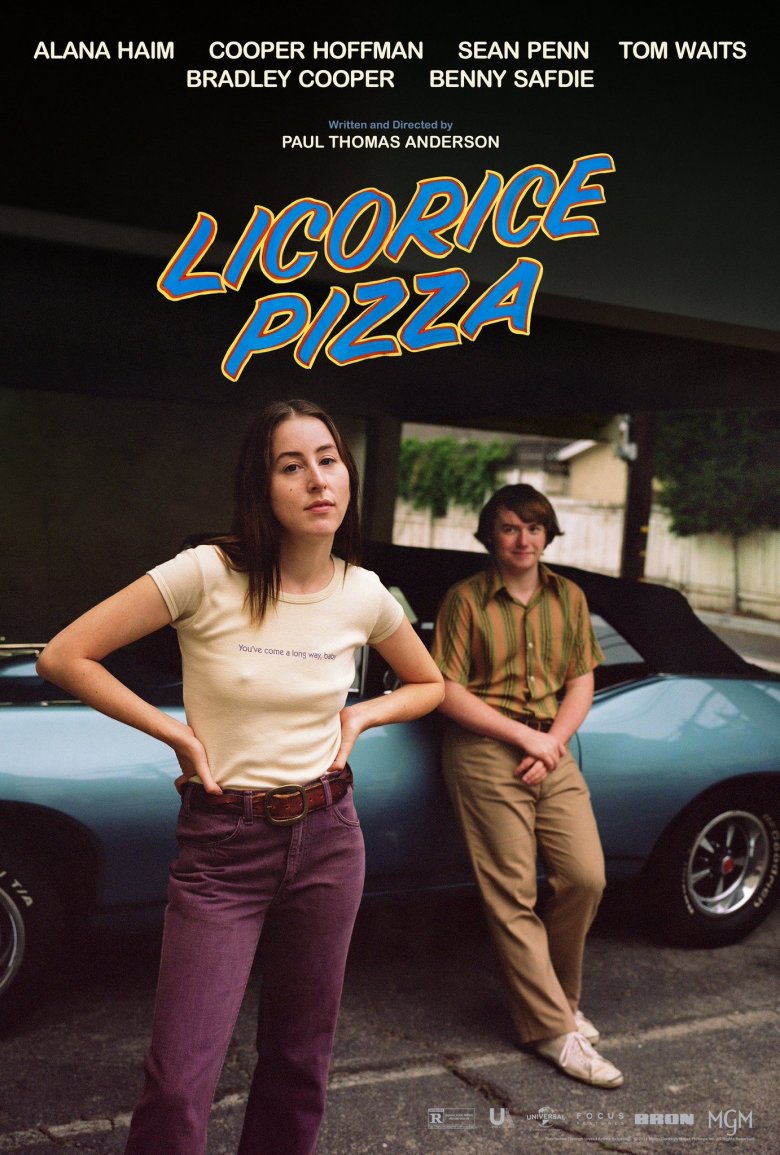
Licorice Pizza is a sprawling, sweet, completely deranged movie that ultimately feels like more of a game of chicken to see which of your friends is going to blame you for two hours of time wasted, because when it comes down to it, this movie is a story about a twenty-five year old girl whose options for boyfriends in 1973 are so bad that she ultimately chooses to date a fifteen year old boy. Look, I am no stranger to these movies, and there’s obviously something to be said for the magic of different age friendships. Anyone who watched Netflix’s Crip Camp had a sense that the 70s were a time of experimentation when the psychic resources of confident teenagers and twenty-somethings could be drawn upon to equip the next generation for the struggle for equality. So, when I say that this movie was not high on my list of recommendations if you aren’t under the age of seventeen and a precious little white boy for reasons entirely apart from the age gap romance, I hope that this is a warning sign.
I got the sense from a couple of best movie of the year lists (NPR, Slate), that this movie had created a “Discourse” that was possibly getting in the way of enjoying the movie itself, but I didn’t spend too much time investigating, because I wanted to be free of any bias beyond the delightful scenes of running I had caught in the trailer. Coming out of it, I wonder if I had understood better why Asian advocacy groups were so pissed off about this movie I might not have avoided it, but I might have chosen Matrix: Resurrection or Nightmare Alley before seeing this. I’m not saying that I think you’re a bad person if you liked this movie (Bob Mondello), but I am saying that I would have some follow up questions for you before I quietly deleted your number from my phone.
I don’t want to belabor the point too much, but if you haven’t seen the movie or you don’t intend to see it but want to be mad for a few minutes, there is basically where this douchebag middle aged white guy who’s lived in Japan for too long to be racist about it talks to his wife in front of real life people like he’s a badly dubbed karate movie–in a moment when Gary Valentine’s mom has just dropped a casually sexist, racist trope on this poor Japanese woman’s advertisement for her restaurant. No one really comments on it. We really only get this one close up of Gary when the wife politely asks (in unsubtitled Japanese) for different copy. Gary smiles with a shit-eating grin that might say, Haha, she didn’t like your copy, she likes mine, or it means, I didn’t get away with my racist “doll” joke. Hard to say, because, really, they’re both equally likely, which is a sad commentary on the times and Gary’s weirdly oblivious, codependent mom. And then it happens again. This dude comes back later and he has a different Japanese wife and they do the unsubtitled Japanese bit again, but at the end, to twist the knife, when asked by Alana what was said, the husband responds, “It’s hard to say, I don’t speak Japanese.” What?
It’s at this point that I’m wondering if this is a thing? Is Paul Thomas Anderson thinking of someone in particular? Am I missing a reference? Having known a lot of people in bi-racial Japanese relationships, even ones from the 1970s, I don’t have any examples of anyone speaking like this in broken English ever. The first scene is something that could be tolerated, but its call back really feels odd and obsessive and weird. For all the movie’s satire of casual racism from the 70s–they do not hold back at all from the frustrating antisemitism Alana has to endure–it feels especially strange to include this second scene, especially because there are no Asian voices to push back in this movie. For all of its interest in race relations, our most prominent black actress is a sex object used to seduce a wilier Gary into purchasing a water bed. Maya Rudolph gets her own sight gag to lampoon Gary’s ungraceful aging out of child acting, but weirdly it almost serves to emphasize the fact that Gary is maturing enough to be a real contender for Alana’s affection and not just a sad mistake she makes out a sense of depression and hopelessness.
Licorice Pizza straddles the line between an Australian indie movie like Breath, which is virtually unmarketable because of the age gap sex scenes, and the darling film adaptation of Scott Pilgrim Vs. the World, in that Licorice Pizza is able to achieve a wide release and cameos by big name stars while also executing some of the most filthy psychic sucker punches imaginable. At least in Scott Pilgrim, which is one of the few mass market films in recent memory I could think of that features an age gap relationship, Scott’s character’s choice to date a minor is commented on with derision and hostility, Scott is forced to apologize to Knives for taking advantage of her, and Knives is given multiple opportunities to steal the show with cool fight scenes. In LP, we’re coaxed into accepting the romance through a slow boil of context and history, and there’s not a lot of commentary on why the dynamics are weird, which makes sense because the circumstances in which Alana and Gary meet are so contrived that they can’t really be voiced without ruining the illusion: Alana is isolated socially, doesn’t really have friends, yet we see that she maintains positive relationships with a lot of the older girls in Gary’s orbit; Gary is independently wealthy, Alana is poor; Alana is worldly wise but innocently hoodwinked by any boy or man who pays her mind; Gary toggles between attraction toward Alana and the other fifteen year old girls from school; the details of his time at school fade as the relationship becomes more serious because to continue to include those details would undermine the romance.
For those who like this movie, I assume it feels like a boomer take on Jane Austen, a comedy of manners. It’s a winter movie masquerading as a summer movie, but the things that drag it down are hard to ignore. Alana’s motivations for falling for Gary depend heavily on a sense of existential dread, desperation, and the charisma of a fifteen year old boy. Gary, as it happens, is a dick. The scene where he says Unspeakable Things at the set for the interview with the candidate for Mayor (Wachs) introduces a moment which should indicate to Alana that Gary has a mean side and no amount of maturity is going to lessen that. Alana never asks for an apology for saying that without him she would be nothing and nobody and that the world revolves around him. Why is it always up to her to be the one who apologizes? Why are all of his hijinks a direct result of his wealth and power which she lacks?
Skyler Gisondo’s Lance is probably the second most compelling character aside from Alana herself. Gisondo does not simply reprise his role from Booksmart, but finds entirely fresh ways to be awkward and smarmy. Alana Haim and her entire family are transcendent and every moment of her on screen is compelling, fun, funny. I suspect her performance is the reason why this movie received any of the buzz it did, and I hope the next movie she chooses will have a little less random race-baiting.


