
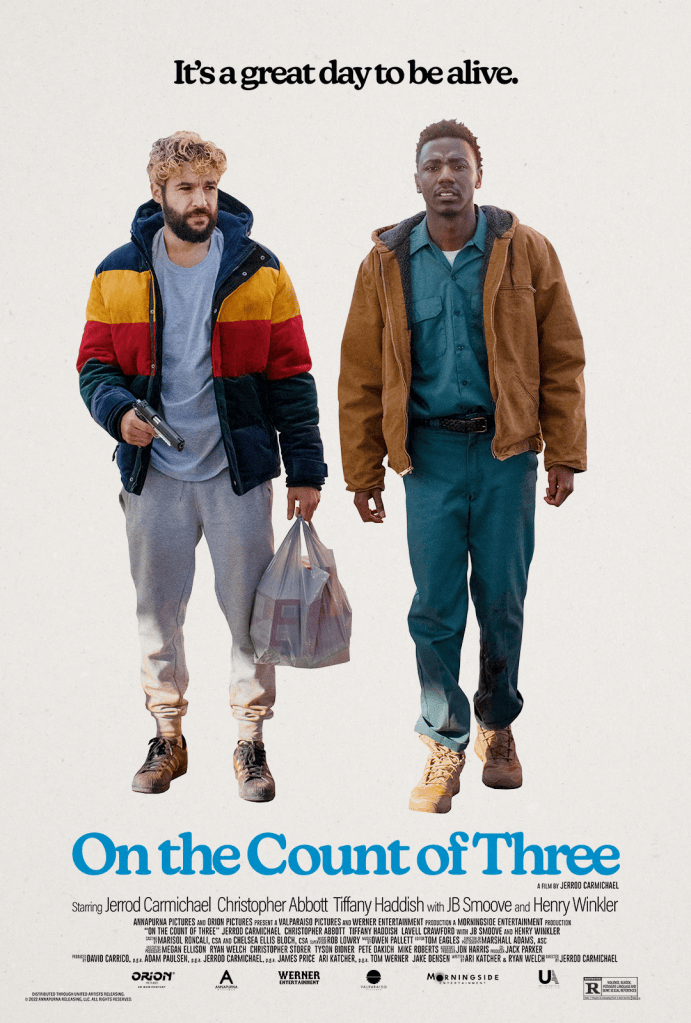
On the Count is what if Queen and Slim but suicide pact. It has the same level of shark jumping and none of the cool visuals. Carmichael has little to say that hasn’t been said and the film cannot save itself from rolling the ball up the hill, as Jo Walton describes the tendency to write lazy, trite, comfortable plots.
There’s a scene from the TV show Louie by the long-time disgraced Louie CK that set a standard dark comedy’s discussion of suicide ten years ago. The tone is exasperated and callous, an old feeling in the guise of a new, slick twist on the politically correct way to speak to those suffering from mental illness. Do it already and The rest of us are too busy trying to keep our careers and our family’s together to deal with your narcissism are the refrain. It’s couched in a sense of resentment about being made to perform sympathy and do the “emotional labor” of coming up with reasons to live for others–sentiments that are easy to identify with by the ones who have to pick up the pieces and move on when their loved ones inflict pain and trauma through their death in the least considerate and resolvable of ways. You could see how the fantasy fulfillment of yelling at your would-be suicidal friend in the 2011 episode from Louie could be a response to something like Netflix’s Thirteen Reasons Why, which mainstreamed fantasy fulfillment from the opposite perspective, the vantage point of being able to control the effect of your suicide on others.
Suicide, as I’ve said many times before (probably most clearly in Damsel in 2018), is the antithesis of resolution, which is why it is so deadly to plot. On the Count of Three isn’t just suicide as plot, as in “in lieu” of plot. This movie’s plot is entirely suicide, which takes the sting out of a lazy trope. That Louie episode encapsulates a lot of the energy of On the Count of Three, the exasperation and the hopelessness, but it spins it into a something more kinetic than Louie’s diatribe.
In Jerrod Carmichael’s directorial and acting debut, he partners with the excellent character actor Christopher Abbott, who specializes in playing dickheads most memorably as Charlie in four seasons of Lena Dunham’s Girls (He’s also graced these hallowed halls in Black Bear opposite Aubrey Plaza in 2020 and in the weirdly unimaginative It Comes at Night from 2017, which I neglect to even describe as a knock off of The Survivalist in one of the very first entries of this blog). Val (Carmichael) breaks Kevin (Abbott) out of his suicide watch so that they can “do it right” and commit to a murder-suicide pact in an oddly sweet and off-color buddy comedy premise. Obviously for the plot, Kevin balks at the last moment and asks for a day, during which time (SPOILER), Val decides that he does not, in fact, want to kill himself, leading to conflict within their friendship. The way Wife described her impression of this movie to me when I pitched it to her was “Oh it’s like Booksmart, where one of the girls decides to take a gap year.” I think that might be exactly what Carmichael is going for.
In some sense, I think this movie has a lot in common with buddy dramedies like Hell or High Water (two brothers Bonnie and Clyde it against capitalism in Nowheresville, USA) or Queen and Slim (two 20-somethings on a date accidentally on purpose kill a cop and try to get away with it), but also maybe it has more in common with some high school best friend comedies like Booksmart or even Plan B? There’s definitely a trend of movies (Vulture calls them “abortion thrillers” and Salon gets even more granular with “abortion road trip comedies”) trying to put their finger on ways to depict and talk about abortion in fresh ways. It’s easy to see how the serio-comic buddy movie for men that’s lacking is about the suicide epidemic among young men in America.
You’d think that Carmichael, with more than ten years of time to think about the Eddie episode, to reflect on his own transformation as a comedian, especially as a queer black man, might have something new to say. He’s had ten plus years to observe the changes in comedy which largely have begun to recognize and take into account mental illness (and to set aside its love affair with some of the grosser comics who took aim at these conversations, see Louie CK, again). You’d think that, but you’d be wrong. Trauma plots abound in On the Count, and a lot of the film’s wish fulfillment takes the form of violence. It’s an angry and unable to express itself with emotional language. Val’s friend Kevin dispenses pithy psychobabble like “To forgive is to set a prisoner free and to recognize that the prisoner is you,” but he’s (SPOILER) obsessed with the idea of murder-suiciding his abusive childhood psychiatrist, The Fonz, because Trauma and convenient to the Plot. The film’s wry commentary on gun violence is better than its perfunctory asides about mental illness which the film is oddly mute on, despite its centrality to the plot. Probably the best scene of the movie is the opening when Kevin unsuccessfully attempts to sweet talk his doctor into releasing him just days after his suicide attempt, and then lets his true self leak out in true God of Carnage fashion.
On the Count of Three falls off the rails around the same place as Queen and Slim, which is to say, pretty early, but also when it counts most, the end (SPOILER): Kevin’s abrupt and unearned exit in the penultimate scene leaves little room a more challenging conversation, because the ethos of this film is, like the Eddie episode, not up to the task of shouldering the emotional labor on behalf of its supporting man. All of the good will that their relationship has built up over the course of the day’s events, every quiet moment of restraint at the Lake and every aborted opportunity for redemption or violence is squandered in his final moments, confirming that suicide is, in fact, a plot killer, anathema to the enjoyment of the advancement of a satisfying script.


