
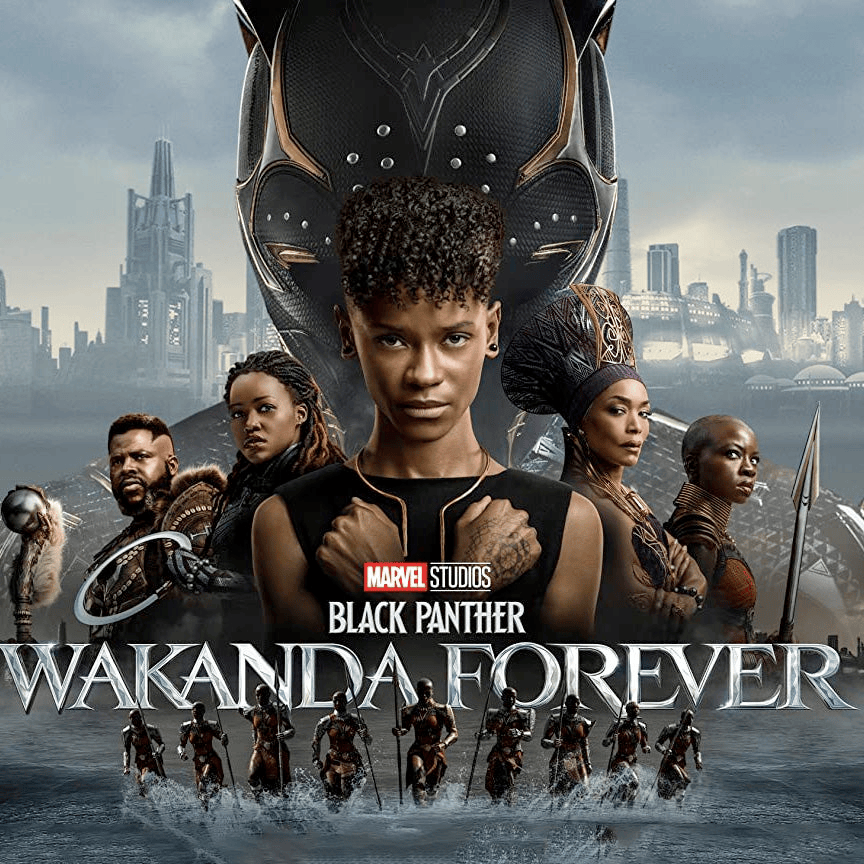
The whole time that I watched Wakanda Forever, I kept thinking “ambitious” is the word we use to describe movies we like that don’t have the discipline to tell its story. Black Panther has all the good will in the world–a talented director, a loyal fan base without a vicelike grip of orthodoxy on the direction the franchise needs to move, a powerhouse of an ensemble cast, a soundtrack that continues to set it apart from the rest of the MCU–and yet Wakanda Forever lacks the sharp criticism of the first film, suffers from sequel bloat–perpetually honoring its fallen hero, Chadwick Boseman, even as it teases Ironheart for no obvious reasons, stuck in a revolving door of grief for big names exiting and new faces entering the franchise simultaneously. Spoilers ahead.
The plot appears to be based on a popular children’s allegory for the Trump era known as the Fate of Fausto. Shuri, grieving from the loss of her family, leads the entirety of her country’s army into the ocean in order to fight merpeople before noticing that she’s chosen some… disadvantageous territory to fight on. More than one person I’ve talked to has pointed out that there are some silly, reductive racial aspects to the to the match up between two powerful minority-majority nations fighting against one another, and that all appears to be added to the film adaptation by Coogler himself, because it’s missing from the children’s book, which, again, I heartily recommend against the advice of Wife.
What makes Black Panther work so well haunts Wakanda Forever at every corner, exposing what’s missing and throwing into stark relief the ways in which Wakanda Forever’s story feels thinner and less developed.
The cameo during the Dreamwalking sequence is excellent. As a choice, in the absence of Shuri being able to reconnect with her brother or recently deceased mother, this is a surprising and rewarding choice. Some of the best storylines in MCU have been when heroes touch the darkness, as Rings of Power might put it. Angelica Jade Bastién describes what’s missing emotionally from the sequel this way:
The Marvel framework tends to falter when it comes to portraying genuine, complicated feelings, and what is more complicated than grief? It lacks a linear quality. It isn’t something you can overcome with a magic spell or godlike abilities. It breaks against the form and function of a Marvel property.
Vulture, Angelica Jade Bastién, Black Panther: Wakanda Forever Doesn’t Have All the Answers
When for a sustained period they are allowed to experience emotions that are regularly reserved for villains. Shuri’s rage is alluded to early in the film during the anniversary of her mourning when she tells her mother that she cannot think about her brother’s death without wanting to burning the world down. But part of the weakness of Namor’s entire justification lies with what makes Killmonger and Black Panther in general so compelling and Wakanda Forever so vexing. Killmonger repeatedly voices the anti-colonial critique, the urge to meet violence with violence through the export of Wakandan weaponry as a reaction to a history of racism and colonial oppression of the global south.
What makes Killmonger’s arguments in terms of international policy and within the MCU so interesting is the way in which his interest in a more assertive foreign policy contrast with the America First, isolationist political rhetoric that had taken hold in 2018, which was already subverting some of the traditional political alignment of the early 21st century, the reaction to the failures of American “Nation-Building” in the Middle East, of curbing the expansion of weapons programs in Iran and North Korea, and even within the MCU, the wind down of SHIELD after Winter Soldier and Hydra’s infiltration.
In Wakanda Forever, Namor rightly identifies in a stunning–Wife describes as “Jungle Cruise-like”–five hundred year flashback that his kingdom–seeded by approximately fifteen people, or maybe they’re constantly kidnapping people and feeding them the flower to turn them blue?–that he too has experienced the horrors of racism and colonialism and would like to seek restitution, but he then directs much of his animus towards the only people who might truly be associated with those horrors, Wakanda. In fact, his accusation that they should be punished as collaborators betrays a real misunderstanding of their culture, all because–Wife surmises–the Wakandans suffer from power creep and an ever-growing Russian doll of antagonists who must meet them at their advanced level. The whole conflict feels unncessary and shoe-horned in, and ripe–Vulture bravely suggests, for a steamy, tense romance, which I am in favor of in any permutation you wish.
Just a laundry list of things that continue to consistently represent for me missed opportunities for cool: The Midnight Angels are part of a trend of masked combatants that Black Panther was not immune from, which makes it hard to follow fights with any level of emotional attachment. The masks make it hard to read faces and make the combat a lot less expressive, even if it’s easier to do the CGI editing without a human head in the way all the time.
What a gut punch that Okoye never gets to have a reconciliation with the Queen. Their last words together are “I”m done with you” and that’s not entirely a bad thing? But at the same time, it means that you get Friends who say things like, why couldn’t Shuri give Okoye the flower or Nakia, for that matter (my pick)? Shuri had a good thing going on as the young, snappy jokester in the lab and now she’s the dour, serious, intense facsimile of her brother. And then we haven’t even started with Riri Williams. Having not kept up with any of the developments beyond my current Marvel crush, Kang the Conqueror, Riri Williams is such a cool introduction and also such a letdown of a character. She doesn’t actually get to show off how smart she is when she goes to Wakanda. What could have easily been a truly collaborative effort to synthesize the flower between two people who have totally different upbringings is really just a short montage of watching Shuri shout at her computer. Even Tony Stark had an extended jam sesh with his arm-y robot thingy, why can’t Riri get her moment in the spotlight? At least she didn’t have to wear a face-covering while she was killing ancient Aztec-Mayan mermaids.
It’s hard to say that this movie is bad for a lot of reasons, not least of which is that it doesn’t deserve to be mediocre–“graded against other MCU movies,” Wife insists, “it’s pretty good.” But that’s a downgrade for a franchise that felt innovative and groundbreaking only a few years ago.


