
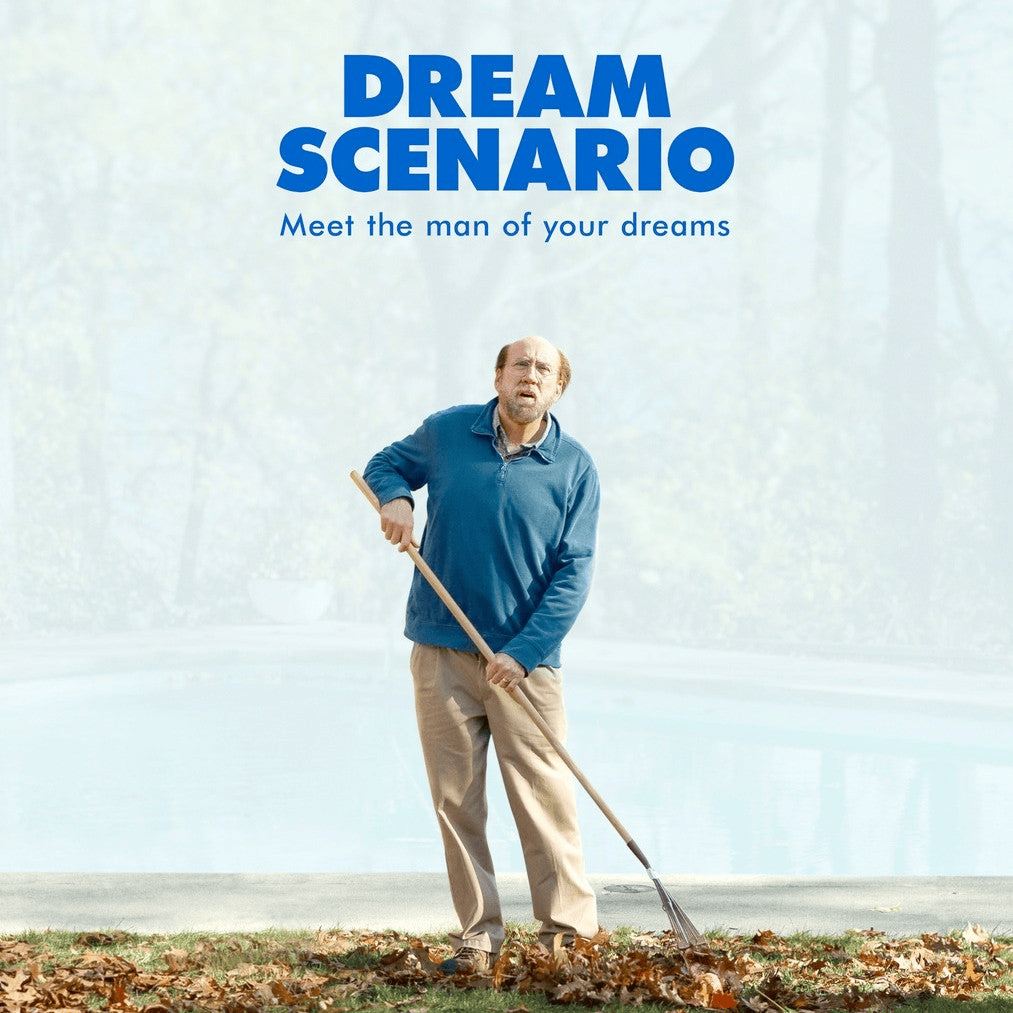
One of the first things that I talked about with Bestie when we were getting to know each other this year was her obsession with Nicholas Cage films. When I had mentioned going to see him in Renfield, she quickly rattled off twenty or thirty of her favorite Nic Cage films in order of craziest, and that’s when I realized I really hadn’t seen him in anything since 2010 in Kick Ass and before that really just the National Treasure movies, which I think are kind of like Gen Z’s Indiana Jones movies? Anyway, I think it’s fun that one of the last movies of the year is going to be a send up to Bestie’s hero, the Guy Fieri of the silver screen.
Dream Scenario’s first half has the cringiest seduction scene imaginable (featuring Dylan Gelula from Flower!) and the second half is mostly nightmare sequences and some commentary about cancel culture. Friend said it was her “favorite film of the year” but she also said that about Bottoms and Thor: Ragnarok and she took an edible half an hour before it started, so I really don’t know how useful that is as a secondhand review.
The structure of this film is sort of wonky if you think about it in terms of some classical rules. The hero is bog-standard American anti-hero in the vein of Willy Loman: petty, whining, entitled, mediocre, constantly score-keeping, pining for the glory days that never were. Where we would maybe lament a good guy or even an ordinary guy having something horrible happen to him by Aristotle’s standards, we’re really there to watch this guy pour gasoline on himself a little bit. Even the genre of this movie “comedy/horror” kind of messes with the three act structure, leaves us at a loss in the final scene (a little like why people seemed to like La La Land‘s ending so much?).
What is the purpose of the final act device and the dreamfluencer plotline? Everything before that moment feels magic and creepypasta, divine and mysterious, and then suddenly we’re given a rational explanation that’s not actually that satisfying.
While on the topic of satisfaction, it’s hard to really conjure up warm feelings about the politics of this film’s fixation on cancel culture. It, like Netflix’s The Chair before it, creates a magical student body of sensitive idiots, rather than the much more common and real population of politically motivated partisans using speech-dampening rules on college campuses to silence and punish liberal voices (this is Jill Lepore‘s take in These Truths).
Cancel culture, as it appears in these two fictional worlds on college campuses, is the result of overly empathic students misunderstanding reality and projecting their own egos onto whatever they come into contact with. It is unrelenting, swift, and final in its justice, which is administered by HR as well as the student body as a whole. We can zoom in a little to Dream Scenario’s specific situation for a moment with some spoilers. Professor Paul Matthews’s students are having violent nightmares of a sometimes sexually charged nature about him and so he is placed on administrative leave? Someone tries to spook him in his home? Once? He has an awkward interaction with his kid’s teachers at school?
The trajectory of his dream visitations, as I mentioned earlier, doesn’t quite follow the prescribed path of “Man in the Hole” that Kurt Vonnegut talks about in story structures. It’s much more the bittersweet one two punch: things are nice, Matthews tries to take advantage but reveals himself to be too small and petty for the fame he’s given, and then when things get bad, he seems too small and unimportant to really deserve the full heat of the fire he’s tossed into, like Justine Sacco.
So, who is this a commentary for or on? Friends were very happy to describe this as the newest iteration of Being John Malkovitch, a semi-autobiographical story about Nicholas Cage’s ability to “accurately sense the way he is perceived by the public” after a long and meme-y career and a renaissance in his silver years, as Friend put it, but I don’t really understand the point of a movie whose sole commentary about the nature of fame is “It’s fickle,” when the object of that fame is so universally adored. Let’s stop and think about the way in which Prof Matthews’s is treated by his friends and family and see if there’s anything profound in their portrayal in Dream Scenario: the movie makes an interesting choice of closing off Matthews’s wife Janet from any dreams about her husband, and for the most part, Matthews himself doesn’t have dreams–with a couple of notable exceptions, and his children seem to have dreams about their dad, but nowhere near as graphic or violent as the ones that their friends have. If one of his daughters were to confess that any one of the violent or sexually charged dreams that had happened to the college students had happened to them (something fairly standard in Freudian dream analysis), Matthews’s reaction to his detractors’ “lived experiences” would probably be a lot different. The worst thing that Janet says to him is that she’s embarrassed to be his husband, at one point, after a particularly cringe tirade he posts to the internet. Matthews’s work friends give him a place to crash for the night. He has some uncomfortable interactions with the public, but not so much that he ever needs to completely abandon his everyday life. So how bad is his cancellation, really?
Agnes Callard writes about cancellation in a wonderfully funny essay called “If I Get Canceled, Let Them Eat Me Alive,” in which she advocates for people to cultivate a set of friends and loved ones who are willing and eager to disagree with you when you are wrong and do so in a public manner when need be, not to socialize with others simply because they share your opinions about the right sort of things. Those are “allies,” not friends, Callard says. This is the sort of commentary that I find beguilingly simple, contrary, and useful when living my life. All of us who deal with complicated topics, who write about interesting things, will, definitionally almost, say something that offends others, and at that point they’ll be cancelled, Callard suggests of herself at the beginning of her essay. Cancellation is not a social trend so much as a consequence of free-thinking. And not everyone who gets canceled in television or in real life is fighting the good fight of truth and justice, but Callard is saying that when you think out loud in public, which is the best way to think, you best surround yourself with people who love you enough to tell you you’re wrong. Dream Scenario is in love with the trite roller coaster of emotions that comes with the same tired critiques of SJW slacktivists firing up their laptops to virtue signal, but it isn’t actually that interested in making any kinds of claims about the quality of redemption, what is required for grace either from the actor or the observer.
And if the true object of this cancel culture movie is to highlight the injustice of ordinary people being thrust into the limelight, to lament the fact that we all get our 15 seconds of microfame, to borrow Tim Wu’s formulation, then why pick the demographic least likely to be canceled, the boring, straight white male tenured professor from a local college? Is his indiscretion with the assistant Molly the trigger for the winter sequence that never thaws? If so, why does he never wrestle with that fairly anodyne interaction later? Why not introspect on that exquisitely weird and fleeting moment of infidelity? And if there really is no explanation for the turn in tenor of his dreams, what is the point? That wholesome Try Guy Dad Dudes can be flawed too? That our parasocial relationships cause pain to the relatively powerless performers we idolize? That seems sort of… empty? Maudlin and reductive?


