
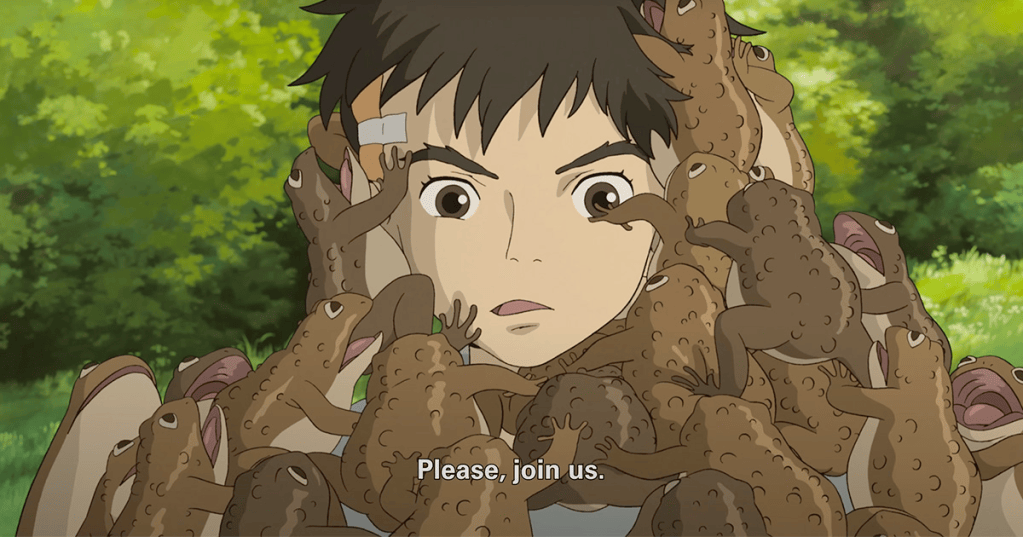
The Boy and the Heron is a cross between Coraline, Pan’s Labyrinth, and The Lion, the Witch, and the Wardrobe. Miyazaki returns to the adult themes of loss, regret, self-destruction, and shame in his most recent film. Wife and I had seen The Wind Rises back in Vancouver in 2013 and it was challenging and strange, but if memory serves it was more historical than magical realism. The Boy and the Heron blends some of the political themes of Wind Rises with the whimsy and strangeness of Mononoke and Spirited Away.
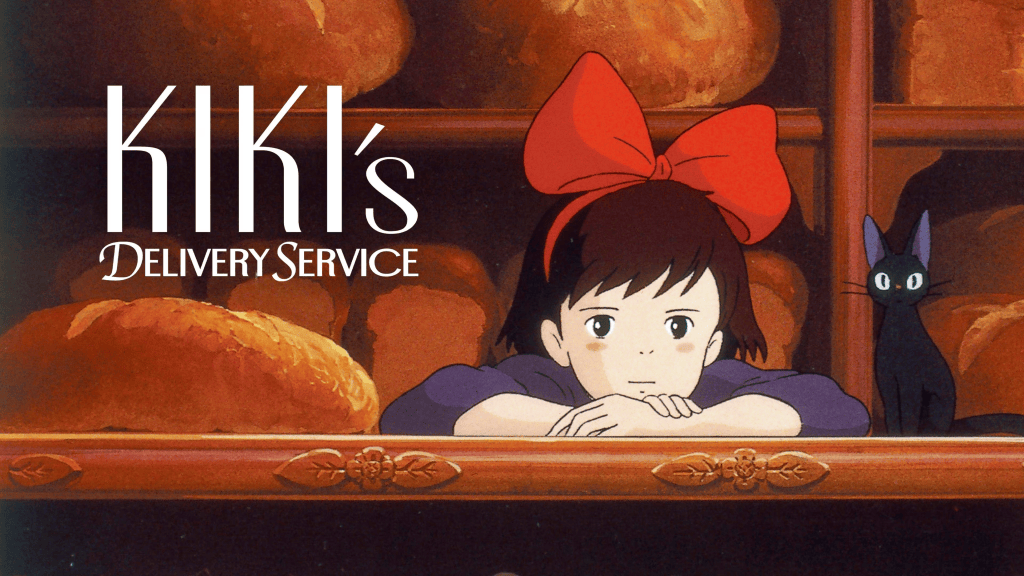
I’m not sure I’ve gone on record saying this here, but I have been steadfast in my insistence that Kiki’s Delivery Service is at the root of a lot of evil in the world. Kiki’s lowest point is that she can no longer talk to a cat and she has to deliver her packages the way that everyone else in the world has been doing for centuries? Boo-fucking-hoo, Kiki.
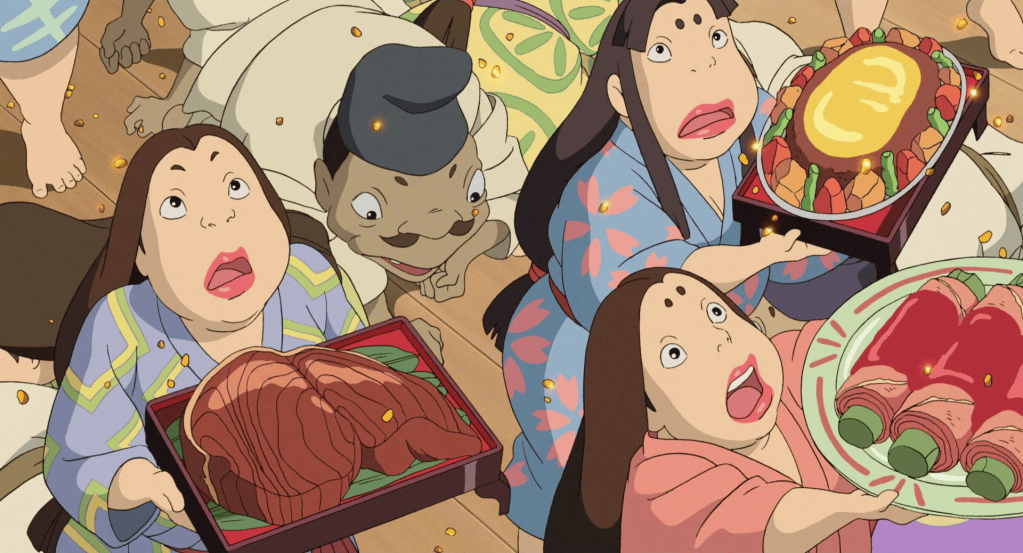
A lot of the children-oriented Ghibli films grate on me because of the lack of stakes, the way that the characters drown in an aimless, atmospheric malaise of pretty settings (hi Ponyo, Totoro, I assume). I think my first exposure to Ghibli was the adaptation of a Diana Wynne Jones book, Howl’s Moving Castle, which hit me right at the peak of my sci-fi/fantasy phase as a teenager. Some Ghibli films I’ve grown into, like the way I learned Neil Gaiman circuitously was responsible for the English subtitles of Mononoke. Some, I still have a sensory reaction to seeing for the first time, like Nausicaa and the Valley of the Winds, which felt like seeing Star Wars for the first time as a kid. I remember keeping Spirited away as a movie on my desktop through most of college and then quietly taking an evening to see it as a young adult for the first time and being so confused that Chihiro doesn’t try to save all the slaves who work in the castle despite the fact that the humans that come to visit are eaten or turned into animals that are eaten.
Which is all to say that I’ve gravitated toward the films that pose more questions than answers, with strong female protagonists, and a complicated moral framework. Dana Stevens’s Slate review confirmed all that I needed to hear about this film, so I skimmed the first few paragraphs and then booked tickets. I’m going to discuss some things that could spoil your enjoyment after the jump.
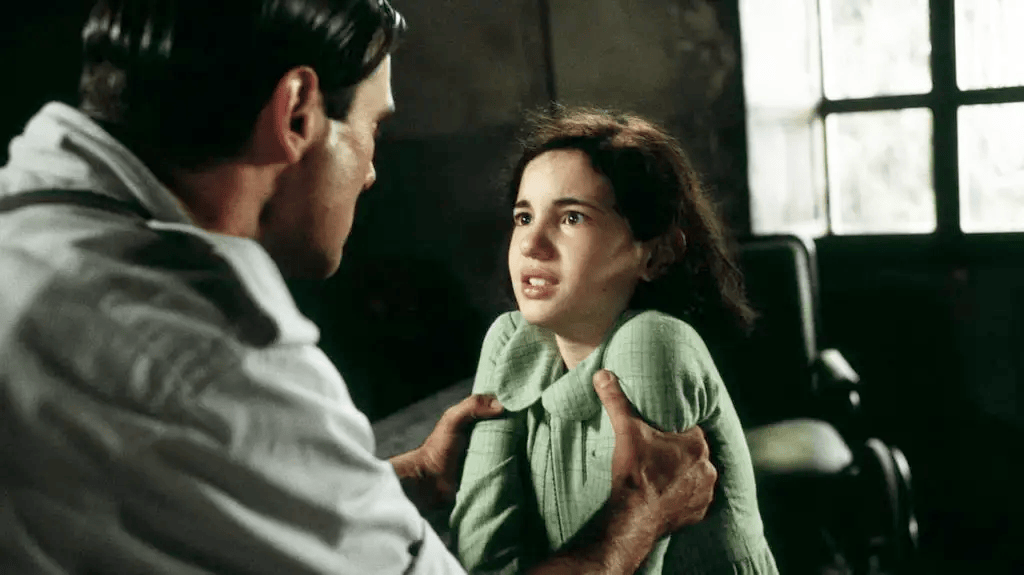
The first scene of this movie is essentially Mahito Maki waking up to see a fire in the distance during the lead up to WW2. His dad says “that’s your mom’s hospital” and then everyone takes off running toward the flames. Cut to the next scene where Mahito and his dad are traveling to move to the country a few years later. Mahito sees a young woman pull up in a rickshaw and comments that she “looks so much like my mother” at which point Mahito’s dad drops off his things and goes to the factory where he’ll be working and leaves his son with the woman, Natsuko. Natsuko turns to the boy in the rickshaw and says something to the effect of, “Don’t worry, I’m going to be your new mom. Here, can you feel the baby kick?” So within the first five minutes of this film, we get the full gut punch of a Dead Mom AND a remarried to Dead Mom’s Sister story. Fully and entirely a Pan’s Labyrinth-type story twist.
The Heron is fully nightmare fuel down to its weird little round teeth, and the fact that it can quote the screams of Mahito’s mother in her dream to him when he’s awake. Their relationship throughout the movie is so perfectly insane. One moment that sticks out in my head is one of the craziest moments in the entire story, when Mahito and the Heron approach a small farmhouse and the Heron offhandedly mentions that there are no people around because the owner of the house raised parakeets and elephants and they ate all the people and then you see these giant bipedal parakeets. The Heron offers to create a distraction to give Mahito time to investigate the house in search of Natsuko, and it seems like maybe the Heron is warming to the boy because he’s helped restore his ability to fly in just the previous scene, but it becomes clear the moment that the Heron flies off to sea that he has left Mahito to spring a trap for himself, one he’s really only rescued from by Himi, an incarnation of his late mother. How messed up is that? You get forgiven for being a liar not once but twice by the kid who bested you in combat and your master wizard tells you to help the kid out and you STILL trick him into maybe being eaten by parakeets?
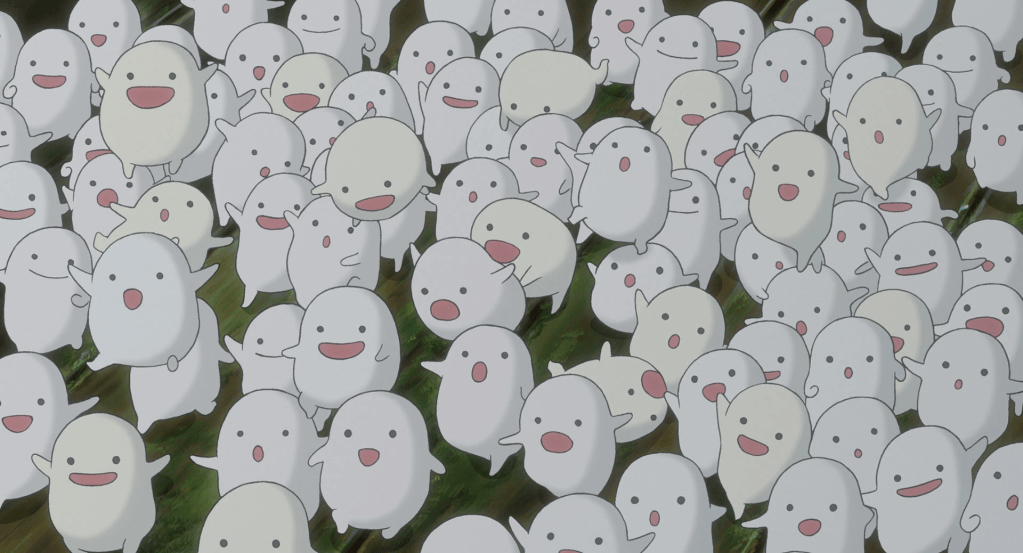
Probably the most clear moment in the movie that we are in a morally grey universe is this scene where these kind of marshmellow-looking guys called warawara, which just translates as something like “bustling,” “shuffling,” “creeping,” “crawly,” are kind of floating up into the sky when suddenly some pelicans that pushed Mahito into a definitely-would-have-entranced-then-killed-him death shrine previously return and start eating these cute fuckers out of the sky. Mahito freaks out and then suddenly a flame princess starts shooting fire into the air to kill them ALSO KILLING WARAWARA. And after all of that Mahito comes out later that night and finds a maimed pelican dying near the outhouse who asks him to put it out of its misery. How completely fucked is that? The movie doesn’t even give you a fucking rest for two minutes to grieve the loss of all of those gumdrop motherfuckers before you have to start considering the mortality of all the pelicans who’ve been introduced into this Underworld in order to cull the population of souls that are allowed to rise up into the world. Oh right, the warawara are souls. Did I not mention that? Yikessss.
This is also around the time when Friend turned to me and said, “Ah this movie is for you,” in the discussion which kind of jumps around from a bunch of the old maids talking about the missing boy and his stepmother by mentioning the tower was not actually built by the eccentric great grand uncle of years past, but rather built around a massive cosmic rock, which, by the telling of a denizen of the Underworld, appears to exist in multiple worlds all at once. We don’t get much more mention of the multiversal aspect of the story until a little later, when Himi rushes Mahito to a hall of doors with strange numbers on them and asks him if he wants to return to his own world yet or not. The fact that there’s so little explanation for what’s happening here is one of the hallmarks of my favorite characteristics of Ghibli films. Where do the other doors go to? At the end Himi says that she can’t go with him because she needs to go to a different time to be his mom, but then the sailor who isn’t from that timeline (she says she was born in the underworld) goes with Himi, so what gives there?
Friend suggests that it might be two things happening. One is that there appears to be some amnesia effect once you travel from one world to another, but also we clearly see that when being pass through at least Mahito’s door they can change in form. So maybe, Friend says, Himi would change into a regular non-fire magician if she went to a different world or timeline? Maybe, Friend suggests, the sailor is approximately the right age to enter and would’ve changed as well? All of it feels a little too pat, a little too perfect, and I’m much more interested in this other aspect of the multiverse that they seem to have decided, which is that every being kind of exists as the only version of themselves in all worlds. They don’t have variants or doppelgangers, but rather as they pass through worlds, they change to suit the rules of that world.

I saw this movie with English subtitles because I’m not a monster, but upon reflection of the English cast, I really wonder if I need to see it again like Friend is, because she liked it so much.
This may be my last review for the month until I’m back from traveling (I wrote the Trolls review earlier today, and I have three or four I want to see with Wife when we’re away, but we’ll see how much can be written on a phone or borrowed computer). In lieu of any more reviews though, I think I can write a little bit about the year in review. I think this makes for roughly fifty films in what constitutes one of the weirder years that I’ve written about movies since this all started. Between the second monster in the spring, the summer strike that stretched into the fall, and starting to take the first monster to see her first movies ever this past summer, it’s been a strange and wonderful time. I didn’t think that I would be seeing Kung Fu Panda, The Secret Life of Pets, The Little Mermaid, or really any old Disney movies this year when things started. I certainly didn’t think I was going to be staying up late on Thursday and Friday nights to be ready to discuss movies with a bunch of octogenarians and Bestie on Saturday morning Zooms, but it makes sense that this weird period of time has sent me to return to some comfort movies (First Reformed), to revisit classics I haven’t thought about in ages (Wall-E, The Odd Couple), and to learn about people through their favorite movies (Saved!, Six Foot Hero, God Bless the Girl, Beetlejuice).
And just as much as the movies you watch in a year telling the story of what you’ve done, there are so many movies I didn’t get to see this year, and that time too is indicative of the wealth of people in my life vying for all of this valuable time. To another years of movies with the monster, another year of finding old ones to share and new ones to experience for the first time together. To fewer sequels and more originals. To fewer biopics and adaptions and more musicals. To less backstory and our first drive in. Happy New Year, everyone!


