
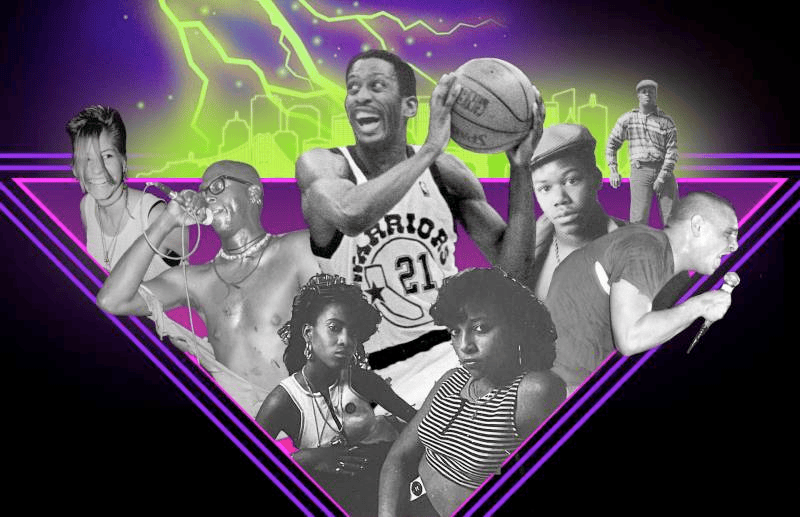
Freaky Tales is a movie with a lot of gas in the tank: described as a “Roshomon-like” film with overlapping stories, what Friend calls “Once Upon a Time in Hollywood vibes” because of its 1980s period setting and black surrealist elements, resplendent with send-ups to blaxploitation and Oakland pride, stuffed with lore, and filled out with a killer ensemble cast with an even more killer (spoiler) Colin Meloy-esque The Stars Did Wander Darkling-type cameo. The casting itself is a kind of parlor game, where real life people are double cast as themselves and also as tertiary characters in their own biographies (i.e. the rapper is a cop, the basketball player is a background person, etc.).
My own experience with this movie is sitting next to three of the horniest women I have ever met in public literally barking at the screen whenever Pedro Pascal’s face was on screen while Friend wailed at them laughing at Pedro but also pointed out any music location to say “I’ve been there” and any bus to display his encyclopedic knowledge of Oakland transit routes (“I’m a transit nerd”), about a beer and a shot in at ten thirty at night on a Friday, which is about right for the vibe of this movie. If you don’t have a person or a theater in your life that can help you replicate this combination of events, it’s probably something you need to correct, like hand wringing over whether or not you have enough PoC friends at your wedding (if someone can find me the Slate advice column about the nice white couple who doesn’t have any black friends to “fill out” their guest list, I’ll give them a cookie).
Walking out of the theater past midnight, I wondered aloud to Friend if I liked the first or last act most: much like Kinds of Kindness, a movie only people chronically in theaters ever saw, it felt like a movie whose acts could be easily shuffled around, but that the kinetic scenes were arranged tightly to fit in an intended order. For that reason, the first act feels both fresh, poignant, politically relevant, but also a little flat and shallow: rainbow coalition of disabled, Asian, nice white bois and punks all band together to fuck up some Nazis. There were scenes in the first sequence that I called because they were so predictable. The final act is a lot more A24-esque gonzo, a lot more visually inventive and daring, but also sort of light on plot, heavy on action–what Senecan and Kurosawa scholars both describe as “atmospheric” or vibes-based storytelling. The third act is eclectic, beautiful, schlocky, and imagistic, but it lacks nuance that some of the more emotionally impactful moments like the twist in the rap battle story when Entice realizes why they’ve been treated so hospitably.
Even more interesting is the fact that Ryan Fleck (Bay Area native) and his collaborator Anna Boden (MA native), the pair who directed the Captain Marvel movie that made a billion dollars, wrote and directed this movie, which at first feels a lot like the kind of fact that could lead to the criticism leveled at director Anna Rose Holmer by some black movie nerds for her really fun and problematic movie The Fits in 2015 (mayonnaise people telling black stories), but it really does feel like a fundamentally different case study with a lot more diverse roles, a lot more community buy in, and a lot more collaborative storytelling here. The inimitable Ben Mendelsohn apparently has a long-running collaboration with this directing pair going back decades, which means he has an amazing role in this movie as a kind of unsettling cop.
It’s creative lineage makes me a little queasy to add it to the likes of its black surrealist siblings (Boots Riley, Jordan Peele, Donald Glover, etc.), but it does feel a little like a cousin.


