
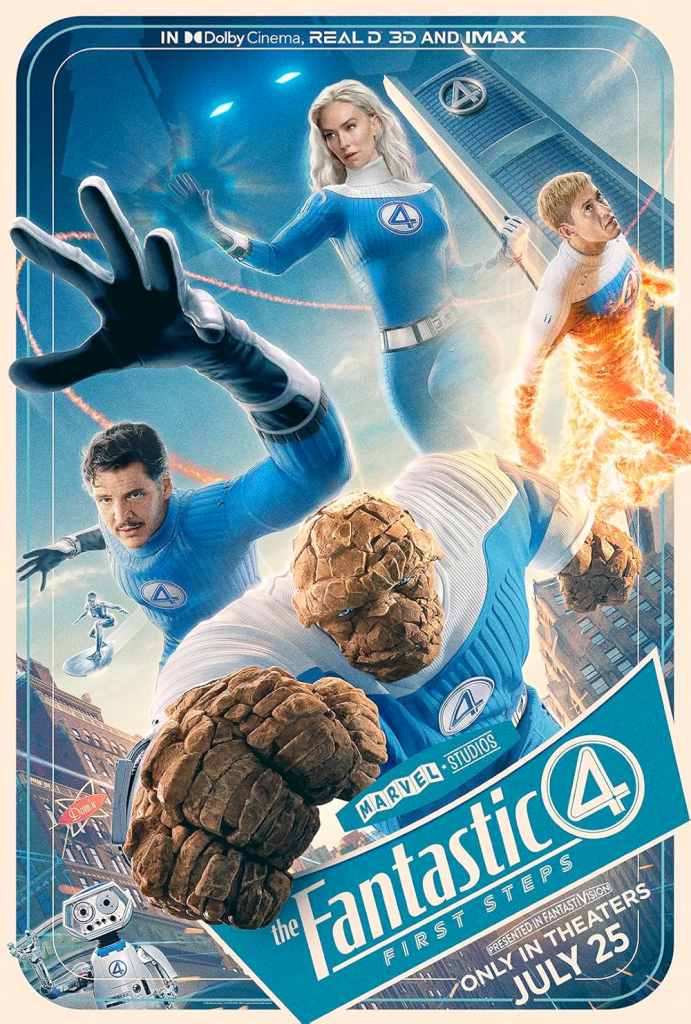
I don’t know that much about the Fantastic Four as comic book heroes or its former glory on screen as a movie franchise. The monster who lives in my house and eats my food was interested and this is their first Marvel movie and so I sort of shut my brain off about everything beyond that point. I had a fun time trying to explain ahead of the movie what the multiverse was, had a lot of success explaining what a “herald of doom” was, and mostly won them over by repeating the phrase “Stretchy Guy, Invisible Lady, Rock Guy, and Fire Boy” a lot in anticipation for the movie. A variety of critics and reviewers have used F4 as a chance to log their ongoing complaints about the MCU at large, or to describe this movie as a successful move away from Phase Shoot Yourself In the Foot Repeatedly and Then Retcon It Out AKA Introduce As Many New Actors as Possible and Cross-Promote Characters We’ve Only Seen On Disney+ or whatever, so I want to outline some of the issues and also talk about films and franchises that F4 owes a lot of itself to and the ways it diverges from, and then lastly to explain how mostly it’s sort of a limp, silly frilly thing of a guy in the end, if you give it more than a thought.
So, F4 is sort of damned if it does and damned if it doesn’t in a lot of storytelling paths. It’s set in a retro-futuristic utopian Jetsons world where the countries of Earth have united because of the creation of its first and only four superheroes, who are charismatic, and also weirdly all white for reasons that don’t seem entirely clear, though one seems like he’s maybe secularly Jewish for reasons? Which all is to say that it seems like it’s an excellent opportunity for the F4 to all get somehow trapped in a wormhole or whatever that sends them to our timeline where things are shitty and wifi doesn’t work if you walk three steps into the kitchen or leave the room with the router and your fries don’t stay crispy ten minutes after you’ve ordered them, politics, famine, etc., etc. Let’s call this the “Elan Mastai model” for comic multiverse, i.e. “in my reality we ate healthy because it was good for the environment and tasted good, why is everyone having big gulps and making themselves sick burning coal here?” jokes. And obviously there are the detractors of the multiverse narratives from the MCU, because, rightly or wrongly, Kevin Feige and his goons have been serving up that slop for the better part of my monster’s life without a lot of success, stakes, or plot advancement for the larger arc of a story, plus or minus a Kang. Let’s call this the “Fuck your multiverse” model of fan reaction.
Like, yeah, it’s been done, and it’s even been done in the MCU’s most recent phase multiple times, and would it have the same payoff with this new team of superguys? Maybe? Maybe not? But there’s another issue which is that ensemble movies are hard and the MCU itself is pretty sparing when it comes to ensemble movies that are ALSO origin stories. Most MCU movies are either one or the other: Iron Man, origin story; Winter Soldier, ensemble; Avengers, ensemble; Black Panther, origin; Multiverse of Madness, wtf were you??? I’m kidding, it was an ensemble. Point being, the hybrid genre of ensemble origin is not unheard of (see Guardians), but also the less screen time any one character has flattens the complexity of characters and reduces them to their catchiest one-liners, or at least threatens to do so.
So the marketing of this movie was a lot about how they’re a super-family, and the story itself is a LOT about these ordinary (except Reed Richards who seems smarter than really anyone in the MCU: he invents FTL travel? Somehow that’s not used for going back in time, idk why fuck you for asking) people being turned into the world’s only superheroes and how their bonds to one another strain and strengthen as a result. They do family stuff for most of the movie (spoilers): they cook meals, they have babies, they deliver babies in space ships in 0 gravity, they use those babies as live bait against a super villain who starred in a movie no one with self-respect saw, etc., etc. The most devastating exchange in the entire movie is actually a parenting argument between Richards and his wife Sue Storm when she says, “Sometimes you being you hurts me,” turning what seems like a strength and virtue of Richards’ febrile, Batman-like brain into an ugly, cold, and unfeeling machine, the vast and yawning distance between their two styles of parenting that seems irresovably at odds with one another.
In addition to all those self-imposed challenges of introducing a super hero group with a long and storied history in the comics in two hours while also being aware of the poetic anxiety of nineteen other movies or whatever, trying to do something new comparative to the multiverse phase of films while also trying to do something new relative to the first three phases of origins, partnering, and End Gameing, oh what a web you weave, Feige. And on top of that, the powers that be at Marvel had concluded in the creation of this story that they wanted to get away from the “homework” of having to know all the movie-adjacent properties that have cropped up since 2020, because they have concluded, rightly or wrongly, that there’s been an oversaturation of content which has led to superhero fatigue’s lethal acceleration and the lethargic performance at the box office. Intelligent people can disagree about whether a limited run series about She-Hulk or the recent Iron Man spin off is in anyway related to the demographic turn out or turn off at the even bigger budget movies. I’m just happy to see Pedro Pascal is starring in multiple movies (The Materialists, Eddington, and F4) this summer. Vanessa Kirby can come too.
So, to summarize: the movie cannot be too origin-y, but it also can’t be too Guardians. It shouldn’t be set in the timeline but also it shouldn’t be in the multiverse. It can be deep but it shouldn’t reference any of the deep issues we’ve been waiting for payoff on for more than five years (Kang, the shapeshifting dudes of Secret Wars plot that fizzled into Disney+ obscurity, Dr Doom, X-Men, Where is Spidey and does anyone care, ditto She Hulk, etc.). So instead, F4 sort of just decides to copy the plot of The Incredibles, which David Plotz holds up as a virtue, as someone not really interested in superhero movies in general. Once you see that comparison it’s hard to unsee it, since the powers, and some of the actual characters including some of the villains and their interactions are almost shot-for-shot homages (the “undertaker” character). But where the Incredibles is a tale of moral hazard and the anxiety of being replaced or being deemed obsolete in both your profession and your marriage, F4 is mostly about the super specific question of whether or not you would trade your unborn child for the safety of your entire planet and what scientific discoveries you would devise to avoid making that trade if you had approximately four weeks (and your baby is also going to age a lot more rapidly than normal without anyone commenting on it because it’s entirely AI and looks creepy).
The movie’s structure is zippy and strangely all over the place, which totally works: the first act is intros, the second is a Hail Mary space movie, and the third is a pretty conventional boss fight in which the heroes get what they want with a Noble Sacrifice (3x) and by Wanting It More. Herbie the robot nanny is probably the most lovely robot slave in the MCU and I would watch an entire two hours of him putting together a crib by himself, but other than that the F4 don’t actually seem to have much to add to a tangled carcass of storytelling that has gotten too big to fix, a veritable hydra of loose ends that exponentially introduces more more loose ends to tease for Secret Wars and Doomsday ad infinitum with virtually no payoff, though an unspecific army of actors from Marvel’s days and futures past (HA) are currently in Europe filming instead of attending Comicon, so maybe the 9th Symphony of the 21st century is being filmed right now by the Russo brothers or whatever, but I doubt it.


