
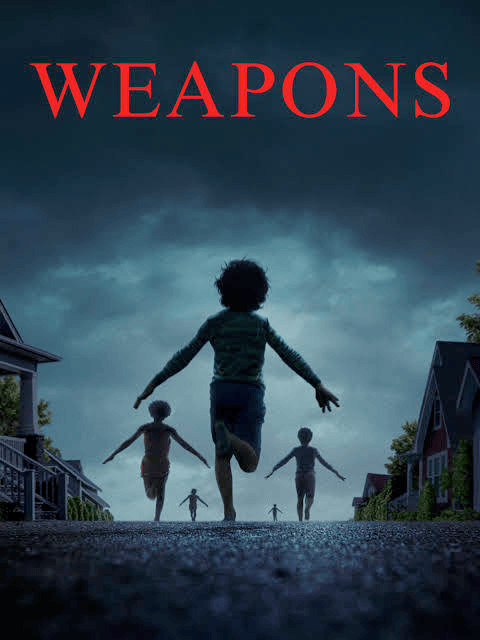
I saw Weapons on Friday of its opening weekend sort of on a lark. I don’t really like horror movies about kids and this one seemed like it was especially going to be pretty savage, but there seemed like enough buzz and goodwill built up that it might be superior to the other film by the director Zach Cregger that I had spoiled for me and then perma-noped for its twist, Barbarian. Spoilers ahead.
It seems obvious now that Weapons is about school shootings, or at least that it takes as part of its central metaphor the idea of a classroom empty of every child while a bunch of grieving parents try to make sense of the tragedy, which feels both absurd and horrible. I had the pleasure of sitting next to these two millennial gay guys for the show and their reading of child actors in the pre-show was funny enough that I thoroughly anticipated fireworks for the actual feature, which did not disappoint. Weapons has a lot of moments in it that are specifically designed for a collective audience laugh at how spooky and tense a scene has become. There are a lot of slow shots around walls and through windows just in case followed by jump scares. There are more than a few WTF moments when someone or something comes shambling out of some place it shouldn’t and gets way way too close to people they ought not or when everyone in your row is slapping their palm to their forehead as some white knight goes someplace wrong. That collective laughter at a tense scene is part of a phenomenon of comedy-horror/horror-comedy that has taken center stage in recent years.
Some hero included a meme of Naruto running guy from Occupy Area 51 news tape in the preshow as he ran through iconic scenes from movies, which really dispelled anything creepy about the way that the kids do their thing in the movie, to the point where it almost seemed like an obvious homage. Something silly and obviously Gen Z turned into a central aesthetic of the creepy kids.
Back to gun violence: that central metaphor finds ways to slip into the movie in subtle and less subtle ways (a giant AK-47 hovering over a house in a dream sequence). The central Big Bad is a witch, who according to Cregger was told she could pick her own backstory during filming: either, you turned to the dark arts because you were deathly ill as a last resort, or you are an otherworldly being who is imitating a human in order to fit in while doing your black magic. Apparently the actress never told him which she chose. That dramatic polysemy totally shows in the way that the story unfolds. School shootings and the regularity with which mass casualty incidents occur on elementary and secondary school campuses across the country as if they are random tragedies works really well as a kind of cuckoo narrative, a parasitic lifeform which warps reality around it to seem inevitable, normal, and essential.
There are elements of the villain that are really perfectly done. Her final reveal at the principal’s office is well-earned and the clown iconography has been hinted at throughout the movie, so her kind of slapdash, harried, hurried introduction in the final act of the film pushes the story to the finish line with new energy. The story structure has a sort of Roshomon-like quality to it, shifting from one character to the next and looping through events to arrive at a high-pitch climax, and though the first two or three narrative perspectives have some impact, there are some diminishing returns, especially in the homeless storyline and the final boy’s story, which is sort of a rushed exposition dump in which MAGIC is the explanation for all sorts of things that seemed more ominous as mystery, a murky Jaws in the water always scarier than Bruce flopping his heart out on your boat. The police officer’s chapter, played by a mustachioed Alden Ehrenreich, contains some gut punches and laughs worth staying for the last act, but in general the audience has already been let down by the lead balloon of fan theories punctured by the reveal and one too many red herrings (e.g. the teacher’s intimated to be too familiar with her students in the past and she has a bad drinking problem that never really contributes to the plot).
Even the kids themselves, once recovered, provoke more questions and loose threads like: what are they doing? Are they batteries? Why doesn’t the witch have to do anything with them? They’re just in perfectly normal health besides the copious cans of soup they’re eating? (As an aside, there’s this wonderful piece of comedy in the third act when the kid whose house is being inhabited by the cuckoo is tasked with acquiring something from each kid in his class and he starts taking notes on all of the unique little toys and paraphernalia that they’ve got on their bags before he elects to do an entirely lazy and very understandable shortcut of taking their name plates from their cubbies.) A lot of the rationale for the Big Bad in the final act is swept away with IT’S MAGIC SHUT UP, electing rather to go for big, bombastic comic sequences and visual gags for the catharsis.
And in some ways that catharsis is merited and I think if I had been aware of the morality of violence in this movie ahead of time, I would’ve been more on board with it in general, the way that it only really let’s people who do something nasty get hurt (besides the gay principal who seems perfectly nice in all ways), and for the most part, mostly, no kids get hurt (physically).
The movie has received audience scores as high as Get Out and Silence of the Lambs, which means that my sort of lukewarm feelings about this movie are contrarian. It seems worth mentioning some Pedro Pascal trivia: this movie, conceived during the pandemic spent so much time in pre-production that almost all of its original cast were replaced, necessitating Pascal be replaced with Thanos.
Some weaker elements to the movie for me are that a lot of the scares are jump scares and a lot of the jump scares are in dream sequences, but once the Big Bad is revealed in the (spoilers) principal’s office, the movie both takes off and also grinds to halt, because the menacing, conniving Cuckoo Witch is our mystery, our explanation, our exposition dump, and also the person we want to see vanquished all in one.


