
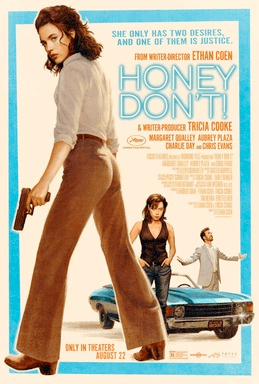
The premise of Ethan Coen and Tricia Cooke’s last film, Drive Away “Dykes”–as Cooke sometimes refers to it–is enticing not least of which because the movie stars some of the most promising young comic actors of the decade in a sub 90 minute feature film about two young gay girls going on a roadtrip while being pursued by hitmen because of a thing they stole on accident. Suffice it to say, there aren’t that many movies that occupy the same space in terms of length, star power, or comedy–and the fact that two elder filmmakers have somehow found a way to make a more progressive, funny movie than Ari Aster or whatever should actually make some people stay up at night, but, like, it seems to work! Honey Don’t! continues in that same vein of short run-times, rising stars meets cinema royalty (Chris Evans), snappy dialogue, and queer storylines.
That last bit, queer storylines, really does give Qualley a way of interacting with her male leads, Charlie Day and Chris Evans, in different ways than their bread-and-butter performances. Both of them (spoilers) are incorrigible flirts who don’t really let the fact that Honey is a lesbian get in the way of their indefatigable quest to grab a drink with her. Meanwhile some of the spiciest gay bar dialogue and blocking ever to grace the screen exists in a mere 85 minutes of this film.
If you have not seen Margaret Qualley’s press tour for this movie, you really ought to. She shares some of the same fuck-it attitude as Dakota Johnson’s devil-may-care nepobaby-who-got-disowned energy but crossed with like an imp that was given snacks past midnight or whatever and now only answers questions on press junkits in the form of riddles and dares. If this interview with Fallon is a staged bit, color me surprised, because so much of what she’s doing here seems to be angled specifically and making him look like a moron, but in the nicest way possible. The character Honey, but contrast is someone who seems ever-poised, prepared, and cool, collected, despite the fact that at almost no point is she any of those things.
The story and character all feel like they’re indebted to Joseph Hansen’s Brandstetter novels, a series that was ahead of its time in 1970 when being gay, even in sunny California, was a crime.
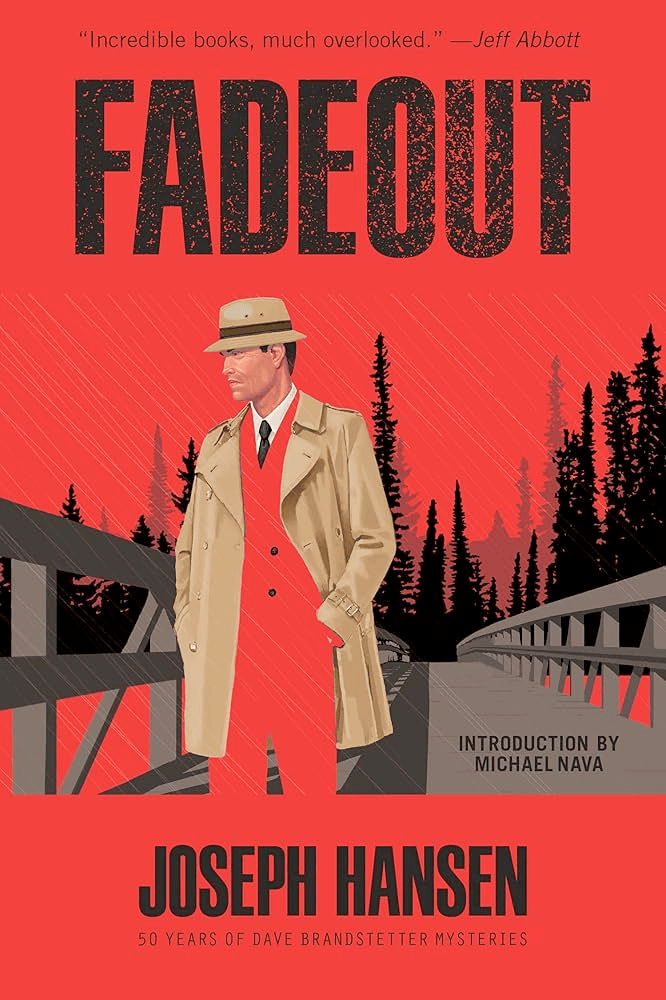
The protagonist is a insurance investigator who finds himself at the scene of a lot of murders and suicides, all while juggling his own personal issues, which range from the comic to the tragic. The stories are pulpy and queer in ways that seem like they should be part of a fully syndicated show by now, and yet they’ve only recently received a reprint. That being said, there are a lot of structural cues that this neo-noir takes from is spiritual siblings in Veronica Mars, The Good Guys (2016) and Under Silver Lake (2018). One that sticks in my head is a premise from Kiss Kiss Bang Bang in one intertextual moment when someone mentions a different detective series where the dick always takes two different cases, one big and one small, which ultimately end up being related to each other.
I remember going to a talk where the author and illustrator Philip Reeve was releasing one of his books from the Mortal Engines series and he talked about a lot about his love for schlocky genre conventions (“Baddies that become goodies and goodies that become baddies”), but one of the things that stuck with me the most as someone who loves his stories is his process, the way he thinks up scenes that are visually stunning first and then tries to write to connect those scenes with one another, which I guess is just a way of describing what Zach Snyder is doing every day of his entire life, but I think in some ways it can be an informative way to think about the way that a movie like Honey Don’t! feels episodic even with such a short runtime. I lost track at a certain point, but this movie features leopard print pushup bras, cult sex, discussion of incest with childrens (arguments against), the offer of cocksucking for drugs, and the question “what does a piece of macaroni do?” Which is to say that raunch is the point and quippy chatty conversations is the point and if the plot feels contrived or impossible to unravel early, it’s only because the self-imposed challenge of creating a sprawling caper in less than an hour and a half means that the fishbowl is that much smaller to economically introduce characters, suspects, and victims, but that shouldn’t be a reason to scare you from seeing this movie, because it trucks from full frontal beginning to the very end.


